
From the Toysit archive
Bop It: Original Three-Action Design
The original three-action Bop It uses a button, pull end and twist knob for rhythmic cues, inspiring an original weather radio show.
The play at a glance
Three colorful actions along one handle
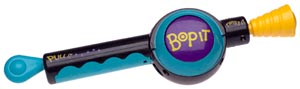
The original Bop It stretches from a turquoise pull end to a yellow twist knob, with a purple Bop button near the middle. Each part gives a different response to the game’s recorded cues. Listening and choosing an action create its distinctive rhythm. Players can borrow that idea for an entirely new sound scene: a weather broadcast where sun, rain and wind each have their own voice.Listen for the next action
The earlier guide describes spoken and musical cues for pressing, twisting and pulling. A response leads into another cue, giving play a continuous rhythm. Its group play also includes handing the toy onward, while a solo version follows one player’s responses.
The three distinct controls make the basic idea easy to picture. A new cue asks for a new choice. In the original activity below, players invent their own cues and set a comfortable pace together.
Present a three-sound weather show
Draw three large symbols: a sun, a rain cloud and a curling line of wind. Agree on a sound or comfortable gesture for each. Sunshine might get a warm “ah,” rain a gentle fingertip tap on a table and wind a soft “whoosh.” Voice-only choices work just as well.
Choose a presenter to welcome listeners to an imaginary radio station. The presenter holds up one picture, and the group supplies its sound. Leave a pause between pictures so everyone can join in.
Now add a short forecast around the cues. “At the seaside, the morning begins with…” gives the sun picture a setting. A rain cloud can arrive over a garden, followed by a breeze that carries the clouds toward the hills.
Make the forecast tell a story
Invent a listener with plans for the day: a puppet opening a flower stall, a paper sailor visiting a harbor or a mouse preparing a picnic. Ask how the weather changes those plans. Perhaps the picnic moves beneath a leaf umbrella, or the flower seller welcomes a little rain.
Let a new presenter arrange the three pictures in a different order. Players may repeat a favorite cue, introduce a quiet pause or close the show with a cheerful spoken sign-off.
This radio show is a separate creative activity. Its voices, timing and story belong to the players, and everyone can stay involved as presenter, sound maker or illustrator.
The historical record
Original Toysit coverage
The complete earlier coverage follows. Its opinions, promotional claims and broader historical commentary remain part of the archive; researched details and qualifications appear in Sources.
Bop it game is a musical challenge toy that can be played at a party.
This hilarious game requires speedy reflexes and a rhythm section in the brain. Musical and spoken commands instruct players to Twist it. Pull it. Bop it. Pass it. Electronic impulses move the random play faster and faster; players have to keep up or risk the disappointment-filled recorded scream: Aoowww. Played alone or with a group, Bop It keeps score and keeps the beat. All the players have to do is keep on bopping, pulling, and twisting the button, knob, and ratchet. Cymbals crashing, bass drum booming, whistles shrieking ... who can resist?
Since its introduction in the 1990s, Bop It has cemented its place as a beloved electronic game. Its catchy phrases, combined with the need for rapid reactions, make it an irresistible challenge that can be enjoyed solo or as a spirited competition among friends.
Sources and editorial notes
The 1997/1998 Hasbro guide transcription, marked 40735-1 R1, was reviewed through Manualzz. Direct access to the transcription and official PDF was blocked; a matching facsimile was not recovered. This profile therefore describes the visible three-action design and general cue pattern, with exact mode-selection and scoring instructions omitted. The inherited ASIN overlaps Extreme listings and is preserved; the photograph distinguishes this design from the five-action Extreme 2. The companion activity is original to Toysit; no physical toy or recorded sound was tested.
- Hasbro: original Bop It guide transcription — Manufacturer text with 1997/1998 imprint and 40735-1 R1 identifier reviewed through web indexing; no visual facsimile review claimed.
- Original Toysit coverage — Complete original text, SSI values and historical image inspected and preserved.
Images and descriptions are retained as historical material. How Toysit covers toys.
Created for Toysit by Tabbloza — the artwork in our header.