
From the Toysit archive
Break the Safe
Plan a shared route, discuss tools and return together with four keys in Mattel’s cooperative game against the clock.
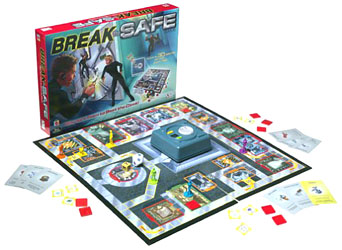
The play at a glance
The team wins by getting everyone and the keys home
Break the Safe is a cooperative board game: players search for four keys and bring their agents back to the Start/Finish Room to stop the safe’s countdown. The main challenge is coordinating actions while time passes.
The standard four-player limit is 30 minutes. The old Toysit description says 30 seconds; that is an error preserved in the historical section, corrected here using Mattel’s instructions.
Learn the board before starting the clock
Use the matching instructions to identify the agents, rooms, tools, tiles, guard and dog. Locate the Start/Finish Room and look at possible routes back to it. Deal and arrange the components according to the guide before beginning the timed game.
The instructions set 30 minutes for four players, 22 for three and 15 for two. Once started, the timer cannot be paused. That makes an untimed explanation beforehand especially useful.
Let everyone ask a question and point out a feature on the board. Readiness should mean understanding what a turn involves, not memorizing every rule before touching a piece.
Give the active player room to decide
Use a brief practice conversation before the timer starts. One player names a destination; another checks a route; a third asks which tool might be needed. Then return the decision to the player whose turn it is.
For example: “I could head toward that room. Which trap is there? Do I have its matching tool, or should someone else approach it?” This is a planning discussion, not a script that guarantees a legal or successful move.
In the actual game, consult the movement and hazard rules before acting. Keep suggestions short enough that the clock does not turn a shared discussion into one person giving orders.
Make the tools part of the plan
The guide pairs tool cards with particular traps. A correct tool used in the same room can disarm a trap and expose the Top Secret tile beneath. That tile may be a key, but not every room yields one.
Before committing a tool, say what you expect it to accomplish and check the matching illustration. Distinguish what the team knows from what it hopes to find. The Robot card has special transfer and use rules, so look those up instead of assuming all cards can be passed freely.
After an action, give a short update: what was revealed, who holds it and which question remains open. This can keep the next player involved without retelling the entire game.
Leave time for the return
Finding the fourth key is not the finish. All agents must reach the Start/Finish Room before the keys are inserted and the countdown stopped. Include the return route in the team’s planning.
Afterward, discuss one decision that helped and one point that caused confusion. If you replay, try a clearer way to share information before seeking a faster result. A loss can still leave the group with a useful idea for its next attempt.
Collect the pieces using the inventory in the guide. The spy story gives the game its setting; it does not require inventing real locks, extra codes or additional escape-room equipment.
The historical record
Original Toysit coverage
The original description and complete safe-cracking essay remain intact. The description’s “30 seconds” is incorrect: the standard four-player game uses 30 minutes. The later essay discusses generic puzzles, codes and progressive difficulty; these are not a verified feature list for Mattel’s Break the Safe.
Break the Safe Game
Break the Safe is the family board game where the players collaborate as one team to race against time and crack the safe. The movers resemble spies. The object of the game is to crack the safe by finding all four keys to the safe before 30 seconds time runs out. The electronic timer lets players know when time is up.
Immersing yourself in a game centered around cracking a safe offers a unique and exhilarating experience that combines strategy, problem-solving, and a touch of mystery. The theme of breaking into a secure vault or cracking a complex safe code adds an element of intrigue that captivates players. Here's why this type of game is so much fun:
- Challenge and Puzzle Solving: Cracking a safe requires players to engage their minds in deciphering intricate puzzles, codes, and riddles. The challenge of piecing together clues and unlocking the safe's secrets sparks a sense of achievement as players use their analytical skills to conquer each obstacle.
- Thrilling Narrative: The theme of cracking a safe often comes with an exciting backstory. Players may take on the roles of skilled thieves, detectives, or agents on a mission. The narrative unfolds as they progress, adding an extra layer of suspense and motivation to solve the mystery.
- Strategic Decision-Making: Players must carefully plan their moves and decisions as they explore the safe's contents. Choosing the right approach, sequence of actions, and tools enhances the strategic aspect of the game, requiring players to think several steps ahead.
- Interactive Exploration: The game typically encourages players to examine their environment, gather clues, and interact with various objects. This interactive exploration keeps players engaged and invested in the outcome, as they search for hidden hints and items that contribute to solving the puzzle.
- Suspense and Tension: The sense of suspense and tension as players work against the clock to open the safe generates an adrenaline rush. The thrill of getting closer to cracking the code keeps players on the edge of their seats, creating a dynamic and immersive experience.
- Team Collaboration: Many safe-cracking games offer cooperative multiplayer options, allowing friends or family members to work together to solve the mystery. Team collaboration fosters communication, brainstorming, and shared excitement as players pool their ideas and efforts.
- Progressive Difficulty: Safe-cracking games often feature levels of increasing complexity. As players advance, the challenges become more intricate, requiring them to adapt their strategies and approach. This progressive difficulty curve keeps the gameplay engaging and satisfying.
- Hidden Treasures: Successfully cracking a safe can lead to the discovery of hidden treasures, valuable information, or unexpected plot twists. The anticipation of unveiling the safe's contents adds a layer of mystery and curiosity to the gameplay.
- Intellectual Satisfaction: Successfully cracking the safe code provides players with a sense of intellectual satisfaction and accomplishment. The feeling of outsmarting the game and overcoming its challenges creates a rewarding and memorable experience.
A game centered around cracking a safe offers a blend of strategic thinking, problem-solving, immersive storytelling, and interactive exploration. The combination of challenge, suspense, and teamwork creates a thrilling and intellectually stimulating gaming experience that keeps players engaged and entertained from start to finish.
Sources and editorial notes
Reviewed October 16, 2026 against the original photograph, ASIN B00008O0XH and Mattel’s B4859-0920 instructions, copyright 2003. All four PDF spreads were visually reviewed; the board, central safe and components correspond to the image. The guide supplies player-count timing and the return-to-start requirement. The suggested team conversation is editorial practice, not an extra game mode; no physical set or timer was tested.
- Mattel: Break the Safe, B4859 instructions (PDF) — Setup, tools, hazards, timing for two to four players and the team finish.
Images and descriptions are retained as historical material. How Toysit covers toys.
Created for Toysit by Tabbloza — the artwork in our header.