
Toy profile
Gecko Run Starter Set: Build a Marble-Mail Route
Explore Gecko Run’s vertical marble paths and imagine a two-destination mail route, revising one connection as the story grows.
The play at a glance
Give the marble somewhere to arrive
Imagine a delivery route with two neighborhood destinations. Each arriving marble brings a little news; each interrupted journey gives the builder one place to revise. Gecko Run’s movable tracks and two-branch switch provide the route for this small storytelling game.
Find the Toy on Amazon: Thames & Kosmos Gecko Run Starter Set (paid link)
A route you can rearrange
Gecko Run puts the building surface behind the action. Pale, flexible tracks stretch between blue mounting pieces, while bright green parts turn, catch or redirect a metal marble. The mounts attach to a suitable smooth vertical surface using the supplied pads. Moving a section changes the route in front of you: a short descent can become a curve, and a single journey can divide into two.
The Starter Set’s switch is the heart of this play idea. It alternates the marble’s path between two branches, with its response also affected by the marble’s arrival speed. Begin with the manual’s small examples and get to know what happens at each join. A useful route is one whose journey you can follow from release to arrival.
Choose a place and make one working route
Thames & Kosmos lists this Starter Set for ages 8 and up. An adult should choose a clean, dry, stable surface within the player’s reach and follow the manual’s setup guidance. It permits suitable smooth surfaces; drywall, wallpaper and rough walls are excluded. Doors and windows must stay closed, glass must be safety glass, and the mounting surface must remain secure when parts are removed. Take particular care with mirrors, which can loosen from their mounts. Keep the whole build reachable from the floor.
Protect the area below from falling marbles and keep the run away from babies, toddlers and pets. Small parts and balls are choking hazards. Start with the illustrated short run and a track turn used as a catcher, checking each addition from the same starting point. Follow the manual’s diagrams for pad placement, mounting and the switch. Use the included Gecko tool for removal, then dismantle and store the run after play.
Try this: Marble Mail
Imagine that every marble carries a little news across a neighborhood. The news lives in your story; the marble simply makes the journey. You will need a separate sheet of paper and something to draw with for the delivery desk.
- Give the route two addresses. Draw Lantern Library and Pine Station on the paper. Add one detail to each: perhaps a reading lamp in a window and a clock above a platform. Keep the drawing outside the track’s working area. These are imagined destinations, so you can change their names whenever the story needs somewhere new.
- Build a small delivery route. Once your first short run works, follow the manual’s switch example to make two branches, each ending in a catcher. Match each branch to one address on your drawing. Keep the physical arrangement simple enough to see every join. The manual supplies the assembly guidance; the neighborhood is yours to invent.
- Predict an arrival. Point to the address you expect the next marble to reach, then release one marble. Let it finish before sending another. Mark the actual destination on the paper, even if it differs from your prediction. Watch what the switch does rather than assuming every delivery will follow your plan.
- Give the arrival a message. A marble at Lantern Library might mean that a missing map has been found. One at Pine Station might announce a visitor carrying a mysterious parcel. Say the news aloud or add a small symbol beside the destination. Keep all messages on the paper, separate from the marbles and working parts.
- Repair one interrupted delivery. If a marble stops or leaves the route, look for the last join it passed successfully. Adjust one local section and try again from the same starting place. Draw a quick before-and-after sketch of that change. Then decide what the delay meant in the story: perhaps the station clerk had time to make an extra sign.
Change the delivery, then tell the story
With a partner, divide the roles between builder and delivery clerk. One releases the marble while the other predicts, records and announces its arrival. Swap after a few messages. Finish by showing the change that helped a delivery continue, then tell the neighborhood’s news in arrival order.
For another round, leave a working route in place and change what the addresses mean. The library might become a moon observatory; the station might become a harbor. A familiar path can carry a different story without requiring a larger construction.
A paper route to try first
Draw one starting point, a fork and two destinations. Trace a path with a finger, then invent the message that arrives. Redraw one turn or move the fork and try another delivery. This keeps the pleasure of planning a route and telling its story available with just a drawing.
Sources and editorial notes
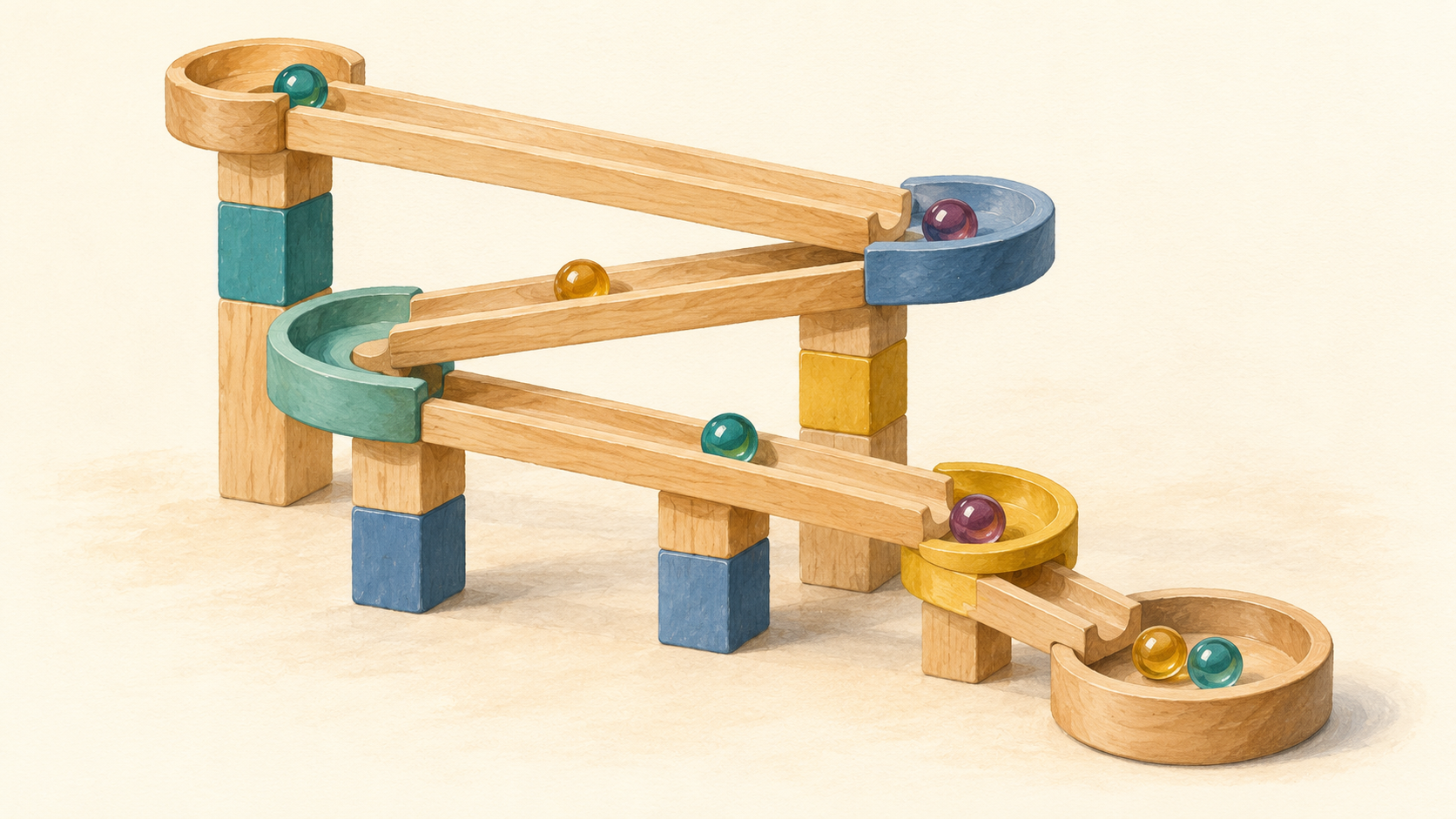
Researched October 23, 2026 for the US Gecko Run Starter Set, model 550201, using its manufacturer-linked English manual. Marble Mail is an original Toysit activity suggestion; neither the set nor this activity was physically tested. Manufacturer images informed the description and are not reproduced here. The editorial illustration shows a generic freestanding marble run; Gecko Run uses surface-mounted tracks.
- Thames & Kosmos: Gecko Run Starter Set — US model identity, age guidance, description and package imagery; checked October 23, 2026.
- Gecko Run Starter Set: English experiment manual — English Starter Set manual: contents and printed pages 2–5, 7–9, 11 and 13–14; setup, parts, selected routes and troubleshooting. Current download matches the reviewed copy.
Created for Toysit by Tabbloza — the artwork in our header.