
From the Toysit archive
Beethoven’s Wig — Sing Along Symphonies
Beethoven’s Wig pairs humorous songs with instrumental selections and inspires an original concert-hat workshop and spoken introductions.
The play at a glance
An enormous wig and a stage full of possibilities
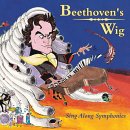
The wig is the star of this cover: great white curls sweep around a cartoon Beethoven and the instruments gathered below him. Blue, orange and yellow turn the picture into a small theatrical scene. Richard Perlmutter’s Beethoven’s Wig uses humorous words with classical music, giving this album a playful performance identity that can inspire a paper show of your own.Two ways through the same program
The official program pairs its eleven humorous songs with eleven instrumental entries. The first vocal title draws on Beethoven’s Fifth Symphony; other pairings include Liszt, Mozart, Offenbach and Tchaikovsky. The complete earlier vocal-title list is preserved below, while the artist’s program provides the additional instrumental context.
For an invented concert, a costume detail can suggest a character before a word is spoken. A hat shaped like a cloud might belong to a weather announcer; a staircase hat could belong to a guide who knows a very tall building. The hat supplies the invitation, and the performer invents what comes next.
Run a concert-hat workshop
Draw a paper performer with plenty of space above the head. Add a hat shaped like a cloud, staircase or teapot. Decorate it with one surprising detail: a tiny door in the cloud, a flower on a stair or a moon on the teapot lid.
Give the performer a name and write an original spoken introduction. A cloud-hat character might welcome guests to a theater that floats above the garden. Follow the introduction with one small, comfortable gesture, such as an opening palm or a gentle wave.
Draw a second version of the performer wearing another hat. Keep the name but change the welcome and gesture to fit the new design. A player can point to the picture or narrate the action instead of performing it.
Let the audience choose an encore
Place the two drawings side by side. An audience member chooses a hat and suggests a place for the next show: a giant greenhouse, a library after closing or a station for visiting stars. Adapt the introduction to that place using your own words.
Draw a miniature program with the performer’s name, the two hats and a thank-you message. Optional music can accompany the scene; the hat designs, introductions and gestures make this your group’s original performance.
The historical record
Original Toysit coverage
The complete earlier coverage follows. Its developmental benefits, listening judgments and broad historical claims are preserved as historical commentary, not findings established by this renovation.
Beethoven's Wig: Sing Along Symphonies
1. Beethoven's Wig (5th Symphony, Beethoven) 2. Franz Liszt the Famous Pianist (Hungarian Rhapsody 2 Liszt) 3. Please Don't Play Your Violin at Night (Eine Kleine Nachtmusik, Mozart) 4. Can You Can Can? (Can Can, Offenbach) 5. Just For Elise (Fur Elise, Beethoven) 6. Haydn's Great Surprise (Surprise Symphony, Haydn) 7. Kings and Queens of England (Trumpet Tune, Purcell) 8. Drip, Drip, Drip (Pizzicato from Sylvia, Delibes) 9. Harmony (The Merry Peasant, Schumann) 10. Hey Guitar Teacher (Bouree, Bach) 11. Tchaikovsky's Cannonball (1812 Overture, Tchaikovsky)
Introducing Children to Classical Music
Introducing children to classical music from an early age can be a truly enriching and rewarding experience. While some might believe that classical music is too complex or mature for young ears, there are numerous reasons why it is never too soon to immerse children in the world of classical melodies:
Early Sensory Development: The soothing and intricate melodies of classical music can stimulate a child's auditory senses, helping them develop a deeper appreciation for sound and rhythm from a young age.
Emotional Connection: Classical music is rich in emotions, and exposing children to a variety of compositions can help them explore and understand different emotional tones, fostering their emotional intelligence.
Enhanced Cognitive Abilities: Studies have suggested a positive correlation between exposure to classical music and improved cognitive development, including enhanced language skills, spatial-temporal reasoning, and problem-solving abilities.
Imagination and Creativity: The diverse range of themes and emotions in classical compositions can spark a child's imagination and creativity, encouraging them to envision stories and scenarios that align with the music's mood.
Exposure to Culture and History: Classical music provides a glimpse into different eras, cultures, and historical contexts. Introducing children to these musical works can help them appreciate the richness of human history and the beauty of cultural diversity.
Developing Focus and Attention: Listening to longer classical pieces requires patience and focused attention. This practice can help children gradually develop their ability to concentrate on a single activity for an extended period.
Building an Ear for Music: Exposure to classical music lays the foundation for developing a discerning ear for various musical elements, such as melodies, harmonies, and instrumentation. This can later lead to an interest in exploring different genres of music.
Introduction to Instruments: Classical compositions feature a wide range of instruments. Familiarizing children with the sounds of different instruments can pique their curiosity and inspire them to explore playing musical instruments themselves.
Fostering a Lifelong Love for Music: Early exposure to classical music can instill a love for music that lasts a lifetime. Children who grow up appreciating classical compositions may later explore different genres and become lifelong music enthusiasts.
Parent-Child Bonding: Sharing the experience of listening to classical music with children can create special moments of bonding and shared enjoyment. Discussing the music's emotions and stories can also encourage meaningful conversations.
Introducing children to classical music offers a wealth of benefits for their development, cognition, creativity, and emotional understanding. By cultivating an early appreciation for the beauty and complexity of classical compositions, parents and educators provide children with a lifelong gift that enriches their cultural awareness and enriches their lives with the magic of melody and harmony.
Sources and editorial notes
The artist’s official first-album index lists eleven vocal selections followed by eleven instrumental selections; the earlier Toysit list retains its eleven vocal entries. Official history dates the Rounder debut to 2002. Product text describes supplementary trivia and activities, but the original CD booklet was not inspected. Comic lyric premises are performance material, not verified composer biography; the claim that every piece is performed exactly as originally written is not adopted here. Earlier developmental claims remain historical commentary. The activity is original to Toysit; no audio playback or physical testing occurred.
- Beethoven’s Wig: first album — Official product description reviewed for Perlmutter’s lyrics and the vocal/instrumental format; booklet not inspected.
- Beethoven’s Wig: first-album program — Official index of eleven vocal and eleven instrumental entries reviewed; no playback.
- Beethoven’s Wig: artist history — Official account identifies the 2002 Rounder debut; promotional benefit and award claims are not adopted.
- Original Toysit coverage — Complete earlier text, program and retained cover reviewed and preserved.
Images and descriptions are retained as historical material. How Toysit covers toys.
Created for Toysit by Tabbloza — the artwork in our header.