
From the Toysit archive
Fisher-Price 2-in-1 Crocodile Keys
Compare pressing keys with tapping bars, make a small sound pattern and give this musical crocodile a separate pull-along turn.
The play at a glance
Two ways to set a note ringing
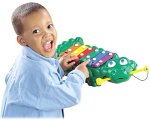
Crocodile Keys combines two actions in one toy: press a key or use its mallet to tap a bar. That gives a player a useful comparison before attempting a tune: how does a small finger movement differ from a tap?
Fisher-Price’s record for product 72676 confirms those two playing methods, mallet storage and a bobbing pull-along action. The manufacturer’s photograph supports the match to the crocodile in Toysit’s archive.
Compare a press with a tap
Choose one key or bar. Listen to a key press, let the sound finish, then try a gentle tap with the toy’s own mallet. Notice the action needed and how the sound begins.
Move to another note and repeat. Listen before naming it: higher and lower can describe a comparison without assuming a particular concert pitch or tuning standard. Use the sounds the actual toy produces rather than expecting the little photograph to supply a music chart.
Make a pattern with two choices
Choose two notes and call them A and B for the game. Try A-A-B, pause, then repeat. Another player can answer with B-B-A or copy the first pattern.
Keep the rhythm steady at first. On a later turn, change the rhythm while using the same notes. There is no need to reproduce a familiar song before a short sequence counts as something worth listening to.
Give pulling and playing their own turns
Use a stationary moment for listening to the notes. Put the mallet in its intended holder before switching to pull-along play, using the toy’s own cord and directions. Then park the crocodile for another musical turn.
The archived account mentions a bell and gives an age range and dimensions. The verified manufacturer record supports the bobbing motion but does not settle every detail in that paragraph. Check the markings and condition of an older toy rather than using the archive as an inspection certificate.
What does xylophone mean here?
The product name uses xylophone for its mallet-playing action. In the instrument families described by Yamaha, xylophones have wooden tone bars, while instruments such as glockenspiels and vibraphones belong to the metal-bar family.
The older essay’s statement that metal bars were an advance in xylophone construction blurs that distinction. Keep the toy’s familiar name, but do not use it as a shortcut to the material, tuning or history of an orchestral instrument.
The historical record
Original Toysit coverage
The original product paragraph and complete xylophone-history essay remain below. The old note count, dimensions and example songs are not a verified tuning chart. The essay’s account of metal bars needs the distinction explained above between xylophones and metallophones; its wider history has not been independently established here.
2-in-1 Crocodile Keys Musical Instrument by Fisher-Price
Toddlers and preschoolers can perform their own version of the Musical pull toy in the shape of a crocodile which you can play like a piano, or like a Xylohone, for 2-in-1 fun! 2-in-1 Crocodile Keys present a unique combination of musical sounds for preschoolers. Crocodile Rock with this combination xylophone, piano, and pull-toy. This multitalented crocodile holds a mallet in its mouth for easy xylophone tapping. Or children can press the colorful keys on the crocodile's back and finger their own melodies. Pull the crocodile along by an attached string and it bobs up and down while jingling a sweet bell song. There are six notes for tapping or fingering--just enough for simple, recognizable melodies, such as Baa, Baa Black Sheep and Mary Had a Little Lamb. This is an ideal starter instrument for ages 1.5 to 4 years. Approximately 14 inches long and 5.5 inches wide.
History of the Xylophone
The xylophone, a percussion instrument known for its vibrant and resonant tones, has a rich history that spans cultures and centuries. Its evolution showcases the fascinating journey of musical innovation and cross-cultural influence:
Ancient Origins: The origins of the xylophone can be traced back to ancient civilizations in Africa, Asia, and Oceania. Early versions were crafted from natural materials like wood and bone, and they were often used in rituals, ceremonies, and cultural celebrations.
Ancient Africa: In Africa, xylophone-like instruments were prevalent among various cultures, including the Akan people of Ghana. The "gyil," a wooden xylophone, was a central part of their musical tradition, played during important events and gatherings.
Ancient Asia: Xylophone-like instruments also appeared in Asia. The Indonesian gamelan ensemble, for instance, includes instruments similar to the xylophone, which play a crucial role in traditional music and rituals.
European Renaissance: The xylophone began to gain attention in Europe during the Renaissance period. Its introduction to Western music is often attributed to traveling musicians and explorers who encountered similar instruments in other parts of the world.
19th Century Advancements: The xylophone underwent significant developments in the 19th century. Innovations in materials, such as the use of metal bars, led to improvements in sound quality and volume. These developments made the instrument more suitable for orchestral settings.
Orchestral Inclusion: By the late 19th century, the xylophone had found its place in the symphony orchestra, adding its distinct timbre to compositions. Notable composers like Camille Saint-Saëns and Paul Dukas incorporated the xylophone into their works.
20th Century Popularity: The 20th century saw a surge in popularity for the xylophone. It became a staple in various musical genres, including jazz, popular music, and film scores. Its bright and percussive sound made it a favorite for adding texture and rhythm to musical arrangements.
Modern Variations: Over time, the xylophone has evolved further with advancements in materials, design, and manufacturing. Variations like the marimba, vibraphone, and metallophone have emerged, each offering unique tonal qualities and expanding the instrument's capabilities.
Global Fusion: The xylophone's journey showcases its role in cultural exchange and fusion. Musicians around the world continue to draw inspiration from traditional xylophone instruments, infusing them with contemporary elements to create new and exciting sounds.
Education and Performance: Today, the xylophone remains a popular instrument for both educational purposes and professional performance. It is often introduced to young learners to teach basic music concepts and develop rhythm skills.
The xylophone's history reflects a tapestry of cultural influences and musical innovation. From its ancient origins in diverse regions to its integration into global musical traditions, the xylophone's journey is a testament to the enduring power of music to connect people across time and space.
Sources and editorial notes
The original image was compared with Mattel’s product 72676 record and photograph on October 15, 2026. That record corroborates the play actions but is not a full instruction sheet. Yamaha’s instrument guide supplies the wood-bar/metal-bar distinction, not a specification for this toy. Exact pitches and physical dimensions were not tested.
- Mattel: 2-in-1 Crocodile Keys, product 72676 — Manufacturer record for pressing, mallet play, storage and pull-along movement.
- Yamaha: Relatives of the Marimba — Explains the distinction between wood-bar and metal-bar instrument families.
Images and descriptions are retained as historical material. How Toysit covers toys.
Created for Toysit by Tabbloza — the artwork in our header.