
From the Toysit archive
Disney Monopoly
Identify the older Disney Monopoly set, understand buying and rent, and separate its themed pieces from later rules and familiar house rules.
The play at a glance
Recognize the theme, then check the transaction
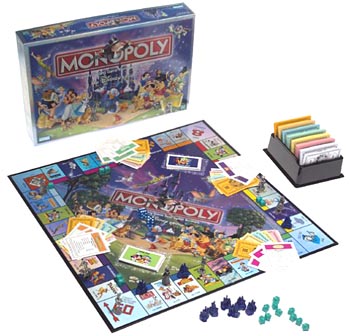
Disney Monopoly turns familiar films into places on a property-trading board. The older Toysit account highlights character movers, Disney money and cottages and castles in place of ordinary buildings.
Knowing the story on a space helps identify it; the deed and rule sheet tell you what happens there. Start by matching the board, cards and instructions to the same edition.
What the theme changes
The older booklet keeps the standard Monopoly rules and changes their presentation. Disney film properties replace street names; Magic Moments and Show Time replace the two familiar card decks. White Rabbit cottages and Sleeping Beauty castles stand in for houses and hotels.
Lay one deed beside its matching board space and find the purchase price and rent schedule. Then find the relevant building names in the booklet. This small comparison is more useful than assuming every component works like a different Monopoly set remembered from childhood.
Follow the money to the right place
In the included standard rules, an unowned property may be bought at its printed price. Declining it sends it to a bank auction, where the declining player may also bid. Rent on an unmortgaged property goes to its owner according to the deed.
Pause at each payment and identify three things: who pays, who receives it, and where the amount comes from. A purchase from the bank and rent paid to another player are different transactions even when the same property is involved.
For a practice discussion, imagine choosing between buying a property and keeping the cash available for later payments. Explain what information would help make that choice. There is no need to turn the game into a claim about real-world investing or financial success.
Read the printed rule before a house rule
The booklet allows building after acquiring a complete color group and requires even development. Free Parking gives no money or property. The standard game ends with the last player remaining after the others go bankrupt.
A family may remember a cash prize on Free Parking or skipping auctions. Treat those as proposed house rules and agree on them explicitly before starting. Mixing remembered rules during play makes it harder to understand why one person expects a payment that another does not.
The booklet also supplies shorter-game options. Choose an option together from the actual sheet before play rather than changing the winning condition when someone wants to finish.
Inventory the set before setting out money
- Board and deeds
- Match names and color groups so each property has the correct card.
- Card decks
- Separate Magic Moments and Show Time; check their instructions belong to this board.
- Movers and buildings
- Keep character movers distinct from the cottages and castles used on properties.
- Bank and rules
- Check the money, dice and booklet together before using the setup quantities printed for that copy.
Return pieces to clear groups after play. If a card or building is missing, identify it before planning another full game; an unrelated Disney edition may have different names or an additional mechanism.
The early film-themed set pictured here should not automatically gain the golden Tinker Bell mover found in a later version. Matching the actual components gives the family a consistent set of decisions from the first purchase to the final turn.
The historical record
Original Toysit coverage
The original description and complete Monopoly-history essay remain below. The token name “Baboo” is retained as written; it is not used as a verified inventory label in the new guide. The historical essay has not been recast as newly researched history.
All of your favorite Disney characters are featured in classic Monopoly style for a family game that everyone can enjoy.
All of your favorite Disney characters are featured in classic Monopoly style for a family game that everyone can enjoy. You already know how to play, so nothing has changed--except a few things that actually make this version collectible. Solid pewter moving pieces feature Snow White, a coupled Lady & The Tramp, Cinderella, Pinocchio, Dumbo, Alice, and Baboo. Property is represented as a cottage and the Prince's well-known castle. Scrooge McDuck, naturally, is featured on all Monopoly money in place of Rich Uncle Pennybags.
The history of the Monopoly game is a fascinating tale of innovation, adaptation, and enduring popularity. From its origins as a financial teaching tool to its global fame as a beloved board game, the story of Monopoly spans nearly a century:
Early Beginnings: The game's precursor can be traced back to the early 20th century when Elizabeth Magie created "The Landlord's Game" in 1903. Intended to educate players about the negative aspects of monopolies and land ownership, this precursor featured elements recognizable in the modern Monopoly game.
Parker Brothers Acquisition: In 1935, Charles Darrow, an unemployed salesman, developed a version of the game based on the streets of Atlantic City. Darrow's design was rejected by several game companies but found success when he self-published it. The game's popularity attracted the attention of Parker Brothers, a renowned game publisher, which acquired the rights to the game and helped bring it to a wider audience.
Global Expansion: With Parker Brothers' backing, the Monopoly game quickly gained traction in the United States and around the world. The game's premise of buying, trading, and developing properties resonated with players of all ages and backgrounds.
War-Era Adaptations: During World War II, the game was adapted for various military services and organizations to promote morale and strategic thinking among soldiers. Customized versions of the game were created for the Red Cross and the U.S. Army, solidifying its popularity even further.
Iconic Tokens: The game's iconic metal tokens, including the top hat, thimble, and shoe, were introduced in the 1930s and quickly became beloved symbols of the game's identity and charm.
Evolution and Innovation: Over the years, Monopoly has undergone numerous editions, themes, and adaptations, ranging from city-specific versions to pop culture tie-ins. These variations have kept the game fresh and engaging for new generations of players.
Electronic Era: As technology advanced, Monopoly transitioned to digital platforms, reaching a new audience through video game adaptations and online versions that offer virtual gameplay and interactive experiences.
Social and Cultural Impact: Monopoly has left an indelible mark on popular culture, inspiring books, movies, and even a world championship. Its enduring popularity reflects its status as a beloved pastime that bridges generations.
Innovative Twist: In recent years, there have been new editions that incorporate innovative twists, such as the "Monopoly Gamer" edition that introduces characters from popular video game franchises.
Global Reach: Monopoly's universal appeal has led to localized editions tailored to various countries and cities, highlighting the game's adaptability and global significance.
The Monopoly game's history is a testament to its enduring appeal and ability to evolve with the times. From its humble beginnings as an educational tool to its iconic status as a beloved board game, Monopoly continues to captivate players of all ages and backgrounds, leaving an enduring legacy in the world of gaming.
Sources and editorial notes
Reviewed October 16, 2026 against the original image and ASIN B00005JG32 and Hasbro’s MONOPOLY—The Disney Edition record 40224 and linked 2001 booklet. The booklet’s cover art, film properties, Disney money, White Rabbit cottages and Sleeping Beauty castles correspond to the archived set. The catalog page lists 2–6 players while the booklet cover says 2–8; use the instructions and labeling of the actual copy. The planning lead 41804 was not confirmed. Later 19643 Tinker Bell rules were not substituted. The pictured token details are too small to authenticate the complete historical list. No physical set was tested.
- Hasbro: MONOPOLY—The Disney Edition, 40224 — Older film-property edition with eight character movers; its player-count listing differs from the linked booklet.
- Hasbro: Disney Edition booklet (PDF) — Themed substitutions on printed pages 2–3 and the included standard rules on pages 10–14.
Images and descriptions are retained as historical material. How Toysit covers toys.
Created for Toysit by Tabbloza — the artwork in our header.