
From the Toysit archive
Farm Puzzle
Explore the lift-out pieces and farmyard picture of Hide and Seek Farm, then create a three-picture story about what happens before and after a scene.
The play at a glance
Lift a piece and give the farm a story
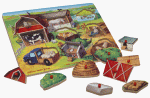
A red barn, a blue vehicle, a haystack and green bushes give this little farm several places to explore. In Toysit’s original photograph, some covers sit beside the board, leaving animal pictures visible in the scene. The loose red barn piece and the rounded haystack make especially recognizable shapes.
The original headline calls it Pictures Under Pieces Puzzle: Hide and Seek Farm. Its lift-and-return pattern invites a small moment of discovery: pick a cover, look at the picture beneath it and find the shape’s place again. A player might add an imaginary event each time another part of the farm comes into view.
Follow the outline back home
Start with a cover whose shape is easy to recognize. Notice the slope of a roof, the round top of a haystack or the curve of a bush. Compare that outline with the place it came from as you return the piece.
A player can give a clue about the cover before lifting it: “I’m thinking of something with red doors.” Another player can point to the choice, then describe the picture revealed underneath. Take turns choosing which part of the farm to visit next.
Imagine what happened a moment earlier
Choose a visible animal or building as the middle of a story. Imagine what might have happened just before this scene: perhaps a farm visitor arrived with a basket, or an animal heard a familiar voice. Draw that earlier moment on a separate card.
Then invent what happens next. The visitor could share news at the barn, or the animal could find a sunny place to rest. Place the two drawings beside a sketch of the original detail to create a beginning, a middle and an ending.
Tell a before-and-after farm story
- Choose one detail from the board and sketch it on a card.
- Draw an imagined moment that happens before it.
- Draw a second imagined moment that happens afterward.
- Arrange the three cards and tell the story in order.
- Return a lifted puzzle piece to its place as you finish, or change the last card for a new ending.
This original Toysit activity also works with a farm picture and three drawings. Players create the sequence and events themselves.
The historical record
Original Toysit coverage
The original product account and commentary are preserved below as historical coverage.
Pictures Under Pieces Puzzle: Hide and Seek Farm
Friendly farm animals surround the barn and tractor in this handcrafted wooden puzzle. This is a good farm puzzle for the very young--it is made of sturdy wood, and each of the nine pieces features a grip knob to help maneuver the pieces into place. Each piece is approximately 1.5 by 3 inches and fits easily into its own hole; the identical picture in the hole makes finding where it goes easy. The farm animals pictured include a duck with chicks, a sheep, a horse, a cow, a rooster with hen and chicks, a pig with piglets, and a goat. Lift up the puzzle piece for a surprise! Each removable puzzle piece is hiding a special full color illustration underneath. Tell a story, play a game, find the hidden pictures! 9" x 12".
Wooden Puzzles
Wooden puzzles have long been cherished as classic toys that provide young children with a range of benefits and a sense of satisfaction as they engage with them. These timeless puzzles offer more than just entertainment – they contribute to cognitive development, fine motor skills, and a feeling of accomplishment. Here's why wooden puzzles are so satisfying for young children:
- Tactile Exploration: Wooden puzzles are tactile in nature, allowing children to feel the smooth texture of the pieces. The physical interaction with the puzzle pieces engages their senses and enhances sensory awareness.
- Visual Recognition: Wooden puzzles often feature colorful and distinct images or shapes on each piece. Matching these pieces to their designated spots helps children develop visual recognition skills and spatial awareness.
- Problem-Solving: As children manipulate and fit the puzzle pieces together, they are actively problem-solving. Determining the correct orientation and position of each piece requires critical thinking and logic, fostering cognitive development.
- Hand-Eye Coordination: Placing puzzle pieces accurately requires precise hand-eye coordination. The process of picking up, rotating, and aligning pieces helps children refine their fine motor skills and dexterity.
- Focus and Patience: Completing a wooden puzzle demands concentration and patience. Children learn to stay focused on the task at hand, persisting through challenges and setbacks until the puzzle is solved.
- Sense of Accomplishment: Successfully completing a wooden puzzle provides children with a tangible sense of achievement. The act of fitting the last piece in place is a satisfying moment that boosts their self-confidence and encourages a positive attitude towards learning.
- Independent Exploration: Wooden puzzles allow children to engage in independent play. As they work on the puzzle at their own pace, they gain a sense of autonomy and agency over their activities.
- Creative Play: Some wooden puzzles are designed to be open-ended, allowing children to create various patterns and designs using the pieces. This encourages imaginative and creative play as they experiment with different arrangements.
- Repetition and Mastery: Children often enjoy completing puzzles repeatedly. With each iteration, they refine their skills, enhance their problem-solving abilities, and gradually master the puzzle's challenges.
- Transitional Object: Wooden puzzles can serve as transitional objects for young children who may experience separation anxiety. Engaging with a familiar and comforting activity like a puzzle can provide a sense of security in new environments.
Wooden puzzles offer a unique blend of cognitive, physical, and emotional benefits that contribute to a child's holistic development. The sense of satisfaction that comes from solving a puzzle piece by piece not only builds essential skills but also fosters a love for learning through play.
Sources and editorial notes
The original photograph shows the lift-out board; a resale photograph of a closely matching assembled board confirms the cover shapes and red pegs. A complete matched set of under-piece photographs was not recovered. The original account describes both identical matching pictures and surprise illustrations, so exact under-piece scenes and the nine-piece inventory remain attributed to that account. Current Melissa & Doug item 4592 has hinged doors and animal magnets, a different mechanism. The story activity is original; no physical testing or developmental benefit is claimed.
- Original Toysit image — Existing same-site photograph reviewed and retained unchanged.
- Hide and Seek Farm: assembled board photograph — Resale photograph reviewed for matching cover shapes, red pegs and the printed pictures-under-pieces label. Under-piece art is covered.
- Melissa & Doug: current Hide & Seek Farm — Item 4592 reviewed to distinguish its hinged doors and removable magnets from the earlier lift-out puzzle.
- Original Toysit coverage — Complete original product account and historical commentary preserved.


Images and descriptions are retained as historical material. How Toysit covers toys.
Created for Toysit by Tabbloza — the artwork in our header.