
From the Toysit archive
Imaginext Rescue Center
Build a rescue-story setting with Imaginext’s modular panels: choose an entrance, dispatch point and return place, then see how the layout changes the journey.
The play at a glance
Build the place before inventing the mission
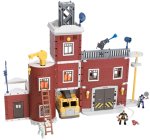
This early Imaginext Rescue Center makes the building part of the play. Its panels can form different arrangements, giving a story new entrances, rooms and places to return.
The matching 78328 record describes a firefighter, police officer and paramedic with interchangeable equipment. Start with one figure and one short fictional request rather than trying to use the whole building at once.
Let the layout suggest the route
Begin with the guide’s building principles: wall posts face upward, walls are assembled before their platform, and platforms separate levels. Spacers and the illustrated stabilizing connectors have specific jobs. A tall structure should not be improvised by stacking loosely connected sections.
The small archive photograph shows one arrangement, not the only possible story. Once the structure is assembled as directed, decide where a figure enters, receives a request and returns. Those places can all be on the lowest level of a modest building.
Extra height is not necessary to make the setting interesting. A doorway facing another direction can change the imagined journey.
Try dispatch, visit and return
This original activity uses the existing figures and a spoken request. Keep it fictional and low-pressure: someone needs directions, a visitor has lost an imaginary parcel, or a crew is making a routine visit.
- Choose a figure and an entrance to the center.
- Name a dispatch place where the figure hears the request.
- Move through the assembled setting to a pretend destination and describe one helpful action.
- Return to the center and say how the visit ended.
Two players can divide the caller and responder roles, then switch. A child can also choose to build while another person narrates. Neither role needs to reproduce real professional procedures.
Change one building decision
Finish a story before rebuilding. With adult help as needed, follow the system’s connection rules to change one part of the layout. Perhaps the entrance faces the other side, or a return place becomes easier to reach.
Tell the same short story again and notice what changes. Does the figure take a longer route? Can another player reach the room more comfortably? Is there a clearer place to pause?
These are practical questions about the toy arrangement, not a lesson in designing a real emergency building. A quiet session of arranging figures and rooms is also a complete way to play.
Keep this building system distinct
Use the 78328 guide to identify the panels, platforms, spacers and connectors in an older set. Its construction approach should not be confused with the activation disks and fixed buildings of other Imaginext products. A shared brand name does not establish that parts from every generation connect.
Check for damaged connections, loose pieces and a secured battery cover. The guide also contains projectile cautions: use only the supplied projectile and never fire at people or animals. The suggested story needs no launching action.
The original essay discusses first responders broadly. Keep real-world emergency guidance separate from the imagined tasks assigned to these figures.
The historical record
Original Toysit coverage
The complete original product paragraph and first-responder essay are retained below. Their claims about safety awareness, emergency procedures and developmental benefits are historical commentary. Toy missions are fictional play, not real emergency training.
Rescue center by Fisher Price
Children can imagine being part of a rescue squad in a big city when a call comes in: Emergency! Lights flash. Sirens blare. Now, let the Imaginext Rescue Center help bring the adventure to life-with a system of building panels kids can snap together almost any way they imagine. Includes firefighter, police officer and paramedic with interchangeable equipment.
A rescue center playset holds a special allure for children as it allows them to step into the roles of first responders and engage in imaginative scenarios that involve saving the day. The combination of heroism, action, and the opportunity to make a positive impact contributes to the popularity of these playsets. Here's why children are drawn to rescue center playsets:
- Heroic Role-Play: Children naturally gravitate towards roles that involve heroism and helping others. A rescue center playset allows them to embody the roles of firefighters, paramedics, police officers, and other first responders, fostering a sense of responsibility and accomplishment.
- Empowerment: Playing as first responders empowers children by giving them a sense of control over challenging situations. They can actively problem-solve, make decisions, and overcome obstacles, which boosts their self-confidence and decision-making skills.
- Real-Life Connections: Children often encounter first responders in their communities, whether through emergency vehicles passing by or safety talks at school. The exposure to these roles in real life makes them intriguing subjects for pretend play.
- Storytelling and Creativity: Rescue center playsets inspire storytelling and creativity. Children can invent their own scenarios, craft narratives, and engage in collaborative play with friends, fostering their creativity and social skills.
- Social and Cooperative Play: These playsets encourage cooperative play as children take on different roles within a team of first responders. They learn to work together, communicate effectively, and collaborate to solve challenges.
- Problem-Solving: Rescue scenarios often involve problem-solving, critical thinking, and decision-making. Children learn to think on their feet, come up with solutions, and adapt to changing situations, promoting cognitive development.
- Understanding Safety: Pretend play with rescue center playsets can instill a sense of safety awareness in children. They learn about emergency procedures, the importance of following rules, and the role of first responders in maintaining safety.
- Exploration of Vehicles: Many rescue center playsets include vehicles such as fire trucks, ambulances, and police cars. Children are naturally curious about vehicles and enjoy exploring their features, functions, and accessories.
- Emotional Expression: Through role-play, children can express emotions, empathy, and compassion. They learn to understand the feelings of others and the impact of their actions, enhancing their emotional intelligence.
- Positive Impact: Children like to feel that they are making a positive impact. Pretending to be first responders and "rescuing" people, animals, or situations gives them a sense of purpose and fulfillment.
A rescue center playset offers children a gateway to a world of heroism, problem-solving, and imaginative adventure. Through these playsets, children not only have fun but also develop important life skills, empathy, and an understanding of the crucial roles that first responders play in keeping our communities safe.
Sources and editorial notes
Reviewed October 16, 2026 using Mattel’s 78328 record and all sixteen pages of its English guide, including panel orientation, spacers, platforms, assembly and stabilizing connectors. The linked international editions were retained as research documents; the English guide supports this treatment. B2499 and 78332 were not used to supply inventory or mechanics. Activities are original suggestions; no structure, launcher or cross-generation connection was physically tested.
- Mattel: 78328 Imaginext Rescue Center — Matching modular-panel product and figure description.
- Fisher-Price: Rescue Center English instructions (PDF) — Building-system guidance, assembly drawings and stabilizing connectors.
Images and descriptions are retained as historical material. How Toysit covers toys.
Created for Toysit by Tabbloza — the artwork in our header.