
From the Toysit archive
Fit the Shapes Toy — Whose House Shape Sorter
A soft house, mixed textures and pieces to put in and find again: explore Whose House Shape Sorter through a relaxed matching activity.
The play at a glance
Start by exploring what goes inside
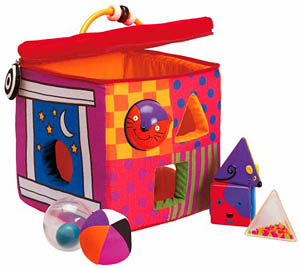
Toysit’s Fit the Shapes Toy page describes Whose House Shape Sorter: a soft container with nine pieces in three groups—clear rattling shapes, vinyl animal shapes and textured fabric shapes. The house has a handle and a zippered opening.
A useful beginning is simply choosing a piece, putting it inside and bringing it out again. Matching a shape to an opening can follow when that catches the child’s interest.
Separate texture from shape
The archive describes three clear pieces with beads, three vinyl animal pieces and three fabric pieces. That gives you two possible conversations: what a piece feels or sounds like, and how its outline relates to an opening.
Choose only one of those ideas for a round. You might compare a fabric piece with a clear one, or look at two different outlines. There is no need to name every color and shape before play begins.
Continuum Games lists the same name under Small World Toys, with SKU SWT7068200. That is a useful identification lead for an older set, but use its own label when deciding suitability and care.
Try choose, turn and return
Use the house and a few of its own intact pieces. Sit where the openings and the top are easy to reach. This is an original play suggestion, not a timed sorting exercise.
- Let the child choose a piece. Notice something about it together: an edge, a face, a texture or a sound.
- Choose an opening and bring the piece beside it. Compare their outlines before pushing.
- Try turning the piece. If the match is awkward, stop and choose another opening or use the open top.
- Find the piece inside and bring it back for another choice.
Because the container is soft, avoid treating it as a rigid lock with only one possible route. A piece going through a different opening need not end the game. Look at what happened and let the next attempt remain a choice.
Make filling and emptying a whole game
Give the house an imaginary visitor. Choose one piece to arrive, put it inside and open the top to say hello again. A second visitor can join, or the first can leave. The child can decide when the house is full enough.
For a comparison game, put two pieces beside each other and describe one visible difference. Return them to the house when the child has finished looking. Counting is optional; handling and choosing are already the activity.
A caregiver can offer a hint by turning the house or holding it steady. Leave room for the child to make the next move rather than completing every match on their behalf.
Look over the house and pieces
Check seams, the zipper, the handle and the condition of each piece. A damaged clear rattle, split animal piece or opening fabric seam calls for setting that piece aside. Do not fill gaps in an older set with improvised small objects.
Follow the label attached to the particular toy for age suitability and cleaning. The soft appearance does not by itself establish machine washability or suitability for mouthing. When play is finished, gather the pieces so an adult can notice whether anything is missing or damaged before the next session.
The historical record
Original Toysit coverage
The original product description and complete shape-learning essay follow unchanged. The broad developmental benefits are historical claims. The activity above is an invitation to explore rather than an assessment or a promise of progress.
Whose House Shape Sorter.
Soft shape sorter with 9 pieces to match. Three clear plastic shapes with beads, 3 vinyl animal shapes plus 3 textured fabric shapes. Shape sorter teaches color, shapes, matching, counting and more. Shape sorter has handle and zipper for easy storage.
Shape fitting toys, also known as shape sorters or shape matching toys, offer a range of valuable learning opportunities for young children. These toys typically consist of various shapes that need to be matched and fitted into corresponding holes or slots. While seemingly simple, shape fitting toys provide a foundation for essential cognitive, motor, and problem-solving skills. Here are some of the learning benefits that these toys offer:
- Shape Recognition: Shape fitting toys help children learn to recognize and differentiate between various geometric shapes, such as circles, squares, triangles, and more. This early exposure lays the groundwork for understanding more complex shapes in the future.
- Hand-Eye Coordination: Manipulating and fitting shapes into the corresponding openings requires precise hand-eye coordination. Children must align their movements with visual cues to successfully place the shapes where they belong.
- Fine Motor Skills: Grasping and manipulating the shapes, as well as aligning them with the openings, helps children develop fine motor skills and finger dexterity. These skills are essential for tasks such as writing, drawing, and using utensils.
- Problem-Solving: Figuring out which shape fits into which hole engages children in basic problem-solving. They must analyze the shapes and the openings to determine the correct match, fostering critical thinking skills.
- Spatial Awareness: As children navigate the shapes into the openings, they gain a better understanding of spatial relationships and how objects fit within specific spaces. This spatial awareness is valuable for tasks that involve arranging objects or understanding directions.
- Color Recognition: Many shape fitting toys come in different colors. Sorting and matching shapes by color enhances color recognition and classification skills, contributing to early learning of color concepts.
- Persistence and Patience: When a shape doesn't fit initially, children learn the value of persistence and patience. They engage in trial and error, adjusting their approach until they successfully find the correct match.
- Language Development: While playing with shape fitting toys, caregivers and children can engage in conversations about the shapes, colors, and the act of matching. This interaction promotes language development and vocabulary expansion.
- Early Math Concepts: Shape fitting toys lay the foundation for basic math concepts such as geometry, symmetry, and pattern recognition. Children begin to understand the relationships between shapes and the arrangement of objects.
- Independent Play: Shape fitting toys offer children the opportunity for independent play, fostering autonomy and self-directed exploration as they figure out how to fit the shapes correctly.
Shape fitting toys provide a host of educational benefits that support children's cognitive, motor, and problem-solving development. Through hands-on exploration, children learn about shapes, colors, spatial relationships, and more, all while engaging in interactive and enjoyable play.
Sources and editorial notes
Reviewed October 16, 2026 using the original Toysit text and photograph, with Continuum Games’ Small World Toys listing as a secondary identity check (SKU SWT7068200). A matching historical manufacturer instruction sheet was not established. The listing is not used to assign a historical age range, washing method or present availability. The suggested activity is original editorial guidance; no physical sorter was tested.
- Continuum Games: Whose House Shape Sorter — Secondary product identity and nine-piece description; not a historical instruction sheet.
Images and descriptions are retained as historical material. How Toysit covers toys.
Created for Toysit by Tabbloza — the artwork in our header.