
From the Toysit archive
Tyrannosaurus Fossil Hunting Kit
Turn a toy excavation into a record of finds, a sorting activity and a skeleton display, while keeping models distinct from fossil evidence.
The play at a glance
Make the discovery part of the story
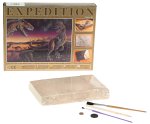
The earlier Expedition kit description promises a sequence: excavate, restore and display a Tyrannosaurus skeleton. The retained photograph shows the box, a block and small tools, leaving the uncovering process to the player.
A useful addition is a simple record of what appears and how the pieces fit together. That gives the activity a beginning, middle and finished display without treating a packaged dig as a real fossil discovery.
Keep a record of the finds
With the kit prepared and used according to its own instructions, pause when a new piece appears. Give it a number on a paper record, draw its outline and note where it appeared in the block. Keep recovered pieces arranged beside their numbers rather than marking them directly.
The aim is to preserve an observation before the arrangement changes. It is an optional recording activity, not a new excavation method: soaking, tool use and handling of the block’s material must follow the matching kit directions.
Sort before assembling
Compare the recovered shapes with the kit’s parts diagram. Look for possible pairs, repeated forms and pieces that seem to belong near the head, body, limbs or tail. Mark uncertain identifications with a question mark on the paper record.
Follow the assembly sequence and intended joins rather than forcing a guessed fit. If a piece seems missing, compare the actual finds with the manual’s inventory; the short original description gives no reliable count.
A skeleton model and a fossil tell different stories
A model represents an animal’s form. A fossil is evidence of past life, such as preserved remains or a trace of activity. A kit called Fossil Hunting does not by its title establish that it contains real Tyrannosaurus remains.
The archive does not identify the recovered pieces’ material or document them as authentic fossils. Treat the experience as a toy excavation and model activity unless the maker’s documentation establishes something more specific. The Natural History Museum’s explanation is a useful next step for learning how actual fossils preserve evidence.
Finish with a small museum label
Give the assembled display a paper label: the animal represented, which parts you identified, and one question the model cannot answer. Color, behavior and the sound an animal made cannot simply be read from an unverified toy model.
One useful correction to the old dinosaur discussion: Tyrannosaurus is extinct, but birds are living dinosaurs. Birds did not descend from T. rex itself; both belong within the broader theropod group.
The historical record
Original Toysit coverage
The original kit description and discussion of Tyrannosaurus appeal remain below. The latter includes broad educational claims and wording about all dinosaurs belonging to the past. Birds are living dinosaurs, as explained in the new context above. The old copy is preserved as a historical account.
Expedition Fossil Hunting Kit - Tyrannosaurus
Dig into the past! Excavate, restore, and display the skeleton of Tyrannosaurus Rex.
Children who love dinosaurs often find themselves particularly drawn to the Tyrannosaurus Rex, one of the most iconic and well-known dinosaurs. Here's why the T-Rex captures their imagination:
- Size and Appearance: The T-Rex was one of the largest carnivorous dinosaurs, with an impressive stature and fearsome appearance. Its massive jaws, sharp teeth, and powerful build make it an awe-inspiring figure for children.
- Pop Culture Presence: The T-Rex has been prominently featured in movies, television shows, books, and toys. Its consistent presence in pop culture has made it a recognizable and beloved symbol of the dinosaur world.
- Mystery and Exploration: Despite being one of the most studied dinosaurs, the T-Rex still holds many mysteries. Children are often drawn to the unknown, and the T-Rex provides an opportunity for exploration and discovery.
- Role as a Predator: The T-Rex's reputation as a fearsome predator adds to its allure. Children are often fascinated by predators and the natural world's food chain, and the T-Rex represents an apex predator in the dinosaur era.
- Connection to Paleontology: The T-Rex has been a significant focus of paleontological research. Children interested in dinosaurs may learn about the scientific methods used to study the T-Rex, further fueling their curiosity and interest.
- Symbol of Extinction: The T-Rex, like all dinosaurs, represents a bygone era. Its extinction story can lead to discussions and learning about natural history, evolution, and environmental changes.
- Inspiration for Creativity: The distinctive appearance and characteristics of the T-Rex can inspire creativity in children. They may draw, build models, or create stories centered around this captivating dinosaur.
The Tyrannosaurus Rex's combination of physical attributes, cultural significance, and scientific importance makes it a compelling figure for children. Its ability to inspire curiosity, creativity, and learning continues to make the T-Rex a favorite among young dinosaur enthusiasts.
Sources and editorial notes
The original image and description were reviewed on October 15, 2026. An exact manufacturer manual, material specification and piece inventory for this Expedition kit were not established. The Natural History Museum sources explain fossils and the surviving bird branch of dinosaurs; they do not authenticate this kit or its contents. No physical excavation or assembly was tested.
- Natural History Museum: What Is a Fossil? — Distinguishes fossil remains and traces as evidence of past life.
- Natural History Museum: Why Are Birds the Only Surviving Dinosaurs? — Explains the relationship between birds and extinct non-bird dinosaurs.
Images and descriptions are retained as historical material. How Toysit covers toys.
Created for Toysit by Tabbloza — the artwork in our header.