
From the Toysit archive
Twister
Follow the classic Twister caller-and-player sequence, understand vacant spots and elimination, and try an optional relaxed color-and-side activity.
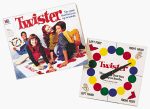
The play at a glance
Listen to the side, limb and color
Classic Twister turns a short spoken instruction into a whole-body puzzle: right hand red, left foot blue. A caller reads the spinner while players decide how to reach the indicated color without losing their position.
Before playing competitively, take a moment to separate the three parts of each call. The side, hand or foot, and color all matter.
Give the caller a clear job
Use the matching instructions to lay out the mat and choose starting positions for the number of players. Keep the surrounding floor clear. The caller stays off the mat, spins, announces the body part and color, and watches for rule questions.
In the classic individual rules, players respond to the same call together. For “right hand red,” each seeks a vacant red circle for the right hand. A called limb already on that color moves to another circle of that color. The caller settles competing claims; if all six circles of the color are occupied, spin again.
Normally a circle holds only one hand or foot. The classic four-player team version has a teammate exception, so decide which version is being played before starting. Do not mix team and individual rules halfway through a round.
Make stopping an ordinary choice
Classic elimination applies when a player falls or touches the mat with an elbow or knee; the last remaining player wins. The transcribed rules also permit a player to withdraw when a position seems impossible or likely to cause a fall.
No one needs to stretch farther, accept unwanted contact or hold an uncomfortable position to keep the game going. Stop the round when needed and give everyone space to stand comfortably. The caller role offers a way to participate without taking a position on the mat.
Try an untimed practice activity
This is a house activity, separate from the competitive rules. Let one willing player use the mat with a caller. Start from a comfortable position, make one simple call, then return to a relaxed stance before the next. There is no elimination or requirement to stay tangled between calls.
- Hear the side
- Say left or right back to the caller before moving.
- Name the limb
- Identify the hand or foot the call refers to.
- Find the color
- Point out a suitable circle before deciding whether to reach it.
- Reset
- Stand comfortably again and choose whether to try another call or switch roles.
Let the player ask for the call to be repeated. Speed is unnecessary for this activity. A short sequence of understandable moves gives the pair a shared language before adding the complexity of several players.
Keep the spinner and rules together
Check the actual spinner before using instructions from another box. Hasbro’s later 98831 description includes Air and Spinner’s Choice; those are not part of the ordinary limb-and-color calls described in the original Toysit account.
Keep the mat, spinner and matching rule sheet together. Inspect the mat for damage and choose an activity that suits the participants rather than assuming everyone will be comfortable on the floor. A round can end after a few moves, and a person can choose another game entirely.
When discussing the result, describe a choice that worked or a call that was difficult to interpret. That makes a more useful conversation than treating a fall or a decision to stop as a failure.
The historical record
Original Toysit coverage
Both original paragraphs remain below. Their broad all-ages and social-benefit claims are retained as historical enthusiasm. This guide concerns the classic mat and spinner, not Twister Air, Moves, Hopscotch or added-move editions.
The Game of Twister by Milton Bradley is one of the great classics.
For generations people have been playing Twister and watching their friends and family contort their bodies in ways never imagined. That's what happens when your left foot is on a red dot and the spinner tells you to put your right hand on a yellow. This Milton Bradley classic game is fun for kids and adults alike. For 2 to 4 players, ages 6 and up. It's the game that ties you up in knots! Twister has been around forever, and it's still as much fun as you remember. The game box contains a spinner, a plastic mat marked with colored circles, and the rules, which are brief. You don't need anything else except a group of friends. A referee spins the spinner to come up with a color and whether a hand or a foot is to be placed in a circle of that color. It's easy at first, but after four or five spins you'll be more tangled than a plate of spaghetti. If you fall, or if any part of you except a hand or a foot touches the mat, you're out, and the last player left is the winner. If you're looking for something to break the ice at parties, this game is it.
Twister is a classic party game that brings people together in a lively and entertaining way. The game consists of a large plastic mat with colored circles and a spinner that instructs players to place their hands or feet on specific colors. The challenge arises as players become entangled with each other, trying to reach the designated spots without falling over. Laughter and camaraderie are inevitable as players twist and contort their bodies into humorous and sometimes awkward positions. Twister's simplicity makes it accessible to players of all ages, and its interactive nature encourages social interaction and breaks down barriers. Whether at a family gathering or a friends' night in, Twister adds a unique and energetic element to the party, creating memorable moments and fostering connections among participants.
Sources and editorial notes
Reviewed October 16, 2026 using the original Milton Bradley image and ASIN B00000DMBK, the classic rules transcribed and attributed to Milton Bradley on Torsten Sillke’s University of Bielefeld page, and Hasbro’s later 98831 product record. The transcription is a copy of manufacturer rules on a university-hosted personal page, not a newly authenticated manual for this box. Its classic rules corroborate the original account; exact packaging/model correspondence remains unconfirmed. Hasbro’s later Air and Spinner’s Choice moves are excluded. No physical game was tested.
- Classic Twister rules: Milton Bradley transcription — University-hosted copy of manufacturer rules, including referee duties, vacant circles and team play.
- Hasbro: later Twister 98831 — Later edition adds Air and Spinner’s Choice; cited to keep those moves separate from this classic profile.
Images and descriptions are retained as historical material. How Toysit covers toys.
Created for Toysit by Tabbloza — the artwork in our header.