
From the Toysit archive
Hoberman Expanding Sphere
Watch a linked structure open and close, compare its outline and follow one repeated shape through the movement.
The play at a glance
The pieces stay connected while the whole shape changes
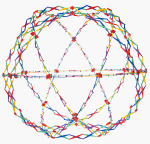
The Hoberman Sphere is an open framework of linked plastic pieces. Its appeal is the coordinated movement: many small joints move together as the sphere expands or contracts.
Begin by watching the changing outline, then choose one colored link to follow. The same object can be both a striking moving shape and a starting point for a careful observation.
Make room to see the outline
Use a clear play area where the expanding structure has room to move. Identify the version you have before following its handling directions; the Original, Mini and Mega names refer to different sizes.
Open and close a sound, freely moving sphere gently as directed for that model. Stop if a joint is damaged or resists. You do not need to throw it, wear it or hang it up to see what makes the design interesting.
Follow one link through the movement
Pick a colored strut near the outside of the sphere. Watch how its angle changes as the structure opens. Then look at a neighboring link: it moves as part of the same connected arrangement, rather than being a loose piece added to make the sphere bigger.
The recent Arbor Scientific guide describes scissor-like linkages. For this activity, the useful observation is simpler: the pieces turn at their connections while the gaps between them change. The plastic struts do not need to stretch for the overall shape to grow.
Compare two silhouettes
Pause with the sphere partly closed and describe its outline. Repeat with it more open. Notice both what changes—the width and the openings—and what remains recognizable about the overall shape.
Make two quick drawings if you want a record. Draw the outside shape and just a few of the links, rather than trying to copy every connection. A partner can point to a repeated pattern while you explain where you saw it.
Let an observation become a question
Ask whether every visible opening seems to change at the same rate, or whether the outline looks different from another viewpoint. Watch another slow movement before deciding. A useful answer can be a more precise description, not a formula.
The old account mentions a pulley and activity booklet. Check the actual edition and its matching directions before using accessories; the retained photograph cannot establish which parts are present. Keep this first activity focused on the linked sphere itself.
The historical record
Original Toysit coverage
The original account and later descriptive essay remain below, including the advertised dimensions, named games, hanging accessories and award claim. Those are retained as historical statements. The new activity uses gentle observation rather than the old catch or helmet suggestions, and makes no therapeutic or developmental promise.
This amazing sphere expands from 9.5" to over 30" with the touch of a finger.
The Hoberman Sphere starts small and grows larger. And vice versa. Made of rainbow-colored plastic links, the sphere expands to 30 inches in diameter and contracts to a compact 9.5 inches. There's a hypnotic fascination in making the sphere expand and contract over and over again, but if kids want to do more with their sphere, a guide (included) lists some possibilities. How about trying the ballerina spin, the flip down, or the hot potato? The sphere can also be a fashion accessory. Think spiked hat or, even better, space helmet. Another option is to hang the sphere as a mobile. A pulley system is included, and a pull of the ring will cause the sphere to contract. Release the ring for expansion. Plenty of fun, the Hoberman Sphere might get kids thinking about mechanical engineering and some folding/unfolding projects of their own. Winner of the Parents' Choice Award. It makes for an interesting game of catch! It's fun to ponder the mathematics and beauty of this expanding sphere.
The Hoberman Sphere is a fascinating and visually captivating toy that engages both children and adults alike. Composed of rainbow-colored plastic links, this geodesic dome-like structure expands and contracts in a mesmerizing display of engineering and art. The seemingly simple act of pulling or pushing on the sphere results in a complex, fluid motion that feels almost magical. Kids can't help but be enthralled as they transform the sphere from a small, compact shape into a much larger, intricate structure. The eye-catching colors further enhance the experience, adding an extra layer of excitement. Beyond its entertainment value, the Hoberman Sphere also provides educational benefits by sparking curiosity about geometry, mechanics, and spatial reasoning. It's a toy that invites exploration, hands-on interaction, and wonder, making it a gateway to understanding more complex scientific principles.
Sources and editorial notes
Reviewed October 15, 2026 using the original small GIF and text, John N. Hansen’s Hoberman catalog and Arbor Scientific’s more recent Original Hoberman Sphere guide. The catalog distinguishes the Original Rainbow sphere from Mini and Mega versions; the recent guide explains the linked mechanism. Neither document establishes every accessory or the condition of an individual older toy. The activity is an editorial suggestion, not a reproduction of an original included game. No physical sphere was tested.
- John N. Hansen: Hoberman catalog (PDF) — Original Rainbow, Mini and Mega versions shown separately.
- Arbor Scientific: Original Hoberman Sphere guide (PDF) — A recent educational explanation of the scissor-like linked structure, not the original toy’s accessory guide.
Images and descriptions are retained as historical material. How Toysit covers toys.
Created for Toysit by Tabbloza — the artwork in our header.