
From the Toysit archive
Star Gazer Planetarium: a small dome and a sky full of patterns
Removable sky domes and a cassette-era guide turn star patterns into a tabletop activity, with an original indoor-and-outdoor sketch comparison.
The play at a glance
Choose a dome, follow a pattern
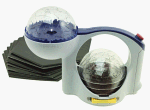
The Star Gazer Planetarium brings the shape of a night sky down to a small tabletop arrangement. The original image shows a blue-gray base, curved dark domes and a stack of plates. Toysit’s earlier account describes a dome placed over a lighted well and a white cardboard half-dome used as a curved screen.
In that account, a built-in cassette player supplies a spoken tour while the domes provide patterns to follow. An included red filter and inverted dome extend the idea outdoors, where a familiar pattern on a model becomes something to look for in the sky.
A small sky to return to
A dome offers a bounded view: a few points can be studied together, traced on paper and revisited. Imagine selecting one pattern during the recorded tour, pausing to draw it, then comparing the drawing with the dome again. A bend in a line or a triangle of points can become a memorable landmark.
Outdoors, the view has a different scale and orientation. NASA explains that the constellations visible at night depend on location and season. A model is a starting point for looking; a current sky guide for your place and date helps decide what to seek on a particular evening.
Try one pattern, two drawings
This original Toysit activity uses the planetarium according to its own instructions, followed by an optional outdoor observation with an adult. A printed star map can stand in for the toy.
- Make the model drawing. Choose a small pattern visible on a dome, screen or map. Draw its points and label the sheet “model view.” Note the name supplied by the guide, if there is one.
- Plan the outdoor view. With an adult, consult a current sky guide for your location and evening. Choose a suitable place and a pattern the guide says may be visible.
- Draw what you actually see. On a separate sheet, record the date, approximate time and viewing direction. Include only the points you can distinguish. Cloud cover or an unsuccessful search is a useful observation too.
- Compare the drawings. Look at spacing, orientation and how many points appeared. Keep “the guide predicts” and “we observed” as separate captions.
The two drawings may show the same pattern at different angles, or they may record a model pattern and a sky that stayed cloudy. Either result gives the next evening’s search a clear starting point.
Let the pattern suggest a story
For an indoor extension, copy the points onto a fresh sheet and invent a picture around them: a kite, a crooked ladder or a creature with a long tail. Label it as your own imagined shape. The astronomical name and your picture can sit side by side, giving the same arrangement two ways to be remembered.
The historical record
Original Toysit coverage
The original product account and commentary are preserved below as historical coverage.
Star Gazer Planetarium by Educational Insights
This device allows one to place one of several star domes atop a lighted well. A separate half-dome made of white cardboard acts as a curved projection screen. The light shines up from the well through the star dome, casting replicas of different sectors of the night sky onto the screen. The base of the Star Gazer has a cassette player on which one can listen to an enclosed tape that discusses various constellations and other points of interest. A nice bonus is a red filter, which allows one to invert the star domes for outdoor night sky exploration. Otherwise, this is an indoor hobby. An activity guide gives all the details on how to get the most enjoyment and learning from this kit. The key to this toy as an educational tool is an adult willing to help a child make the big move from indoor to outdoor viewing. Indoors, the Star Gazer projects images of the major constellations onto walls and ceilings. Amid a dreamy starscape, with the audiocassette as a guide, an ordinary room takes on the aspect of a field trip, and star clusters grow familiar. Then, on a clear outdoor evening, the inverted dome becomes a map to locate actual glittering constellations. Once a child learns to locate the North Star and the key constellations of Cassiopeia, the Big Dipper, and Orion, then he or she can chart the movements of the visible planets. Planetary locator charts are included, but the patience to spend several evenings orienting to zodiac patterns is a likely prerequisite to successfully locating and following a planet.
Home Planetarium Star Projector: A Great Gift for a Child
A home planetarium star projector is a unique and thoughtful gift that can inspire a child's curiosity and imagination. Here's why it makes a great gift:
- Educational Value: By projecting the night sky onto the ceiling, a star projector helps children learn about constellations, stars, planets, and other celestial objects. It can be a fun and interactive way to introduce astronomy and science concepts.
- Sparks Imagination: The magical experience of having a personal night sky indoors can ignite a child's imagination and creativity. It encourages them to explore space, think about the universe, and dream big.
- Enhances Bedtime Routine: A star projector can create a calming and soothing environment, making bedtime more enjoyable. The gentle glow of stars can serve as a nightlight, providing comfort to children who may be afraid of the dark.
- Quality Family Time: Exploring the night sky together can be a bonding experience for the whole family. Parents and children can spend quality time learning, discovering, and talking about space.
- Customizable Experience: Many star projectors come with different settings and features, allowing children to explore various aspects of the night sky. They can change the projection to match the current season or their location, adding to the educational and interactive experience.
- Long-lasting Enjoyment: A star projector is a gift that can grow with a child. As they get older, their understanding and appreciation of astronomy can deepen, making the projector a source of ongoing exploration and enjoyment.
In conclusion, a home planetarium star projector is more than just a toy; it's an educational tool, a source of inspiration, and a means of creating memorable family moments. It encourages children to look beyond their immediate surroundings and think about the vast universe, fostering a sense of wonder and curiosity that can last a lifetime.
Sources and editorial notes
The pictured Educational Insights Star Gazer and original account are the basis for the product description. The cassette-era manual was not recovered. The archive describes both a cardboard screen and wall/ceiling projection; projection arrangement, brightness and accuracy remain unverified. Later CD-edition listings do not resolve those questions. The archived gift essay describes star projectors generally, not verified night-light or adjustable settings for this model. Old planetary locator charts are historical. NASA supplies astronomy context only. No physical testing was performed.
- Original Toysit image — Existing same-site image reviewed and retained unchanged.
- NASA Space Place: What Are Constellations? — Location, season and patterns seen from Earth; not a specification or accuracy assessment of the Star Gazer.
- Original Toysit coverage — Complete original product account and historical commentary preserved.

Images and descriptions are retained as historical material. How Toysit covers toys.
Created for Toysit by Tabbloza — the artwork in our header.