
From the Toysit archive
Prospector’s Mystery Rock: uncovering a miniature collection
A clay excavation block becomes a small display collection, with an original activity pairing close observation and specimen labels.
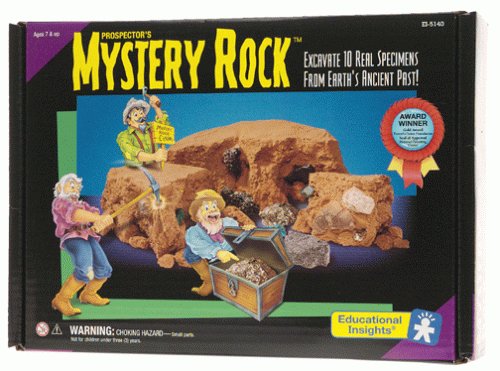
The play at a glance
A discovery that ends with a display
Prospector’s Mystery Rock begins with a compact brown block and the promise of something concealed inside. The Educational Insights package pictures an excavation in progress, with small finds arranged around the block. The play moves from uncovering a specimen to examining it, giving it a label and finding a place for it in a miniature collection.
The original Toysit account describes a clay block with ten buried finds, a prospector’s knife and brush, a logbook, a display case and a sealed identification chart. That sequence gives the kit its appeal: the moment of discovery is followed by another question—what have you found?
From a hidden find to a named exhibit
Imagine the finished display as a tiny museum. One piece might catch the light, another might have a rough edge, and another might show a mark worth drawing. Start with what is visible. A description such as “pale patch on one side” gives the next observer something specific to look for.
The logbook and identification chart described in the old account offer two different kinds of record: your own observations and a supplied name. Keeping them together lets a visitor follow how the exhibit was described. USGS likewise emphasizes matching specimens with labels and notebook entries in its collecting guide.
Try museum-label pairs
This original Toysit activity begins after an adult has checked the kit’s own instructions and the specimens have been recovered accordingly. It also works with suitable loose stones already in a collection, or with drawings.
- Choose three exhibits. Give each a number and a separate place on a tray or sheet of paper.
- Make an observation label. Describe a visible color, outline or surface detail. Add a small sketch showing which side you observed.
- Make an identification label. If the kit’s chart supports a name, write it with “identified from the kit chart.” Otherwise write “identification to investigate.” Keep the exhibit number on both labels.
- Give a museum tour. Ask a visitor to match each observation to its exhibit before reading the identification label. Explain which details you saw and which information came from the chart.
For a second round, rearrange the numbered exhibits and see whether the descriptions still lead visitors to the right ones. A more precise drawing or an extra word can make a useful revision.
A collection with questions attached
Add one question beneath each pair: “Does the pale band continue around the back?” or “Which chart picture is the closest match?” Keep the specimens intact for this activity. Excavation methods and any further tests belong to the instructions for the particular kit.
The archived account uses the adventure word “artifacts” for its finds. In a collection, use the identification supported for each specimen; a natural rock, mineral or fossil is different from an object made by people.
The historical record
Original Toysit coverage
The original product account and commentary are preserved below as historical coverage.
Prospector's Mystery Rock by Educational Insights
You thought Indiana Jones was cool, and then you open this box to find a flat clay rock about 2 inches high and 4.5 inches in diameter... hmmm. But wait! There are no fewer than 10 artifacts buried in here. Some are fragile (including a real fossil) and some are small and valuable (including a real precious stone). Can you use the included prospector's knife and brush, follow the detailed instructions, and excavate all 10 treasures undamaged? Can you identify them? Can you complete the included logbook accurately enough to win a place as assistant on Indiana's next expedition? Only time and a lot of patience will tell. If you do it, there's a plastic display case and labels for your finds--plus a sealed Secret Identity Chart for anything you can't identify. Parent's Choice Foundation Gold Award and National Parenting Center Seal of Approval winner.
Rock Collecting: An Inexpensive, Fascinating, and Rewarding Hobby
Rock collecting is a hobby that appeals to people of all ages. It combines the thrill of discovery with the beauty of nature, and it can be as simple or as complex as the collector desires. Here's why rock collecting is considered an inexpensive, fascinating, and rewarding hobby:
- Inexpensive:
- Accessibility: Rocks can be found everywhere, from your backyard to local parks and nature trails. There's no need to purchase expensive equipment or materials to start collecting.
- Low-Cost Tools: Basic rock collecting tools such as a magnifying glass, a small hammer, and a field guide are affordable and readily available.
- Free Educational Resources: Many online resources and community groups offer free information and support for rock collectors.
- Fascinating:
- Variety and Beauty: Rocks come in various shapes, colors, and textures. Each rock tells a unique geological story, making every find a new adventure.
- Scientific Exploration: Rock collecting offers a hands-on introduction to geology, mineralogy, and earth science. It's a great way to learn about the Earth's history and processes.
- Creative Expression: Many collectors enjoy displaying their rocks in creative ways, adding an artistic dimension to the hobby.
- Rewarding:
- Personal Growth: Rock collecting encourages patience, observation, and critical thinking skills. It can be a meditative and relaxing activity.
- Community Engagement: Joining rock collecting clubs or online forums can lead to friendships and shared experiences with fellow enthusiasts.
- Environmental Connection: Spending time outdoors searching for rocks fosters a deeper connection with nature and promotes environmental stewardship.
Rock collecting is a versatile hobby that can be tailored to individual interests and budgets. Whether pursued as a casual pastime or a serious scientific endeavor, rock collecting offers endless opportunities for learning, creativity, and enjoyment. It's a hobby that can be started at any age and continued for a lifetime, providing ongoing discovery and satisfaction.
Sources and editorial notes
The original image and Toysit account identify this profile. Exact instructions for the archived edition were not recovered; the ten-find inventory, dimensions, tools, fossil and precious-stone descriptions, and awards remain attributed to that account. Specimen identities, value and handling requirements are not independently established. USGS supplies collection-record context only. The activity below is an original Toysit suggestion using already-loose specimens; no physical testing was performed.
- Original Toysit image — Existing same-site image reviewed and retained unchanged.
- USGS: Collecting Rocks — Guide reviewed for labels, numbered specimens and collection records; not evidence of this kit’s contents or a recommendation to follow its field-collecting methods here.
- Original Toysit coverage — Complete original product account and historical commentary preserved.

Images and descriptions are retained as historical material. How Toysit covers toys.
Created for Toysit by Tabbloza — the artwork in our header.