
From the Toysit archive
Hop Along Katie
Meet Hop Along Katie and her pogo-stick theme, explore the stick-horse play in the original account, and draw a three-stop toy journey.
The play at a glance
A striped shirt and a pogo stick set Katie in motion
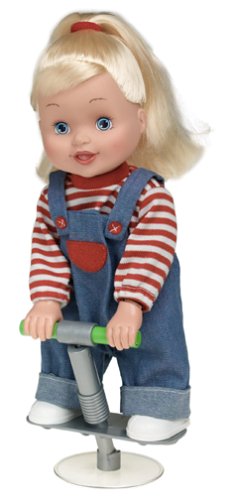
Katie wears denim overalls over red-and-white striped sleeves. Her hands rest on the handle of a small pogo stick, and a red hair tie holds her blonde ponytail high. The pose suggests a character ready to set off, with her next stop waiting somewhere beyond the photograph.
Two accessories suggest two journeys
Toysit’s earlier account describes Katie hopping on a pogo stick or riding a stick horse while saying phrases. The pogo stick appears in the retained photograph; the stick horse belongs to the accessory list in the original text.
Each theme can give an imagined journey a different setting. A pogo-stick scene might begin at a playground greeting sign. A stick-horse story could follow a drawn path to a pony stable. The player chooses the destination and supplies the encounters along the way.
A landmark gives the trip a middle
Try adding one recognizable landmark between the start and finish: a paper bridge, a tree with a ribbon or a small house with a bright door. A character waiting there can ask where Katie is going and offer a friendly message for someone at the next stop.
The message gives the trip a purpose. Perhaps Katie carries news of a picnic, invites a friend to a performance or delivers a thank-you. On the return journey, another player can change the landmark and invent a new conversation.
Draw a three-stop trail
- Draw a starting place, a landmark and a destination on paper.
- Connect them with a broad path.
- Add a character with a greeting at each stop.
- Choose a message for the traveler to carry.
- Trace the journey with a finger or paper character and tell the conversations in order.
This original activity creates a story map. Keep the drawing beside an electronic toy as a prompt, and use the toy’s own guide for its operating surface and movement.
The historical record
Original Toysit coverage
The original toy description and broader play discussion are preserved below as historical coverage.
Doll that hops on her pogo stick and talks.
Active doll that comes with a stick horse and pogo stick. Watch her ride her stick horse or hop around on her pogo stick while having fun and saying 10 random phrases.
The pogo stick, a simple yet exhilarating toy, has a history dating back to the late 19th century. The original concept of bouncing on a spring-loaded device can be traced to George Hansburg's patent for a "spring-stilt" in 1891. However, it was George B. Hansburg Jr. who patented the first recognizable pogo stick design in 1919. This early version consisted of a wooden frame with a spring mechanism and footrests. The term "pogo stick" is believed to have originated from the German word "pochen," meaning "to poke" or "to bounce." The pogo stick gained popularity as a novelty item during the 1920s and 1930s, with people using it for entertainment and in circus acts. In the 1950s, pogo sticks experienced a resurgence in popularity, becoming a fad among children and teenagers. Innovations in materials and engineering improved the performance and durability of pogo sticks, allowing for higher jumps and more stunts. Throughout the years, pogo stick design continued to evolve, incorporating modern materials like lightweight metals and improved spring mechanisms. In the 1980s and 1990s, extreme pogo sticking gained traction as a sport, with enthusiasts performing tricks, flips, and other acrobatics on specially designed pogo sticks. Today, pogo sticks remain a classic outdoor activity and toy, loved by children and adults alike. They offer not only a fun way to bounce and jump but also provide a means of physical exercise and coordination. The pogo stick's enduring appeal demonstrates how a simple concept can continue to captivate generations through its combination of play and physical challenge.
Sources and editorial notes
The retained photograph shows the pogo-stick presentation; Toysit’s original description also lists a stick horse, hopping and spoken phrases. Complete matching manufacturer instructions remain unrecovered, so accessory fitting, surfaces and controls are left to the original guide. A historical licensing record was used only as a research lead. The trail activity is original; no physical testing was performed.
Images and descriptions are retained as historical material. How Toysit covers toys.
Created for Toysit by Tabbloza — the artwork in our header.