
From the Toysit archive
Electronic Hula Heather
Take a closer look at Electronic Hula Heather’s colorful hoops and sporty outfit, then create a poster and rhythm for a toy show.
The play at a glance
Bright hoops put the movement in the spotlight
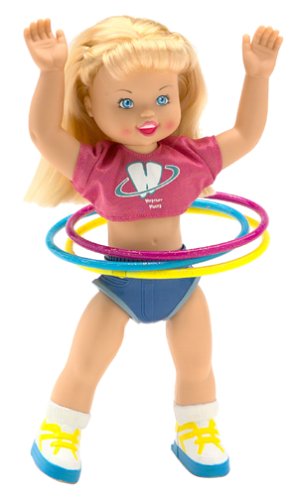
Heather holds both arms up, with three colorful hoops circling her waist. Her pink top, blue shorts and bright shoes give the photograph an energetic feel. The hoops make the toy’s theme immediately visible: this is a character built around a small hoop performance.
A repeated movement becomes a show
The original Toysit description presents Heather as a moving hoop doll. A hoop’s circular shape gives that idea a clear visual pattern: something goes around, returns to its starting point and begins again. The photo gathers several bright circles around the same character.
A player might build a short show around the idea of repetition. A narrator introduces Heather, an audience supplies a simple hand-clapped rhythm, and the scene finishes with a cheerful announcement. The rhythm and dialogue are contributions from the people playing.
Give the audience something to recognize
Choose a circle motif for the show’s sign: a sun, a wheel or rings in three colors. Repeat it on paper tickets and on a small backdrop. A toy guest could arrive carrying a matching invitation.
Imagine a show called “Three Bright Rings.” One guest introduces the title, another supplies a few gentle claps and a third describes the finale. A repeated sound or phrase gives everyone a small part in the performance.
Design a hoop-show poster
- Draw three circles in different colors.
- Turn them into a poster with a show name and a performer.
- Choose an opening announcement, a short repeated rhythm and a closing cheer.
- Invite two toy guests and give each a paper ticket.
- Tell the show as a miniature story, using the poster as its backdrop.
This original activity uses drawings, narration and an optional gentle clapping pattern. Follow an existing doll’s matching instructions for its mechanism and accessories.
The historical record
Original Toysit coverage
The original toy description and broader play discussion are preserved below as historical coverage.
Hula Hoop Doll.
She moves and does the hula hoop. Great toy for an active girl.
History of Hula Hooping
Hula hooping, a beloved pastime that involves twirling a large hoop around the waist and hips, has a rich history that spans cultures and generations. Here's a journey through the evolution of hula hooping:
Ancient Roots: The concept of hula hooping can be traced back to ancient civilizations. In ancient Greece, children played with hoops made from grapevines, while Egyptian tomb paintings depict individuals engaging in similar activities with hoops made from various materials.
Traditional Practices: Indigenous cultures, such as Native American tribes, practiced hoop dancing as part of their traditions. These dances involved intricate and skillful manipulation of hoops to tell stories and express cultural significance.
Wham-O's Innovation: The modern hula hoop craze began in the late 1950s. Richard Knerr and Arthur "Spud" Melin, founders of the toy company Wham-O, introduced the plastic hula hoop to the American market in 1958. They were inspired by Australian children who played with bamboo hoops.
Mass Phenomenon: The hula hoop quickly became a cultural sensation. Wham-O sold over 100 million hula hoops within the first few years of its introduction. The toy's popularity was fueled by media coverage, celebrity endorsements, and hula hooping contests.
Diverse Audience: Hula hooping was embraced by people of all ages. Children, teenagers, and adults alike joined in the craze, enjoying the rhythmic motion and physical activity associated with the activity.
Iconic Symbol: The hula hoop became an icon of the 1950s and early 1960s, symbolizing the carefree spirit and enthusiasm of the era. It was featured in movies, TV shows, and advertisements, cementing its place in pop culture.
Evolution and Variations: As the hula hoop trend evolved, people experimented with different materials, sizes, and designs. The introduction of weighted and collapsible hoops allowed for more complex tricks and performances.
Hula Hooping Revival: While the initial craze subsided, hula hooping experienced a revival in the 1990s and early 2000s as a fitness and dance activity. People discovered its benefits for cardiovascular exercise, core strength, and coordination.
Artistic Expression: Hula hooping also found a place in the realm of performing arts. Contemporary hoop dancers incorporated colorful and illuminated hoops into their routines, creating mesmerizing visual displays at festivals and events.
Modern Day: Hula hooping remains a popular recreational activity, fitness routine, and artistic form of expression. It has evolved to include hoop dance, hoop fitness classes, and even hoop yoga, demonstrating its versatility and adaptability.
The history of hula hooping showcases how a simple toy can capture the imagination and enthusiasm of multiple generations. From its ancient origins to its place in modern fitness and art, hula hooping continues to bring joy, movement, and creativity to people around the world.
Sources and editorial notes
Toysit’s original photograph and brief product description are the evidence for this profile. The earlier account describes an electronic doll that moves with a hoop; exact manufacturer, controls, sound features and fitting instructions remain unconfirmed. The longer hoop-history essay is preserved as historical coverage. The poster and rhythm are original editorial suggestions, and no physical testing was performed.
Images and descriptions are retained as historical material. How Toysit covers toys.
Created for Toysit by Tabbloza — the artwork in our header.