
From the Toysit archive
Hot Wheels Laptop Computer
Explore the original Hot Wheels laptop announcement, its car-themed computer design and an independent pit-crew number-pattern game.
The play at a glance
Bringing a car theme to the keyboard
The Hot Wheels laptop shows how a familiar play theme could move from vehicles to an electronic learning toy. Toysit’s original report centers on Oregon Scientific’s licensing plans and computer-shaped product. The useful questions are what the controls do and how the theme supports the activity.
What the photograph can tell us
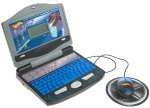
The retained image shows a folding screen, a keyboard and a separate round control. It establishes the computer-like arrangement, but the small image cannot establish the control’s functions, the software menu or an exact model revision.
The original report identifies Oregon Scientific and the Hot Wheels license. It is strongest as a record of how the product was introduced. It does not provide enough detail to reconstruct game rules, scoring or a sequence for operating the pictured toy.
The announcement is part of the history
The preserved report connects the Hot Wheels range with Oregon Scientific’s earlier Barbie products and quotes company representative Steve Jackson. Keeping that attribution makes it clear whose expectations and promotional claims were being reported.
A later toy with the same brand can have different controls and activities. Before using a manual, compare its model number and illustrations with the actual unit. The original battery and outlet reference also belongs to the archived description; it is not sufficient information for choosing a replacement power adapter.
Let the car theme suggest a question
A vehicle theme can provide a reason to work with numbers: arranging numbered cars, counting laps in a pretend event or reading a pit-stop instruction. These are ideas for shared play, not a claim that the laptop contains racing software or those exact activities.
When comparing themed electronics, ask whether the child enjoys the input and response as much as the picture on the case. Leave room for a pause, a conversation or a switch to physical toys when that is more engaging.
Make a pit-crew pattern
Draw five parking spaces and label four of them 2, 4, 6, 8. Invite a player to name the next number and explain the rule. Then try 10, 8, 6, 4. Paper cars can move into the spaces as each number is read.
Let the player invent a new sequence for the pit crew to solve. A color pattern works too: red, blue, red, blue. This independent Toysit activity can be untimed and cooperative; it does not reproduce a built-in laptop game.
The historical record
Original Toysit coverage
The complete Oregon Scientific licensing report, Steve Jackson quotation and broader Hot Wheels history are preserved below. The announcement’s 2002 launch context, intended audience and power details remain period reporting, not current setup advice.
Hotwheels Laptop by Oregon Scientific
Learning products steered a path to success for Oregon Scientific as the company announced that the premiere product in its licensing agreement with Mattel Toys for the Hot Wheels brand is the Oregon Scientific Hot Wheels Laptop. Steve Jackson, Vice President of Sales at Oregon Scientific, said, "We are extremely excited to rollout the new Hot Wheels laptop. It is the first of several learning technology products that we plan to release throughout 2002 and beyond." Paced by the powerful new Hot Wheels Laptop, all of the products in the Oregon Scientific Hot Wheels line will be consistent with the recognizable, dynamic, colorful, blazing Hot Wheels brand logo, blue and orange colors that immediately imply the respect and high quality standards established by Mattel. In 2000, Oregon Scientific acquired the Barbie license from Mattel and introduced the first family of digital learning products based on the Barbie franchise. Oregon Scientific launched three Barbie products beginning with the Barbie B-Book, a laptop computer for girls. "The Barbie line has been a tremendous success," Jackson said. "It is so strong that Oregon Scientific now has 10 products in our Barbie line. Seven of which are new for 2002. We're thrilled to have the complement of both the Hot Wheels and Barbie licenses." The Hot Wheels Laptop is designed for ages five and up and is fueled through an electrical outlet or, for traveling and remote locations, four-AA batteries.
Hot Wheels, a brand of die-cast toy cars introduced by American toy manufacturer Mattel in 1968, has become an iconic name in the world of miniature vehicles. The brand gained immediate popularity for its attention to detail, speed, and the wide variety of car models, both fantastical and based on real-life automobiles. Unlike other die-cast cars at the time, Hot Wheels were designed for speed and superior performance, often featuring unique designs, "mag" wheels, and bright metallic paints—characteristics that captured the imaginations of children and collectors alike. Over the years, the Hot Wheels line has expanded to include various playsets, tracks, and accessories, transforming simple toy cars into elements of a larger, more interactive world. The brand has maintained its appeal through constant innovation, limited editions, and collaborations with auto manufacturers, pop culture icons, and even video games. Its longevity and sustained popularity make Hot Wheels a staple in the toy industry, transcending generations and continuing to captivate automotive enthusiasts of all ages.
Sources and editorial notes
This profile draws on Toysit’s original report and photograph. No exact manufacturer guide matching the pictured model was established; later Hot Wheels Fast Track manuals have not been substituted. No unit or accessory was tested.
Images and descriptions are retained as historical material. How Toysit covers toys.
Created for Toysit by Tabbloza — the artwork in our header.