
From the Toysit archive
Hot Wheels Motorized Starter Set
Explore the Hot Wheels Motorized Starter Set through its booster, curves and upright loop, then draw a route showing where a car receives a push and coasts.
The play at a glance
One booster, one loop, a repeating route
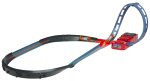
The Hot Wheels Motorized Starter Set makes a compact circuit out of straight track, curves and an upright loop. Mattel’s 52575 instructions match the layout in Toysit’s original photograph: a Power Charger booster feeds the route, and two half-loop pieces join into the tall stunt section.
That arrangement gives the viewer a simple question to follow: where does the car receive a push, and what happens between one visit to the booster and the next?
Read the track as a connected path
Start with the low oval and then trace the loop. A photograph can make an upright section look separate, but the assembly drawing shows how the pieces form one route. The connections matter as much as the largest feature: each straight or curved section has to deliver the car to the next one.
Point out the booster, the loop entrance and the return curve. Giving these places names makes it easier to describe an observation than simply saying that a run worked or failed.
Separate the powered part from the rolling car
The power source belongs to the track’s booster. The car travels onward between encounters with it. This is a useful distinction when comparing a track set with a battery-powered vehicle that carries its own motor.
A route sketch can mark the booster without trying to calculate speed. Use arrows to show travel direction and a different symbol for the place that supplies the push. A tall loop does not, by itself, establish how quickly a particular car will complete it.
Keep an observation small
For an existing set assembled and used according to its guide, notice one section at a time. Does the car reach the curve? Does it return to the booster? Record what happened at the named place before guessing why.
The original manual is the reference for assembly and operation. The historical photograph cannot establish the condition of an old booster, whether a set is complete or whether an additional car will work.
Map the push and the coast
- Draw an oval route and a separate side-view sketch of its upright loop.
- Mark the booster with a star and add arrows around the route.
- Choose three observation points: before the loop, after it and on the return.
- Write one question beside each point, such as “Does the car reach this section?”
- Trace a paper car around the drawing and explain how the two views describe the same route.
This independent paper activity needs no original track set and does not prescribe a new physical track arrangement.
The historical record
Original Toysit coverage
The complete original product description and brief Hot Wheels background paragraph remain below. The enthusiastic racing and collision language belongs to that earlier coverage; it is not a new performance test.
Hot Wheels Super Start Set by Mattel.
Though it's billed as a starter set, this curving and looping Hot Wheels track has all the components young racing fans will need to have an exciting afternoon of high-speed racing, jumping, and crashing fun. The set comes complete with high-wall flat tracks, curving transition tracks, and two half loops that fit together to form one upside-down stunt loop. A battery-powered power-charger booster sends your Hot Wheels cars careening through the track, and the included loop connection adds to the excitement by creating the potential for wild collisions when you have more than one car racing on the track at the same time. The set comes with one exclusively designed Hot Wheels vehicle, but you will have to purchase two D batteries separately to power up the power charger.
Hot Wheels, the iconic miniature toy cars introduced by Mattel in 1968, have left an indelible mark on generations of children and collectors alike. Their compact size, intricate details, and vibrant colors immediately caught the attention of young enthusiasts, sparking a fascination that has endured for decades.
Sources and editorial notes
Mattel’s official 52575 instructions were downloaded and visually reviewed, including the parts list, completed layout, direction arrows and operating notes. The layout matches the retained photograph. The guide documents the booster and two-piece loop; no surviving set, car compatibility or speed was physically tested. The route-map exercise is an independent Toysit activity.
- Mattel Motorized Starter Set 52575 instructions — Original parts, assembly and operating guide; layout matched to Toysit’s image.
Images and descriptions are retained as historical material. How Toysit covers toys.
Created for Toysit by Tabbloza — the artwork in our header.