
From the Toysit archive
K’NEX Roller Coaster: Screamin’ Serpent
Build a large track structure and watch a motorized chain lift bring the cars to the top. Identifying the coaster in Toysit’s 2004 coverage.
The play at a glance
A building project that becomes a moving model
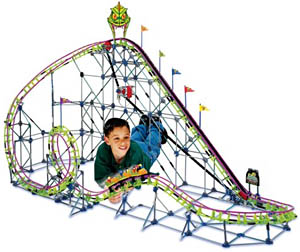
The coaster pictured here is K’NEX Screamin’ Serpent, model 63153. Its manufacturer-hosted manual contains the same photograph used on Toysit’s earlier page, giving a stronger identification than the old generic title.
The project combines a rod-and-connector structure, shaped track, cars and a motorized chain lift. Building and checking that route is a substantial part of the play, before watching a car complete a run.
Plan the space before sorting the parts
Page 4 of the 63153 manual specifies a footprint of 78 × 36 inches (198 × 92 cm) for Screamin’ Serpent. That is 6½ feet long and 3 feet wide, before allowing room to reach around the model. Its smaller Junior layout is listed at 64 × 30 inches (163 × 77 cm).
Those are model-specific planning figures. The old description’s narrower measurement should not be used to decide whether the main build will fit. Choose a smooth, flat surface and a place where an unfinished section can stay between sessions.
Build in sections and check each connection
Sort rods, connectors, spacers, track pieces and cars separately. The manual’s diagrams distinguish newly added parts from earlier work; matching the pictured orientation makes a misplaced connection easier to spot.
Track placement deserves its own check. The original design involves cutting track to specified lengths, so use the matching instructions and adult help for that step. Avoid cutting an unidentified or already shortened length from a used set merely to make it reach.
Movement and sound are separate systems
The documented red PowerPack drives the chain lift and uses two AA batteries. The separate sound module uses three AAA batteries. These details apply to the illustrated original units; compare the actual hardware and markings before following them.
Keep hair, hands and clothing clear of moving parts, and keep the sound module away from ears as the manual directs. Power off before adjusting the structure. An old photograph cannot show whether a motor or sound unit still works.
A useful project question
Ask which parts hold the track in position and which parts make the car move. Following those two systems through the model gives a concrete way to discuss structure and motion. If a run stops, record where it stops and compare that section with the instructions before changing several things at once.
The original article also reports on a school design challenge. That is a separate historical example of using K’NEX, not a measured learning result for this coaster.
The historical record
Original Toysit coverage
The September 27, 2004 description and the complete school-program report remain below. The earlier dimensional claims differ from the manual’s stated floor-space requirements; use the documented figures in the new context above. The competition account is historical, not an invitation to a current program.
The amazing building set that connects together
Roller Coaster excitement for the whole family. Build a huge replica of today's steel style roller coaster -- with twists, turns, loops, and cool styling. Over 6 1/2 feet long, 2 1/2 feet wide, and 3 1/2 feet tall -- the battery-powered motor pulls the roller coaster cars up the incline. The sound module creates real coaster sounds and screams. The figures easily press into the seats. Alternate model includes a canopy and is 5 feet long. Perfect for smaller spaces.
Founded in 1992, K'NEX Industries was established to make and sell what has become one of the world's leading construction systems for children.
Founder Joel Glickman came up with the toy set while playing with straws. While sitting at a crowded, noisy wedding, Joel began tinkering with some straws and thinking about the possibilities. This dabbling, followed by some innovative product engineering, led to the very popular Rod and Connector building system now available throughout the world.
Soon builders could add wheels, pulleys and gears to create vehicles and other innovative creations. Easy-to-follow, color-coded instructions, included in every set, made it easy to bring the models to life.
The company has an education program that provides school children with an introduction to the world of engineering and technology. Over 3000 schools throughout the UK and Ireland participated in the competition this summer. The design and build competition is open to all primary schools and organizations teaching 7 to 11 year-olds.
To participate in the challenge, students pair up to design and build a model out of K'NEX Education construction kits that meet a specific design brief. The models are then judged by experienced engineers. There are three stages of challenge: The School Challenge, whose winners progress to the Regional Challenge, whose winners finally go on to the National Challenge. The national final design brief asked the 12 final teams to design an Olympic stadium, with a roof that opened and closed.
Sources and editorial notes
The 63153 manual’s photograph, setup and operating guidance were visually compared with the archived image on October 15, 2026. Basic Fun’s manufacturer-hosted scan is incomplete; the K’NEX User Group copy includes all 140 numbered pages of the manufacturer’s booklet, including the Junior build and troubleshooting. No coaster, motor or sound module was tested.
- K’NEX: Screamin’ Serpent 63153 instructions (PDF) — Manufacturer’s 140-page booklet preserved by K’NEX User Group.
- Basic Fun: manufacturer-hosted 63153 scan (PDF) — Corroborates the model photograph and setup pages; this scan ends during the Junior build.
Images and descriptions are retained as historical material. How Toysit covers toys.
Created for Toysit by Tabbloza — the artwork in our header.