
From the Toysit archive
Kitty the Tekno Kitten
Meet Kitty the Tekno Kitten through touch sensors, sound cues and programmed tricks, with the original description and a simple observation activity.
The play at a glance
A mechanical kitten with several ways to respond
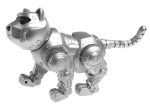
Kitty the Tekno Kitten brings the robot-pet idea into a cat-shaped body: a moving tail, small sounds and responses to attention. The original photograph shows the silver robotic kitten, rather than a later plush or newborn toy.
The useful question is what prompts each response. Separating touch, sound and light makes the toy easier to understand and gives pretend play more possibilities.
Three cues worth separating
- Touch
- The guide maps three touch inputs along Kitty’s head and back, alongside mouth and nose inputs.
- Sound
- Its sound sensor responds to voices and other noises. A response to a spoken name alone does not demonstrate recognition of that name.
- Light
- The guide describes a sensor that detects changing light levels. This is different from identifying objects in a scene.
Use the guide’s diagram to understand where a documented input belongs. A sensor is a practical explanation for a response; the player can still give that response an imaginative meaning.
What “teaching” means here
The manual describes selecting routines with buttons and sensors. Its talking routine uses built-in words, and its counting trick uses a printed placemat plus a sequence the audience follows. Neither establishes open conversation or counting arbitrary objects by sight.
That is a useful design idea in its own right: a simple sequence can feel surprising when the performer and the audience each do their part.
Sharing a scene with another pet
The guide describes Kitty hearing and responding to another Kitty or a Tekno puppy. It does not establish compatibility with every electronic pet.
For storytelling, compatibility is much simpler. A paper kitten and a stuffed dog can share a scene because the players decide how each character answers. That invented dialogue does not require the toys to exchange signals.
Compare one cue at a time
- Make three paper cards labeled touch, sound and light.
- Draw an imaginary kitten and choose a response for each card.
- Turn over one card and draw only the response it calls for.
- Ask another player to describe what changed before explaining what they think the kitten feels.
- Give the same response a second possible meaning. Could a quiet pause mean listening rather than sleeping?
This is a design-and-observation game, not Kitty’s programming sequence. When observing an actual toy, keep the cue and the visible result in separate columns and follow the matching manual.
The historical record
Original Toysit coverage
The complete original description and later general discussion of robotic kittens remain below. References to apps and advanced voice recognition in the general paragraph are not verified features of this Kitty. Claims about emotional benefits and being a real-cat substitute are preserved as original commentary, not evidence of measured effects. The counting description refers to a staged trick, not general visual arithmetic.
How to buy a robotic kitten at a discount.
Kitty the Robotic Kitten is Manley Toy Quest's contribution to the robotic pet revolution. This cyber feline really captures the true cat essence. Kitty has three electronic nerve sensors located on the back of her head that run down the top of her body. These electronic sensors trigger Kitty's emotion program. When you pet her on her back, she will purr with appreciation. She will meow with a variety of emotion, look up with curiosity when called, move her tail with anticipation, cry when she is unhappy, and even fall asleep several times a day. Kitty's internal clock wakes her up in the morning and her light level sensor lets her know it's time to go to sleep at night. Kitty's microprocessor allows for customized programming. She can be taught to speak, do a song and dance routine, pounce, excuse herself, and even count to four. She is designed to hear and respond to other Tekno the Robotic Puppies or other Kitty the Tekno Kittens. Kitty measures approximately 13 inches by 4 inches by 9 inches.
A robotic kitten offers a unique blend of technology and tactile interaction that can be incredibly captivating for children. These kittens often come with sensors and programming that allow them to move, meow, and even respond to touch, thereby offering a more interactive and dynamic play experience compared to a traditional plush toy. The unpredictability and range of actions make the robotic kitten feel almost like a real pet, engaging a child's imagination and sense of wonder. Some advanced models may even feature voice recognition or app integration, allowing for customized interactions and additional modes of play. For children interested in both animals and technology, a robotic kitten serves as a perfect nexus of these two worlds. It provides not only the emotional comfort of a pet but also an educational glimpse into robotics and programming, making playtime both fun and enriching.
Sources and editorial notes
The original Kitty owner’s manual was reviewed for its sensor diagram, behavior descriptions, trick tables, counting-card routine and interaction notes. Its body diagram matches the original photograph. Baby Kitty and NewBorn Kitty manuals were not used to supply features. No toy was physically tested. The cue comparison is an independent paper activity.
- Kitty the Robotic Kitten owner’s manual — Manufacturer guide preserved by The Old Robots; original Kitty sensors and routines.
Images and descriptions are retained as historical material. How Toysit covers toys.
Created for Toysit by Tabbloza — the artwork in our header.