
From the Toysit archive
Talking Clever Clock
Connect analog hands, digital notation and spoken time with short examples, then compare a starting time with an ending time.
The play at a glance
Read the picture, say the time
Toysit’s original description presents the Talking Clever Clock as a way to connect clock hands, digital time and spoken answers. That combination suggests a simple activity: look first, offer an answer, then compare.
Begin with an hour or a half-hour. Save elapsed-time questions for a separate turn, when reading a single time feels comfortable.
Read one time in three ways
On a conventional analog clock, the shorter hand shows the hour and the longer hand shows the minutes. The minute hand at 12 marks the start of an hour. At half past, it points to 6 and the hour hand is halfway toward the next hour.
Choose an example and say what each hand contributes. Then write the same time in digits. The minutes after the colon are not the numeral the long hand points toward: a hand at 6 means thirty minutes past, not six.
- 3:00 — three o’clock
- Minute hand at 12; hour hand at 3.
- 3:30 — half past three
- Minute hand at 6; hour hand halfway between 3 and 4.
- 4:00 — four o’clock
- Minute hand returns to 12; hour hand reaches 4.
- What changed?
- From 3:00 to 4:00, the minute hand makes one full turn and the hour hand advances one hour.
These are clock-reading examples, not a sequence of buttons for this toy. If the unit’s operation is unfamiliar, draw the faces beside the written times and compare those instead.
Give the answer before hearing it
When you have the matching instructions for a working clock, use its documented answer feature after the player has had time to respond. Ask “What do you notice?” before asking for a complete time.
If the spoken answer and the player’s answer differ, return to the hands: which one marks the hour, and where is the minute hand? A disagreement is a reason to inspect the display and setting, not to assume the toy is always right or the player is always wrong.
Take turns being the person who reads and the person who explains. Repeating one example can be more useful than introducing several new time expressions at once.
Separate a time from a duration
“It is three o’clock” names a point in time. “Half an hour has passed” describes a duration. Draw a starting clock and an ending clock side by side to make that difference visible.
For example, a pretend visit starts at 3:00 and ends at 3:30 on the same afternoon. The interval is thirty minutes. Extend the ending time to 4:00 and the total interval becomes one hour.
Keep the start and end written down while discussing the change. Try whole hours first if half-hours add too much at once. A stopwatch measures duration too, but its use is a separate activity that needs the toy’s own instructions.
Use the original controls with their own guide
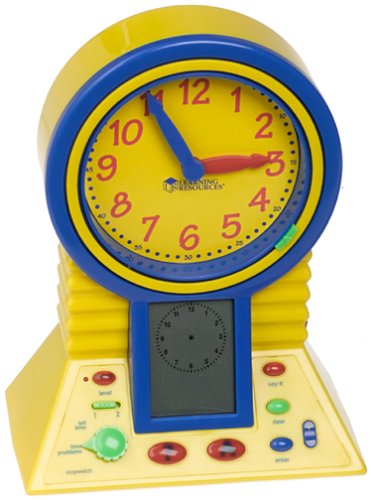
The archived photograph shows a yellow-and-blue clock, a lower display and several colored controls. It does not establish how to choose a mode, change a setting or activate every feature.
Check the label on the actual clock before using instructions found for another learning clock. Do not force the hands or infer a button sequence from its color. Follow the matching guidance for power, care and operation.
The historical description concerns a teaching toy. It is not evidence that the unit keeps the current household time. A short paper-and-pencil comparison remains possible while the correct operating guide is being located.
The historical record
Original Toysit coverage
The original product description and explanatory paragraph remain below. The listed Say It, stopwatch and practice features are preserved as historical claims. The new guide explains time-reading examples without reconstructing unverified button sequences.
Digital and analog learning
The Talking Clever Clock teaches students how to tell time, read digital time, say the time, and solve elapsed time problems. Designed for multiple level skills, this clock features all of the necessary tools for mastering time-telling skills. Children can practice hours of hands-on analog, digital and elapsed time drills. A bonus stopwatch feature lets children demonstrate live action activities. The Say it, self-checking answer button lets children hear their solutions out loud. This 10 3/4 clock comes in primary colors and features easy-to-use buttons and large graphics.
A talking clock serves as an engaging and educational tool that can greatly assist a child in learning how to tell time. By audibly announcing the time in a clear and friendly voice, the child can associate the spoken words with the visual representation of the clock's hands. This auditory reinforcement helps bridge the gap between abstract concepts and concrete understanding, allowing the child to grasp the relationship between hours and minutes, as well as the movement of the clock's hands. Additionally, a talking clock often provides interactive features, such as quizzes or games, which encourage active participation and reinforce the learning process. The repetitive nature of hearing the time announced at regular intervals helps solidify the child's comprehension over time, ultimately fostering their ability to read analog clocks and understand the passage of time more effectively.
Sources and editorial notes
Reviewed October 16, 2026 against the original source and photograph. Learning Resources LER 2998 remains an identification lead, but a matching original instruction manual was not located. The control modes, response increments and stopwatch operation have not been independently verified. The examples in this guide explain conventional clock reading and can also be drawn on paper. No physical clock was tested.
Images and descriptions are retained as historical material. How Toysit covers toys.
Created for Toysit by Tabbloza — the artwork in our header.