
From the Toysit archive
Abacus Counting Toy
Move one bead for each number, make a small group and split it two ways using the animal-bead counting frame from Toysit’s archive.
The play at a glance
Make the amount visible
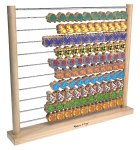
The pictured frame keeps its animal-shaped beads on horizontal rods. For a first activity, use a few beads on one row and agree which side will hold the group you are counting.
Sliding a bead gives each spoken number a visible action. The useful question is how many are in the chosen group, not how quickly someone can recite the numbers.
Choose a counted side
Place the frame securely and choose one row. Move its beads to the left, then agree that beads moved to the right will be the counted group. Keep the other rows out of this first activity.
Move one bead right and say “one.” Move a second and say “two.” Stop at three, point to the group and say “three altogether.” Count it again slowly if needed, touching or moving one bead for each number word.
The gap between the groups matters more than the distance each bead travels. Make that gap easy to see so it is clear which beads have already been counted.
Build and change a small amount
- Start with none
- Keep the chosen row’s beads on the left. The counted group on the right is empty.
- Make three
- Move three beads to the right, one at a time. Say how many are there altogether.
- Add two
- Move two more to the right. Count the group again: three and two make five.
- Take one away
- Move one of those five back to the left. Four remain in the counted group.
Let a partner describe the change before you move the beads. Then swap: one person moves them and the other tells the story. If keeping track is difficult, reset the row and use a smaller starting amount.
Find two parts of five
Select five beads and keep any others at the far left of the rod. Within the selected five, separate two from three with a small gap. Count both parts, then bring them together and count the five again.
Try a new split, such as one and four. Ask what changed and what stayed the same. The two parts changed, but no bead was added or removed from the chosen five.
For a simpler comparison, make a group of two on one row and three on another, always using the same counted side. Count each group rather than relying only on how much rod it occupies; the pictured animal shapes are not uniform circles.
A counting frame is one kind of abacus
Abaci have taken different forms, as the Smithsonian’s collection shows. Some use beads with different assigned values and a divider across the frame. The pictured toy has horizontal bead rows without that divider.
In the activities here, one bead always represents one item. A bead does not automatically become ten or a coin because it is on another row. Place-value or money activities need an explicitly agreed system and are a separate next step.
Check the wooden frame, rods and beads for damage before use, and follow any surviving product label. The guide does not require an assumed total bead count or specifications borrowed from a different modern toy.
The historical record
Original Toysit coverage
The original product paragraph and full abacus-history essay remain intact. The historical 100-bead description is retained as a product claim; the small photograph alone does not verify that count. The essay’s exact origin date and broad cultural claims have not been adopted as newly established facts.
Wooden animal beads on a sturdy frame
You can count on this wonderful abacus to entertain and educate for hours! 100 colorful wooden animal beads on a sturdy high-quality frame help children learn counting, patterns and more.
The abacus, one of the oldest known calculating tools, has a history that spans thousands of years and multiple civilizations. It is believed to have originated in the Near East or Mesopotamia around 2300 BCE, eventually spreading to ancient Greece, Rome, China, and beyond. Each culture adapted the device to fit its own numerical systems and calculations. For instance, the Chinese version, known as the "suanpan," was optimized for their base-10 number system, while the Roman abacus was tailored for Roman numerals. The abacus was crucial in the pre-digital age for conducting trade, keeping accounts, and various engineering tasks. With the advent of written numerals and mechanical calculating devices, the use of the abacus declined in the West, but it continued to be widely used in many Asian countries. Even today, it serves as an effective educational tool for teaching arithmetic, particularly in areas without access to digital calculators. The enduring legacy of the abacus lies in its simple yet powerful ability to facilitate complex calculations using a basic, tactile interface.
Sources and editorial notes
Reviewed October 16, 2026 using the original animal-bead photograph and source. An exact manufacturer or model match for the historical product was not established. Smithsonian collection material was used only to distinguish counting frames and other abacus forms, not as product documentation. The arithmetic examples are editorial activities; no physical frame was tested.
- Smithsonian: The Abacus and the Numeral Frame — Historical context for the variety of counting devices; does not identify this toy.
Images and descriptions are retained as historical material. How Toysit covers toys.
Created for Toysit by Tabbloza — the artwork in our header.