
From the Toysit archive
LEGO Beach Cruisers
Explore LEGO Beach Cruisers 6734 through its wheeled sail vehicle, skateboard and character play, then sketch a beach route with a design challenge.
The play at a glance
A sail, three wheels and a story to tell
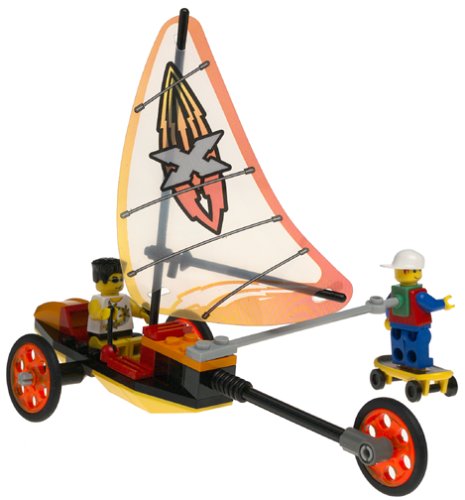
LEGO Beach Cruisers pairs a wheeled sail vehicle with a skateboard and two characters. LEGO’s instructions identify set 6734, and their sail artwork and completed model match Toysit’s original photograph. The contrast between the two vehicles gives a builder an immediate story: who takes which route, and where are they trying to go?
The model invites beach-racing make-believe. Its picture alone does not establish how well it would move under actual wind power.
Read the shape before inventing the race
The long front section, three wheels and upright sail make the cruiser visually different from the skateboard. Point to the parts that suggest a direction of travel, a place for the rider and a way to stand on the surface.
A scene can use those differences without needing a speed contest. One character could deliver a message while the other searches for a meeting place. Explain what each vehicle contributes to the story.
Separate imagined wind from observed movement
A sail is an important part of the vehicle’s appearance, but a sail-shaped toy is not automatically a working demonstration of land sailing. The actual model’s weight, wheels, surface and airflow would affect any physical test.
For story play, an arrow drawn on paper can represent wind. Say that it is part of the imagined setting. Avoid turning the old promotional race over dunes into a claim that the toy works on sand or belongs in a real street.
Let a route create the challenge
Draw a starting area, a turning point and a destination. Decide which spaces are open and which are scenery. A narrow passage or a busy meeting point can prompt a design question without changing the toy’s hardware.
The original essay about sand yachts remains available as an archival text. Its origin story is not needed to appreciate this small model, and it should be researched separately before being repeated as fact.
Design a beach route
- Draw a beach, a meeting place and two routes between the same start and finish.
- Sketch an imaginary cruiser and a skateboard. Give each one a different task.
- Add a story event: a closed path, a delivery or a character who needs directions.
- Change one route to accommodate the event and explain the decision.
This independent paper activity explores route design and storytelling. It does not recreate manufacturer race rules or require the historical set.
The historical record
Original Toysit coverage
The complete original product description and sand-yachting essay remain below. The racing language is promotional storytelling. The essay’s ancient-Egypt origin claim and broad historical account were not corroborated and should not be treated as an established chronology.
Summer lego toys.
When the water gets too cold, grab your sail and go street surfing. If you think that's too risky, try skateboarding instead. When the sun is hot and the wind is strong, Snap Lockitt hits the beach in his brand new beach cruiser. Pepper's ready to take him on to find out which is faster - beach cruiser or skateboard? It's a race over the dunes to the finish line. Includes Snap Lockitt and Pepper. Set contains 53 pieces.
The history of sand yachts, also known as land yachts or land sailers, traces back several centuries and spans diverse cultures and continents. The concept of harnessing wind power to propel a wheeled vehicle over land has ancient roots, with depictions and references appearing in texts and art as early as the Egyptian civilization. However, modern sand yachting is often credited to the late 19th and early 20th centuries, particularly in Europe, where it gained popularity as a sport. Initially seen as a leisure activity for the well-to-do, the design and technology behind sand yachts evolved over the years, incorporating innovations in aerodynamics and materials science. The sport gained more formal recognition with the establishment of governing bodies and international competitions, including World Championships. Today, sand yachting is enjoyed by enthusiasts worldwide and stands as a testament to human ingenuity in harnessing the natural elements for sport and recreation.
Sources and editorial notes
LEGO’s official 6734 building instructions were downloaded and visually checked against the original image, including the cover, completed sail vehicle and alternate-model diagrams. They support the set identification and physical design. The original character names and 53-piece statement remain in historical coverage. No wind propulsion, speed, terrain suitability or surviving set was tested. The route activity is an independent Toysit prompt.
- LEGO Beach Cruisers 6734 instructions — Official illustrated guide; original sail and model artwork matched.
Images and descriptions are retained as historical material. How Toysit covers toys.
Created for Toysit by Tabbloza — the artwork in our header.