
From the Toysit archive
LEGO Flat Gray Base
Use a LEGO gray baseplate to plan a scene’s footprint, entrances and routes, with a paper layout activity and corrections to the archived LEGO timeline.
The play at a glance
Give a building scene a place to begin
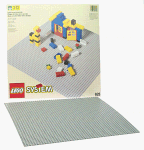
A baseplate gives separate buildings and figures a shared space. Toysit’s original account describes a light gray, fifteen-by-fifteen-inch flexible LEGO base. Its most useful role in a scene is organizational: deciding what fits, what connects and where the open spaces should stay.
Plan the footprint before building upward. A doorway needs room outside it, and a vehicle route needs more than a line on a sketch.
Work from footprints to routes
Place or sketch the outlines of the largest parts of a scene first. Decide which side is the entrance and leave a connected route to it. A building that fits on the plate can still crowd the space needed to play around it.
Reserve an empty area for something not yet built. It can become a park, a meeting place or an extension. Open space is a design choice, not necessarily a gap that needs more bricks.
A building surface and a carrying tray do different jobs
The old review describes the plate as flexible and also praises moving large creations on it. Flexibility matters: holding buildings in a planned arrangement does not make a thin plate a rigid tray or establish how much weight it can carry.
Keep the scene on a stable supporting surface while arranging it. If it must move, consider moving sections separately or supporting the whole layout from beneath; do not treat the edge of an old plate as a carrying handle. Exact fit and condition depend on the pieces in front of you.
Corrections to the archived timeline
The preserved history below groups Technic and Harry Potter into the 1990s and Friends and NINJAGO into the 2000s. LEGO’s own records give different launch dates:
- LEGO Technic: 1977.
- LEGO Harry Potter: 2001.
- LEGO NINJAGO: 2011.
- LEGO Friends: 2012.
These corrections concern the separate historical essay. They do not date the baseplate pictured on this page, and the essay’s remaining broad claims should not be treated as a complete verified chronology.
Plan a scene’s footprint
Draw a large square on paper. Add three smaller outlines for a home, a workshop and a meeting place. Mark an entrance on each and connect them with routes that do not cross through buildings.
Now add one new requirement: a delivery vehicle needs to reach the workshop. Redraw a route or move a building to make room. Explain what changed and why. This independent layout exercise needs no baseplate and is not a scale plan for set 628.
The historical record
Original Toysit coverage
The full original baseplate description and LEGO timeline remain below. The timeline places several themes in the wrong decades; corrections appear above it. The old claims about carrying elaborate models and compatibility are retained as historical wording, not guarantees for an unknown surviving plate.
Each durable baseplate forms a solid base for all your Lego building bricks.
This light gray 15-by-15-inch Lego base plate makes a great foundation for all kinds of fascinating Lego creations. Lego pieces snap easily onto the textured surface of this flexible plastic board, which is large and sturdy enough to support even your more elaborate scenes: space stations, launch sites, castles, forts, and cities--whatever you can imagine. The base plate holds your Lego creations together and makes them easy to move around and display. (Lego pieces are sold separately.) Mammoth creations like skyscrapers or enchanted castles do much better with a baseplate foundation. Each durable baseplate forms a solid base for all your Lego building bricks.
Brief History of LEGO
- 1932: LEGO was founded by Ole Kirk Christiansen, a Danish carpenter, in Billund, Denmark. Initially, the company produced wooden toys and household items.
- 1949: LEGO began producing plastic toys, including a predecessor to the LEGO brick called Automatic Binding Bricks.
- 1958: The modern LEGO brick design was patented, featuring the unique interlocking tube system that provides a more stable connection between bricks.
- 1968: The first LEGOLAND theme park opened in Billund, Denmark, attracting visitors from around the world.
- 1978: Introduction of LEGO Minifigures, adding characters and storytelling elements to LEGO sets.
- 1980s: Expansion into educational products and video games, broadening LEGO's reach into schools and digital platforms.
- 1990s: Introduction of themed sets like LEGO Star Wars, LEGO Harry Potter, and LEGO Technic, collaborating with popular franchises.
- 2000s: Continued growth with the launch of LEGO Friends, LEGO Ninjago, and the LEGO Architecture series, appealing to diverse audiences.
- 2014: Release of "The LEGO Movie," a major box office success that further cemented LEGO's cultural impact.
- Present: LEGO continues to innovate with new themes, digital experiences, and educational initiatives, maintaining its position as one of the world's leading toy manufacturers.
Sources and editorial notes
The original source and small packaging GIF are retained. The package appears to carry 628, but the exact edition was not independently matched; no specifications from modern baseplate 11024 were substituted. LEGO’s official company-profile timeline was visually checked on PDF pages 13–14 for Technic, NINJAGO and Friends. Its official Harry Potter history supplies the 2001 launch date. No plate, attachment strength or completed model was physically tested.
- LEGO Group company profile and history timeline — Official PDF; pages 13–14 support the corrected Technic, NINJAGO and Friends dates.
- LEGO’s history of its Harry Potter sets — Official account identifies the theme’s launch in 2001.
Images and descriptions are retained as historical material. How Toysit covers toys.
Created for Toysit by Tabbloza — the artwork in our header.