
From the Toysit archive
Magic Rattle Pooh
Meet the earlier Magic Rattle Pooh with his red shirt and colorful rattles, explore the wobble-and-music idea, and try a caregiver-led rhythm story.
The play at a glance
A small rattle gives Pooh his cue
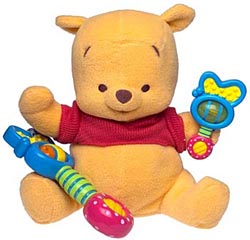
Pooh sits in a short red shirt, holding a bright blue-and-yellow rattle. A larger, matching-style rattle rests in front of him, its handle striped with cheerful colors. Magic Rattle Pooh connects that familiar shaking action with the bear’s wobbling movement, lights and music.
A matching pair in different sizes
The little rattle in Pooh’s hand and the larger one for the player make the picture feel like a shared activity. Mattel’s earlier model description pairs a shake of the rattle with Pooh’s wobble, light and melodies. The appeal is easy to picture: a small action beside a familiar bear brings a visible and audible response.
The original account describes the bear’s rocking body and moving head in more detail. Its observations remain below, preserving how Toysit introduced the toy when it was new.
Leave room for a pause
Try a simple caregiver-led rhythm beside a suitable rattle and a plush companion. Make a brief shake, then pause together and listen. Follow the child’s attention: the next moment might be another sound, a smile, a look toward the bear or a change of activity.
The pause belongs to this suggested shared game. For the electronic Pooh, use the instructions that match the model label for setup and operation. A caregiver should stay with the child during play and use an intact, age-appropriate rattle.
A tiny story can fit between sounds
Imagine that a drawn Pooh is listening for a visitor at his door. A short rattle sound might introduce a bird, followed by a pause while the caregiver gives the visitor a name. Another sound could announce a friend carrying a pretend picnic basket.
Keep the story as short as the moment invites. A greeting and a farewell can be a whole visit. An older sibling or adult can draw the characters on a page and point to them while narrating.
Draw a start-and-pause story
- Divide a page into two panels.
- In the first, draw a bear hearing a visitor arrive.
- In the second, draw the bear pausing to listen.
- Choose a visitor and add a short greeting.
- An adult can narrate the panels with a brief, gentle rattle sound followed by a pause.
This original activity works with a suitable rattle and an ordinary plush bear, or as a narrated drawing. The caregiver handles the page and follows the child’s interest.
The historical record
Original Toysit coverage
The original toy description and broader character or play discussion are preserved below as historical coverage.
Pooh wobbles when the rattle shakes.
Not just an adorable plush, babies will be mesmerized as their friend Pooh magically wobbles whenever they shake their rattle. Pooh also lights-up and plays soothing melodies. Shake, rattle, and wobble. Sitting 10 inches tall, Magic Rattle Pooh is a young likeness of the honey-loving bear, right down to his too small red T-shirt. In his left hand he holds a small plastic rattle, a miniature of the one included for tots. When the child shakes the rattle in front of Pooh, a motion sensor detects the movement and causes the bear to react. Pooh's rattle lights up, his head rolls from side to side, his body rocks back and forth, music plays, and he babbles in words that only a toddler would comprehend. The same effect happens when hands pick him up, drop him, or just jiggle him around. Bonuses are that he never topples over, the volume level isn't deafening, the actions and sound are pretty cute, and he's surprisingly huggable. Magic Rattle Pooh shuts off once small hands stop moving the rattle (or Pooh himself), or he can be manually turned off by a switch on the covered battery box. Batteries are included.
Winnie the Pooh has been a beloved figure for generations, capturing the hearts of little kids with his simple wisdom, lovable personality, and adventures in the Hundred Acre Wood. At the core of Pooh's appeal is his relatability; he embodies traits like friendship, kindness, and curiosity that resonate with young children. The uncomplicated storylines focus on universal themes like love, bravery, and the importance of community, providing life lessons in a gentle, digestible manner. Pooh's straightforward and sincere way of looking at the world aligns closely with a child's perspective, making it easy for them to identify with him. The other characters in the series, like Tigger, Piglet, and Eeyore, each offer their own unique qualities that children can either relate to or learn from. Whether it's the joy of discovering 'hunny' pots or the excitement of embarking on a new adventure, Winnie the Pooh taps into the simple joys of childhood and the essence of what it means to be young at heart.
Sources and editorial notes
Mattel’s 94859 record and photograph support the earlier rattle design pictured here and its wobble, light and melody response. The later C0143 record and complete one-page guide were also reviewed for comparison; they show a different rattle and document tummy activation. The new profile follows 94859 and leaves those later controls with their own edition. A matching 94859 manual remains unrecovered, and the original motion-sensor explanation is retained as historical wording rather than a verified mechanism. The activity is original; no physical testing was performed.
- Mattel: Magic Rattle Pooh, 94859 — Earlier model record and photograph reviewed; basis for this profile.
- Mattel: Magic Rattle Pooh, C0143 — Later model record and different rattle photograph reviewed for comparison.
- Fisher-Price: C0143 instruction sheet — Complete one-page later-edition guide reviewed for comparison; its controls are specific to C0143.
Images and descriptions are retained as historical material. How Toysit covers toys.
Created for Toysit by Tabbloza — the artwork in our header.