
From the Toysit archive
Matchbox Programmable Block Dump Truck
Plan a four-position command sequence with the older Matchbox truck, predict its route and change one block to compare the result.
The play at a glance
The order in the truck bed becomes the route
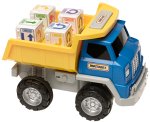
This Matchbox truck uses physical command blocks in four positions in its bed. A child can arrange a sequence, predict the result and press the Go bar to see the truck carry it out.
The matching manual makes an important distinction: the truck follows the order marked in its bed, not the order in which the blocks were loaded. Its return trigger responds to a loud sound rather than recognizing a particular spoken phrase.
Read the positions before pressing Go
Look at the order marked in the bed and identify the available command blocks. Arrange them by the sequence you want the truck to perform. Say the planned steps aloud before starting, using the commands actually shown on your blocks.
The manual says that leaving positions empty can introduce random movements; an empty bed also produces a random driving pattern. For a comparison between two planned sequences, use all four positions rather than treating an empty position as a stop command.
Give the route room to happen
Choose a clear floor area away from stairs or edges and keep hair away from the wheels. Place an imaginary delivery point beside the route rather than building a hard obstacle for the moving truck to strike.
Press the Go bar and watch from the side. Compare each movement with the step you predicted. Treat a turn as part of this toy’s actual movement, not a promise of a particular angle or exact travel distance.
Change one block and compare
After the truck stops, return it to the same starting place and direction. Change one command, then predict which part of the journey will differ. Run the revised sequence and look for that difference.
Keep the other blocks and the starting conditions the same as far as practical. If several things change at once, it becomes harder to tell which change explains the new route. This is a simple sequence-and-revision activity; it does not require a claim that the truck supports loops or conditional instructions.
Understand the return cue
According to the 96522 guide, the return cue is available after the fourth command and the air-brake sound. It responds to a loud sound, so the words “Come back” are not a voice command that the truck understands. Leave the area clear for further movement.
For a short story, let the truck finish a delivery and then return for another job. Turn it off when play ends. If an older unit behaves unexpectedly, identify the model and check its condition and matching guidance before assuming that changing the program will fix it.
The historical record
Original Toysit coverage
The original product paragraph and full programmable-toy essay remain below. The older reference to shouting “Come back!” describes an example sound, not speech recognition. The general essay’s loops, conditionals and other vehicle features are not established capabilities of this truck.
Dump truck follows sequence that kids program in.
What kid wouldn't want to get behind the wheel of a big rig like this? With a clever set of blocks used for programming, aspiring construction workers can send this rugged, foot-long bruiser through any combination of four different commands, including turn right, turn left, turn around, go straight, make a circle, and empty the truck bed. Kids put the 1.5-inch plastic blocks in sequence using four slots in the dump truck's 7-inch-wide bed. Then just press a button on the cab to make the dumper execute its program with cheerful, step-by-step narration (Turn right... Dump it out!). When the program is complete, shout Come back! to make the truck work backwards through its program. Safety note: keep hair away from wheels.
Programmable toy vehicles offer an extraordinary blend of play and education, allowing children to delve into both imaginative storytelling and foundational coding concepts. These toys enable kids to pre-program specific routes and actions, whether it's navigating an obstacle course, performing a series of stunts, or even simulating real-world tasks like firefighting or garbage collection. The joy comes from seeing a vehicle accurately execute a series of commands—turn left, pause, spin, go straight—providing immediate feedback and a sense of accomplishment. It's a hands-on introduction to logical thinking, sequence planning, and even basic programming principles like loops and conditionals.
Sources and editorial notes
Reviewed October 15, 2026 against the original image and text and Mattel’s 96522 instruction sheet. The guide documents four bed positions, the Go bar, fixed position order, random behavior when positions are empty and the sound-triggered return after the fourth command and air-brake sound. Its battery notes are internally inconsistent, so no battery specification is reproduced here. Use the actual unit’s markings and manufacturer support to resolve power requirements. No physical truck was tested.
- Mattel: Matchbox Programmable Block Dump Truck, 96522 — Product identification and manufacturer instruction reference.
- Mattel: 96522 instruction sheet (PDF) — Original controls and sequence behavior; see the editorial note about conflicting battery text.
Images and descriptions are retained as historical material. How Toysit covers toys.
Created for Toysit by Tabbloza — the artwork in our header.