
From the Toysit archive
Mazes: Make a Route, Then Make a Choice
Design a path, add a tempting turn and invite another player to solve it. Explore maze choices with an original paper activity and retained historical coverage.
The play at a glance
The next turn is part of the fun
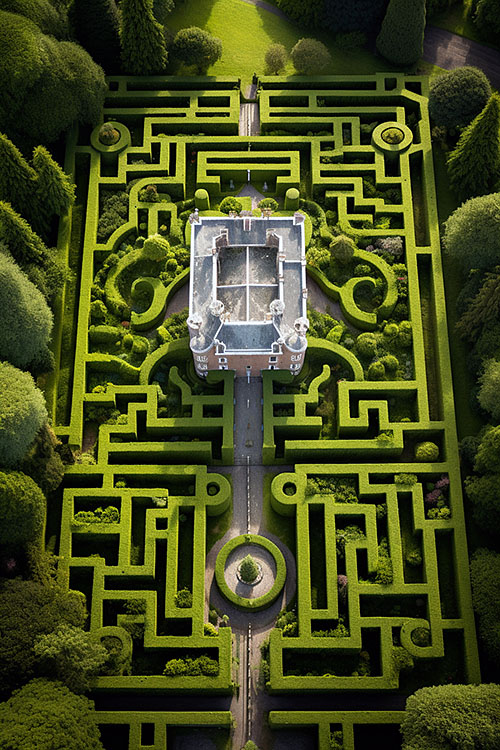
A path slips between green hedges, bends out of sight and divides. One branch might lead closer to the destination; another might bring the traveler back to a familiar corner. The garden scene above captures that invitation to choose, explore and try again.
A paper maze puts those choices in your hands. First you make a route that works. Then you decide where another player will pause, wonder and change direction.
A path to follow, a choice to make
A useful design distinction is between a route that branches and a route that leads continuously toward a center. Historic Royal Palaces describes Hampton Court’s hedge maze as a branching puzzle, or multicursal maze, and contrasts it with single-path, or unicursal, designs. Those words give a player something concrete to look for: where can the traveler choose?
Hampton Court’s maze was commissioned around 1700 by William III and designed by George London and Henry Wise, according to the palace’s account. It is one specific historical example of turns and dead ends becoming a garden attraction. The image on this page supplies a garden setting for imagination; the paper game below lets you invent your own route.
Try this: route designer and tester
This original Toysit activity uses paper and a pencil. Imagine a small delivery traveling from a garden gate to a picnic spot.
- Lay out the garden. Draw a five-by-five grid of roomy squares. Mark an entrance in a square along one edge and a destination along another edge. Treat the grid as a drawing guide, not as walls.
- Make the working route first. Draw a continuous line from the center of the entrance square to the destination, moving through neighboring squares. Keep the line clear of itself so a crossing will not create an accidental shortcut.
- Add two tempting branches. From two places along your route, draw short side paths into unused squares. Finish each at a dead end. Keep them apart from the main route and each other.
- Invite a tester. Another player traces along the lines with a finger, starting at the entrance. Ask them to point to the first junction that made them hesitate.
- Change one choice. Erase and redraw one branch, then try the route again. Did the new bend make the destination easier to predict, or did it create a more interesting detour?
For a smaller challenge, use a three-by-three grid and one branch. For a story version, give the dead ends names: the fountain, the sleeping dragon’s bench or the locked greenhouse. Reaching one can become a discovery in the journey.
Keep a maze maker’s notebook
Save the first drawing beside the revised one. Circle the junction you changed and give both versions a title. A clear maze earns its puzzle from understandable choices: the player can see which marks are paths and where each path ends. When the drawing is easy to read, the interesting question becomes which way to go.
The historical record
Original Toysit coverage
The complete earlier history follows, retaining its September 3, 2023 date. Its broad origin and cultural claims are part of the historical account; the newly sourced example and play activity appear above.
History of Mazes
The history of mazes is a fascinating journey that spans continents, cultures, and millennia. Mazes and labyrinths have been a part of human civilization for thousands of years, with the earliest known examples dating back to the Bronze Age. The original purpose of these intricate designs varied; they were used as traps for game, for ritualistic and religious ceremonies, or as intricate forms of artwork. Some of the most ancient mazes are found in the form of petroglyphs or etchings on walls and floors of caves, indicating their cultural significance in prehistoric communities.
The classical labyrinth, a single, non-branching path that leads to the center and back, is often associated with the myth of the Minotaur from Greek mythology. In this story, the labyrinth was a complex construct designed by Daedalus to imprison the Minotaur, a creature that was half-man and half-bull. The concept of the labyrinth evolved over time to mean not just a single-path maze but also complex branching mazes, often designed to baffle and confuse. During the Medieval period, labyrinths were frequently incorporated into the designs of churches and cathedrals, like the famed Chartres Cathedral in France, symbolizing a pilgrim’s journey towards spiritual enlightenment.
By the Renaissance, mazes started to appear in gardens as a form of leisure and entertainment for the aristocracy. Hedge mazes, in particular, became a staple of grand European gardens. The 18th and 19th centuries saw a revival in maze design, with innovations like the inclusion of traps, dead ends, and puzzles to challenge participants. In modern times, mazes have found new life in various forms—cornfield mazes, mirror mazes, and even digital mazes in video games.
Today, mazes continue to fascinate and challenge people of all ages. Whether used for entertainment, educational purposes, or psychological studies, mazes serve as a compelling symbol of life's complexities, offering both challenges and rewards for those who dare to navigate their intricate paths.
Sources and editorial notes
Historic Royal Palaces supports the Hampton Court example and its distinction between branching and single-path designs. The archive’s claims about prehistoric origins, game traps and a universal historical sequence have not been established by that source. The retained garden image has no verified location identification. The paper activity is an original Toysit suggestion.
- Historic Royal Palaces: The Maze — Institutional account of Hampton Court’s design and history; relevant history and terminology reviewed.
- Original Toysit coverage — Complete substantive text, recorded dates and historical illustration retained.
Images and descriptions are retained as historical material. How Toysit covers toys.
Created for Toysit by Tabbloza — the artwork in our header.