
From the Toysit archive
Meow-Chi
Explore Meow-Chi’s sensors, expressive eye patterns and Robo-Chi play, with preserved original coverage and a simple observation diary.
The play at a glance
A robot cat whose eyes help tell the story
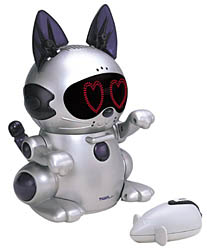
Meow-Chi turns small movements, sounds and changing eye patterns into a cat character. Toysit’s original photograph shows a silver version beside its mouse accessory.
Its display makes a good starting point for observation: first describe the pattern you see, then the action you hear or watch, and only then the personality you imagine.
Five inputs, different jobs
The guide distinguishes light, sound and touch sensors from a magnetic input for the mouse accessory and an infrared input for compatible Robo-Chi interaction. They do not all detect the same kind of event.
A response to a noise should not be described as understanding a sentence. Similarly, the mouse is a toy accessory that supplies a cue, rather than food or an object the cat has independently recognized as prey.
Read the eyes as a display
The guide illustrates hearts, downturned shapes and other patterns. It also charts eight “biorhythm” levels that influence the balance of responses.
These are useful descriptions of a toy’s changing states. They do not mean that an electronic cat is growing biologically or experiencing the feelings its eyes suggest. You can enjoy the character while keeping the display and the story distinct.
Which pets belong in the conversation?
The manual’s compatibility note names Robo-Chi Pets carrying the interactive-family logo and includes Poo-Chi dogs with or without that logo. It is a qualified family connection, not a promise about every robotic pet.
If you are identifying a surviving collection, match the model and its guide first. A shared cat or dog shape is not enough to establish electronic compatibility.
Keep an eye-pattern diary
- Draw three pairs of eyes using dots, curves or simple shapes.
- Under each drawing, describe only the marks: two curves, two circles, or two hearts.
- Add an imagined movement or sound in a second column.
- Give the combination a story meaning in a third column.
- Invite another player to supply a different interpretation without changing your drawing.
Use your own symbols rather than trying to reproduce the toy’s full display chart. With a working Meow-Chi, a separate observation log can record an actual cue, visible pattern and action without guessing an internal state.
The historical record
Original Toysit coverage
The full original text remains below. Its opening calls the cat black, while the retained photograph shows a silver body. Growth and feelings refer to designed toy behavior. The later general claims about emotional intelligence and being a real-pet substitute are original commentary, not demonstrated benefits.
Meow-chi robotic kitten is lots of fun.
This high-tech black robokitty will grow up right before your eyes, much like the popular Tamagotchi or Furby. Meow-Chi grows from a mewling kitten with a high-pitched cry to an adult cat with a lower-register meow. Like most kittens, Meow-Chi requires a lot of attention and play when it first comes home. To play with Meow-Chi, just activate one or more of its five sensors. Clap to activate the sound sensor, and turn on or off the lights to activate the light sensor. Hold Meow-Chi's toy mouse near or press one of the touch sensors, and Meow-Chi will react. Depending on what sequence these stimuli occur in, Meow-Chi will wiggle ears, paws, and tail, sing songs, and make other adorable noises. Meow-Chi's eyes are little LED lights that form different patterns when the kitty gets tired, or is sad or happy. The eyes will also show a pattern that tells if Meow-Chi is a girl or a boy. Meow-Chi can communicate with Poo-Chi or another Meow-Chi by singing songs with it, or, if they don't get along, by speaking unhappily (and unintelligibly) with it.
The Meow-Chi robotic kitten offers a delightful blend of technology and affection, making it an irresistible companion for children and even adults. Modeled to mimic the behaviors of a real kitten, Meow-Chi captures hearts by responding to touch, light, and sound stimuli with endearing actions like purring, meowing, and blinking its expressive eyes. Its ability to display a range of "emotions" through different vocalizations and movements gives the toy a sense of personality and makes interaction feel genuine. This not only fuels a child's imagination for play but also fosters emotional intelligence as they learn to interpret the Meow-Chi's needs and moods. With no litter boxes to clean or allergies to worry about, Meow-Chi provides the joys of pet ownership without the responsibilities, making it a perfect first "pet" or a companion for those unable to have real animals. Its charming antics and interactive features make the Meow-Chi robotic kitten a hit across generations, offering a lovable experience that merges the cuddly appeal of a pet with the thrill of modern technology.
Sources and editorial notes
Both pages of the Tiger Electronics/Sega Toys Meow-Chi guide were visually reviewed, including the sensor map, eye symbols, biorhythm charts and compatibility footnote. The drawing matches the pictured model. No toy, sensor sequence or inter-pet communication was physically tested. The diary is an independent drawing activity.
- Meow-Chi instruction manual — Tiger Electronics/Sega Toys manufacturer scan preserved by The Old Robots.
Images and descriptions are retained as historical material. How Toysit covers toys.
Created for Toysit by Tabbloza — the artwork in our header.