
From the Toysit archive
Geometric Sorting Board
Match shapes, count holes and turn a piece to fit: a practical play guide to the wooden geometric board in Toysit’s archive.
The play at a glance
A shape gives you more than one clue
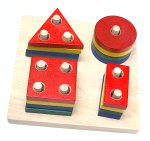
A circle, rectangle, triangle and square each have a place on this wooden board. Their holes add another clue: the player can compare how many there are and how they line up with the pegs.
Start with one piece and one space. Looking, turning and trying again can be the whole activity; filling the board is an optional next step.
Look, line up, then lower
Place the board on a stable surface and choose a loose piece. Look at its outside shape, then count its holes by pointing to each one. Compare that arrangement with a group of pegs before moving the piece over them.
Lower the piece gently. If it stops, lift it clear and turn it before trying again. A matching number of holes is a useful clue, but the holes also need to line up. Pressing harder does not fix a different orientation.
The pictured arrangement pairs a circle with one peg, a rectangle with two, a triangle with three and a square with four. Name the shape after noticing it together; the child does not need to remember every name before exploring the fit.
Change one sorting rule
- Sort by shape
- Put loose pieces with the same outline together. Keep them beside the board before deciding where they fit.
- Sort by color
- Gather one color, even when the shapes differ. Ask what stayed the same and what changed.
- Sort by holes
- Count the holes on one piece and find another with the same count.
- Copy an arrangement
- Make a short row of loose pieces beside the board. Invite a partner to repeat its shape or color rule.
Say the rule at the start. If the aim changes halfway through, explain the change rather than treating the previous answer as wrong. Use only enough pieces to make the pattern visible.
Make the next attempt manageable
For an easier start, offer two possible places instead of the whole board. Hold the base steady while the player handles the piece. A useful hint is “look at the holes” rather than immediately putting it in the correct place.
For a different challenge, ask the player to predict the fit before trying it, or explain why a piece needs turning. Speed is unnecessary. Taking a piece off and putting it back can be a satisfying repeatable task.
End with a reset: group the loose pieces, return them to the board and describe one clue that helped. This gives a short session a clear finish.
Identify and inspect an older board
The archive names both Small World Toys and Plan; the current PlanToys 2403 record offers a close design comparison. Keep the label on the actual set as the authority for its age guidance and care. Similar-looking boards can differ in size, finish and construction.
Check the pegs, wooden edges and pieces before play. Set aside damaged or loose components, and use the pieces on the board or flat play surface. The small original photograph is retained as identification evidence, not a promise about the condition or completeness of a surviving set.
The historical record
Original Toysit coverage
Both original product descriptions are retained below, including their Small World Toys and Plan attributions and award wording. Their developmental promises, finger-fitting suggestion and balancing suggestions are historical copy, not instructions for the activities above.
Geometric Sorting Board by Small World Toys
Sorting board with 4 different wood shapes. Each shape has 4 bright, colorful pieces for children to match to the correct shape and corresponding wood pegs. Children are endlessly taking things apart and putting them together, only to pull them apart again. This ageless game is capitalized upon by the award-winning Geometric Sorting Board. It focuses on attention-getting, easily grasped shapes that come in four colors. The challenge is to find which shape fits on which set of pegs. The circles have one hole, the rectangles two, the triangles three, and the squares four. They are perfectly sized to fit on a finger, too. Making different color patterns, counting, or stating the color before putting it on the 7-inch square wood base adds interest as your child develops a skill.
Note: Winner of the Good Toy Award from Parent magazine. Color, shape, and number are all part of the curriculum for this prize-winning wooden sorting board by Plan. Toddlers and preschoolers will find the painted wooden shapes easy to grasp and manipulate. Rotating the shapes and fitting them onto the pegs will enhance fine motor development. Matching the holes in each shape to the corresponding pegs, children will be able to sort by number and shape (circles have one hole; rectangles two; triangles three; and squares four). Or they can use the solitary peg (or no pegs at all) to sort by color. All shapes except for the circle can be fitted onto random pegs, one or two holes at a time, so they're conducive to all sorts of imaginative play. As visual and motor coordination improve, children may want to rotate the shapes so they can balance and stack them on top of the pegs.
Sources and editorial notes
Reviewed October 16, 2026 using the original source, photograph and PlanToys’ Geometric Sorting Board 2403 product record. Its four-shape, four-color design corresponds to the archived board, but the photograph does not establish the original retail package or resolve its distributor attribution. Modern age labels and material specifications have not been transferred to the older toy. Activities are editorial suggestions; no physical set was tested.
- PlanToys: Geometric Sorting Board 2403 — Manufacturer description of the four shapes and hole-count matching; a design comparison, not confirmation of the original retail edition.
Images and descriptions are retained as historical material. How Toysit covers toys.
Created for Toysit by Tabbloza — the artwork in our header.