
From the Toysit archive
My Beautiful Ballerina
Explore My Beautiful Ballerina’s pink costume, ballet-school setting and turning play, then create a miniature recital program.
The play at a glance
A pink tutu and a ballet barre set the scene
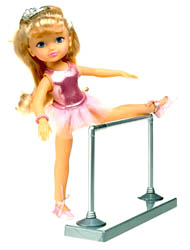
My Beautiful Ballerina stands beside a green-gray barre, one leg raised and an arm extended. Her shiny pink bodice, pale tutu and small tiara give her the look of a performer preparing for a recital. The little practice setting makes it easy to imagine the moments before the curtain rises.
A turn becomes the center of a performance
Toysit’s original account describes helping the doll spin with a fingertip and pressing the ballet support to hear music. Those two ideas give the set its performance theme: a visible turn accompanied by a tune. The photograph shows the doll and barre together, with her costume ready for the imagined stage.
A player can give that moment a beginning and an ending. Perhaps the dancer enters a garden theater, pauses for the audience and finishes with a bow. The setting, characters and narration belong to the story the player creates.
Choose a costume detail for the story
The tiara could suggest a royal celebration; the pink costume might inspire a flower-themed recital. A drawn backdrop can carry the same color into the scene through roses, ribbons or a sunset. One repeated detail helps the little performance feel like a complete occasion.
Invite a toy guest to introduce the dancer. Give the guest a program with the title of the performance and a picture of its setting. Afterward, the guest can describe a favorite moment in the imagined show.
Make a three-scene recital program
- Fold a sheet of paper and give the recital a title.
- Inside, draw three boxes: an entrance, a turn and a bow.
- Add a backdrop detail that appears in each scene.
- Choose a narrator to introduce the performance.
- Tell the recital with drawings or paper characters, then invent the audience’s response.
This original activity works as a paper performance. For an existing doll, follow its matching guide for supported poses and movement.
The historical record
Original Toysit coverage
The original toy description and broader play discussion are preserved below as historical coverage.
Ballerina Doll
She's your very own ballerina to dress up and love. Dress her up, style her hair, and with a touch of your finger help her to do real spinning pirouettes in her realistic ballet school environment. Press down on the ballet beam to hear and dance to enchanting ballet music. You can choreograph real dance numbers. Includes how to ballet book for hours of fun.
The history of ballet dates back to the Italian Renaissance courts of the 15th and 16th centuries, where it began as an elaborate form of court entertainment. It was Catherine de' Medici, an Italian noblewoman and the Queen of France, who played a significant role in bringing ballet to France, where it gained more formal structure. The establishment of the Académie Royale de Danse in 1661 by King Louis XIV marked a pivotal moment, institutionalizing ballet as an art form and leading to the creation of professional dancers. Ballet subsequently spread throughout Europe, notably taking root in Russia, where it experienced significant development and gave birth to many of the classical ballets we know today, like "Swan Lake" and "The Nutcracker." Over the years, ballet evolved from a courtly performance intended to showcase the elegance and etiquette of the aristocracy, to a highly technical form of dance with its own vocabulary. In the 20th century, it further diversified, giving rise to contemporary ballet and other forms that experiment with movement, narrative, and performance space. Today, ballet is a global art form that continues to captivate audiences with its beauty, storytelling, and technical prowess.
Sources and editorial notes
The retained photograph and Toysit’s original description support this profile. The earlier account describes finger-guided spinning, music from the ballet support and a supplied ballet book. Complete matching manufacturer instructions remain unrecovered, so fitting and operating steps should come from the set’s own guide. The recital program is an original editorial activity; no physical testing was performed.
Images and descriptions are retained as historical material. How Toysit covers toys.
Created for Toysit by Tabbloza — the artwork in our header.