
From the Toysit archive
Pikmin 2 — GameCube
Picture Pikmin 2’s tiny explorers, oversized treasures and divided teams, then plan an original paper museum move with two leaders.
The play at a glance
Everyday objects become enormous discoveries
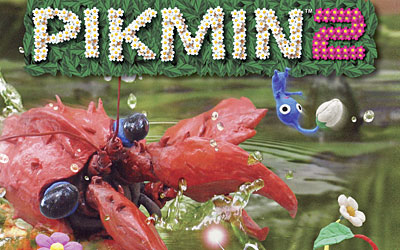
A leaf becomes a landscape when the explorers are only a few steps tall. The original Pikmin 2 artwork places bright little plantlike creatures among broad leaves, making the world feel both familiar and immense. Olimar and Louie’s salvage expedition turns that change of scale into a game of finding things, organizing helpers and choosing a route home.
Plan the journey as well as the discovery
The tiny viewpoint gives an ordinary found object a second identity: something to investigate, carry and fit into an expedition’s plan. A player might pause at a promising treasure and think about the journey back before sending the team forward. The route matters as much as the destination.
Olimar and Louie allow the expedition’s work to be divided between two leaders. Nintendo’s original GameCube site describes sending them on separate tasks. The surface has daylight that runs toward sunset, while the day clock pauses in caves. The earlier account’s “no time limits” wording concerns the overall expedition, not an absence of every timer.
For shared play, the game has separate modes: Challenge Mode can be played alone or cooperatively by two people, and 2P Battle pits two teams against one another. These are distinct from controlling the leaders during the main expedition.
Try a tiny-team museum move
Draw three everyday objects as enormous museum exhibits: perhaps a spoon as a silver bridge, a button as a round plaza and a leaf as a green sail. This is an original paper activity with invented jobs, rather than a recreation of the game’s Pikmin abilities.
- Draw a museum doorway and three display spaces. Place the exhibits outside on your map.
- Invent three teams: route finders, label makers and carriers. Give each team a symbol and one clear job.
- Choose two leaders. One plans the first exhibit’s journey; the other prepares its destination and label. Explain how their jobs connect.
- Trace the move with a pencil, naming which team is needed at each step. Give the exhibit a museum label that describes what a tiny visitor thinks it is.
- Make the doorway narrower on a second drawing. Replan one move: turn the exhibit, choose another entrance or change the display location.
Two people can take the leaders’ roles, or one person can draw both plans. Finish with a museum tour in which the narrator explains one change that made the move work. The fun comes from seeing a familiar object at a surprising scale and giving every helper a useful part.
The historical record
Original Toysit coverage
The complete earlier product account and commentary are preserved below as historical coverage.
Mass strategy game sequel release for Nintendo GameCube has puzzle-solving action options in a world of plant-like creatures
The Pikmin series, developed by Nintendo, has garnered significant success since its inception in 2001 for the Nintendo GameCube. Designed by legendary game designer Shigeru Miyamoto, the same mind behind iconic franchises like Super Mario and The Legend of Zelda, Pikmin brought a unique blend of real-time strategy and puzzle-solving elements to the gaming landscape. Players control a tiny space explorer who must work with native plant-like creatures called Pikmin to navigate through various environments, solve puzzles, and combat foes. The series has received critical acclaim for its charming graphics, intricate level design, and innovative gameplay mechanics, which involve commanding armies of Pikmin to complete tasks collaboratively. With multiple sequels and spin-offs, including releases on the Wii, Wii U, and Nintendo Switch, the Pikmin franchise has solidified its status as a beloved part of Nintendo's game library.
The Pikmin look a little like garden plants, but a single whistle mobilizes a multitude of Pikmin to gather treasure and solve puzzles.
The only place these tiny, hard-working creatures can be found is in Pikmin 2, a unique video game made only for Nintendo GameCube that launches this week. In this mass-strategy sequel, Captain Olimar and his assistant, Louie, must find valuable objects to save their company. They enlist hordes of Pikmin to help.
"With a new character to control and new kinds of Pikmin, players will experience twice the action in this one-of-a-kind adventure," says George Harrison of Nintendo. "The inclusion of brand-name products, a first for Nintendo, means players will find unique value in the familiar items they uncover through the game."
Pikmin 2 improves on the original in every way. Players can switch control between Olimar and Louie to expand the action and find new ways to solve puzzles. They also will encounter two new types of powerful Pikmin.
Unlike the first version, the game has no time limits, so players can fully explore the world of the Pikmin at their own pace. Time even stops when players enter the new cave environments, but the underground areas offer their own tactical challenges: Players can't grow new Pikmin there, so they must marshal their forces strategically. Pikmin 2 has a new split-screen mode that lets two players compete to see which of the Pikmin armies has the most skillful commander.
Best known for video game characters like Mario and Donkey Kong, Nintendo game developer Shigeru Miyamoto created the engrossing world of the Pikmin. The first edition won the award for Innovation in Console Gaming. Pikmin 2 sells for $49.99.
Sources and editorial notes
The GameCube publisher page and Nintendo’s original Japanese GameCube site support this profile. The Japanese surface, cave, Challenge Mode and 2P Battle pages were reviewed in their text and image descriptions; they establish daylight and mode distinctions. A complete matching GameCube instruction booklet was not recovered, so no detailed controller sequence is offered. Wii instructions and Switch changes were excluded. The retained 2004 launch account includes its original price, quotation, branded-treasure examples and broad time-limit wording. The paper activity is an original Toysit idea; no physical game testing was performed.
- Original Toysit image — Existing same-site image reviewed and retained unchanged.
- Nintendo: Pikmin 2 for GameCube — Original platform listing identifies Olimar, Louie, new Pikmin and two-player modes. Its broad time-limit wording is clarified by the original Japanese site.
- Nintendo’s GameCube Pikmin 2 site: surface exploration (Japanese) — Original publisher image descriptions identify separate leader tasks and surface exploration until sunset.
- Nintendo’s GameCube Pikmin 2 site: caves (Japanese) — Original publisher image descriptions distinguish caves where the day clock does not advance.
- Nintendo’s GameCube Pikmin 2 site: Challenge Mode (Japanese) — Describes timed challenges for one player or two cooperating players.
- Nintendo’s GameCube Pikmin 2 site: 2P Battle (Japanese) — Describes a separate competitive mode for two players.
- Original Toysit coverage — Complete historical account retained, including its original claims and wording.

Images and descriptions are retained as historical material. How Toysit covers toys.
Created for Toysit by Tabbloza — the artwork in our header.