
From the Toysit archive
Home Depot Electronic Play Workbench
Choose a toy tool, turn a bolt and tell a repair story with the orange-and-blue workbench from Toysit’s archive.
The play at a glance
Give the tools a job
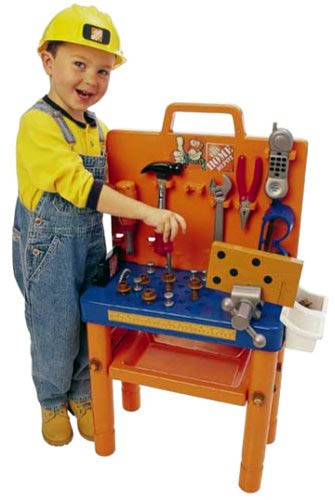
A play workbench gives a pretend repair its own place: tools hang on the back, pieces sit on the work surface and the next job can begin with a make-believe phone call. The archived photograph shows this older Home Depot-branded bench with a vise, bolts and toy hand tools.
Start with one small task, such as turning a bolt or finding the tool for a pretend repair. The story can grow from what the child chooses to do.
Try a short repair story
- Take the job: pretend a customer has called about a loose part.
- Choose a tool: point to the toy bolt or fitting and find a tool that fits it.
- Do the repair: turn the fitting, use the toy vise or hammer the intended toy pegs.
- Finish the visit: explain what changed and return the tools to their places.
Use the bench’s own toy fittings. A prop that resembles a real workshop tool is not equipment for cutting wood, driving real nails or protecting a child during real repairs.
Keep the physical play and talking features distinct
The old account describes spoken tool names, reminders about goggles and help returning tools to storage. A contemporary retailer announcement also describes talking and tool-storage prompts. These features belong to the historical electronic design; they do not establish what still works on an individual secondhand bench.
The pretend job can continue through naming tools, turning fittings and taking roles. If checking an old unit’s electronics, first locate its own maker and model markings and matching instructions. A newer Home Depot-branded workbench may have different hardware.
Make room for a helper
One player can describe the problem while another chooses a tool, then swap. A drawing of the finished repair or a small paper job ticket gives the customer something to collect. The calculator cash register can become a separate payment counter if both toys are available.
These are play suggestions. There is no need to turn each action into a lesson or expect a particular developmental result.
End with a tool check
Lay out the loose pieces, pair each tool with a storage place and put the next job’s fittings together. For an old bench, check that the structure stands securely and that the vise, fittings and hanging parts are intact before starting. Follow the unit’s own labels and instructions for its age range and electronic components.
The historical record
Original Toysit coverage
The original description and broader discussion of workbench play remain below. Tool-identification speech, reminders and the phone activity are claims from that account. Developmental benefits were not measured in a Toysit test.
The Home Depot Electronic Workbench.
The workbench provides a defined play area, which can help children focus. Playing with the child-sized tools can encourage gripping and grasping, turning and twisting, hand and finger dexterity and strength, fine motor coordination, two hands working cooperatively, and eye-hand coordination. The unit will verbally identify tools, remind the child to wear safety goggles, and help put tools back in the correct area. Fine motor skills are used when the nails are hammered, the vice is adjusted and the bolts are tightened. Satisfying sounds and clear words can promote imaginative play. Language skills can come into play as children call The Home Depot.
A play workbench can serve as an invaluable platform for sparking a child's creativity and instilling the "maker" spirit from a young age. Equipped with toy tools, screws, and wooden or plastic "building materials," these miniature workstations offer a safe and playful environment where kids can experiment, build, and fix things, much like they see adults do. This hands-on experience not only enhances their fine motor skills and understanding of how things work but also nurtures problem-solving abilities and critical thinking. By imitating real-life roles and projects, children get an early taste of the satisfaction and empowerment that come from creating and repairing, potentially sowing the seeds for a lifelong passion in engineering, crafting, or DIY projects.
Sources and editorial notes
The retained photograph and text were reviewed on October 15, 2026. A Toys’R’Us 2001 press release, preserved by Raving Toy Maniac, corroborates the Home Depot Electronic Workbench name and talking/tool-storage features. It does not establish the exact manufacturer, model revision or battery specification of the pictured unit. No physical bench was tested.
- Toys’R’Us: Hot Toys for Holiday 2001 — Archived retailer press release naming the Electronic Workbench and describing its speech and tool-storage prompts.
Images and descriptions are retained as historical material. How Toysit covers toys.
Created for Toysit by Tabbloza — the artwork in our header.