
From the Toysit archive
Pokémon Math Challenge: Grades 2–3
Pokémon Math Challenge’s Grades 2–3 cover pairs character artwork with number problems, inspiring an original three-stop number-quest exchange.
The play at a glance
A character-filled cover opens onto a number adventure
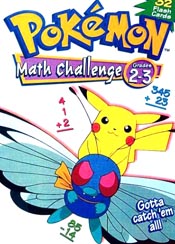
Pikachu leans into the cover beside a blue winged character, with arithmetic examples tucked around the artwork. The title, Pokémon Math Challenge, makes the invitation direct: bring the familiar world of characters to a page of number problems. The visible Grades 2–3 badge and 32 Flash Cards callout identify the pictured edition’s theme.
Turn a short problem into a place on a map
A number problem can have a tiny setting. Twelve flags and seven more might decorate a welcome gate; a delivery of twenty-four parcels might leave sixteen after eight are handed out. The arithmetic stays clear while the story gives the numbers something to count.
Choose problems that suit the player’s current comfort. An adult or companion can read the words aloud, and the solver can use drawings or tally marks to show the quantities. The grade printed on an old cover is a useful identifier; the actual task can be adjusted to the person playing today.
Exchange a three-stop number quest
Draw a trail with three stops: a welcome gate, a parcel station and a lantern garden. Give each stop one original problem. At the gate, there are 12 flags and 7 more arrive. At the station, there are 24 parcels and 8 are delivered. In the garden, 18 lanterns are joined by 6 more.
Write an answer key on a separate sheet before sharing the map: 19 flags, 16 parcels and 24 lanterns. Invite a companion to travel from stop to stop, explain how they found each answer and add a small drawing at the destination. For 24 minus 8, they might draw two groups of ten and four single marks, then show the eight being removed.
Swap roles for the return journey. The new mapmaker can choose different places and numbers, checking the answers before handing over the quest. Smaller numbers make a gentler route; larger numbers or an extra stop offer another version when the player wants it.
Let the traveler explain the route
Finish by choosing one stop and explaining its solution together. There may be several ways to show the same calculation: counting on, separating tens and ones or making a drawing. Keep the invented map and answer key together so the adventure is ready to share again. Ordinary paper is enough to make the whole quest.
The historical record
Original Toysit coverage
The complete earlier workbook description and educational-benefits commentary follow. The detailed contents remain attributed to that account, and the benefit claims are historical assertions rather than measured outcomes.
Take advantage of your child's love of Pokemon to encourage learning.
Grade 2-3 Spans problems covered in both 2nd and 3rd grades. Uses Pokemon characters and information in one and two-digit addition and subtraction problems, the harder ones requiring regrouping (carrying). Also has four sheets with 32 perforated flashcards. The back sides of these are decorated with Pokemon characters and divided into trainer and master level problems.
Pokemon-themed math workbooks and flashcards combine education and entertainment, making learning math more engaging for children. The familiar characters and themes can make math problems feel less intimidating and more relatable, encouraging reluctant learners to participate. Moreover, the integration of a beloved franchise into educational materials can provide additional motivation for kids to practice, as they associate the task with fun and their favorite Pokemon characters. The varied challenges found in the workbook or flashcards can also be seen as 'battles' or 'quests,' adding an additional layer of interest and complexity to what might otherwise be considered boring or tedious. Overall, such themed educational tools can be a beneficial supplement to traditional learning methods, aiding in the retention and application of mathematical concepts.
Sources and editorial notes
The original cover and ISBN 0307306119 identify this Grades 2–3 title. Open Library’s edition JSON links the ISBN to Golden Books and a 2000 catalog date; its source record is Amazon, and no copyright page or interior was recovered. The detailed regrouping, perforated-sheet and trainer/master descriptions remain attributed to the earlier Toysit account. A catalog date is not a Toysit publication date. The new puzzles are original editorial examples, not copied workbook exercises or evidence of learning outcomes; no physical testing was performed.
- Original Toysit image — Existing same-site image reviewed and retained unchanged.
- Open Library: Grades 2–3 edition record — Catalog JSON associates ISBN 0307306119 / 9780307306111 with Golden Books, 2000, and this title. The record cites Amazon as its source; no interior or copyright page was reviewed.
- Original Toysit coverage — Complete historical account retained, including its original claims and wording.

Images and descriptions are retained as historical material. How Toysit covers toys.
Created for Toysit by Tabbloza — the artwork in our header.