
From the Toysit archive
Pokémon Memory Game
Pokémon picture pairs turn a grid of round tokens into a shared game of noticing and remembering, plus a cooperative visitors activity.
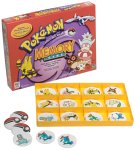
The play at a glance
Where did that Pokémon go?
A red Pokémon Memory box, a yellow tray and round picture tokens set up a game of small discoveries. Turn over two pictures and everyone gets a glimpse of the hidden arrangement. A familiar face may be waiting beside the corner you remember—or one space farther along.
Two pictures, one remembered place
The earlier Toysit account describes laying the tokens face down, turning two over on a turn and keeping an identical pair. A match earns another turn; a nonmatching pair goes face down again before the next player tries. The interesting moment often belongs to the whole table: someone reveals a character that appeared a few turns earlier, and everybody silently searches the grid in memory.
Make each reveal easy to see. Turn both tokens fully face up, pause, then return a nonmatching pair to its original positions. A description such as “the one beside the top corner” can be as useful as a character’s name. Players can enjoy the pictures while gradually getting to know the cast.
For a short introductory round, choose a few complete pairs together before mixing them. Keep the arrangement consistent, with enough space between tokens for easy turning. Add more pairs when the group wants a longer search. Agree on the round’s rules before starting.
Try returning visitors
This original Toysit cooperative variation imagines that pairs of friends are arriving for a picnic. Start with four pairs, or draw four pictures twice on eight similar paper cards. Arrange them face down in two rows of four. Draw a separate picnic blanket with four places for the reunited visitors.
- Take turns revealing two pictures. Everyone may describe where a matching visitor was last seen.
- When a pair meets, move it to the blanket and give the visitors a shared job: carrying the imaginary basket, choosing a game or telling a story.
- If the pictures differ, invent a brief greeting between those two visitors, then turn them back over in the same places.
The group finishes when all four pairs reach the picnic. Retell the arrival story using the pictures as prompts. On another round, let the finder offer just one location clue before the next reveal. Cooperation and storytelling are the rules of this variation; the original competitive account remains below for readers who want that version.
The historical record
Original Toysit coverage
The complete earlier product account and commentary are preserved below as historical coverage.
Pokemon memory game to help children learn.
Turn the Pokémon obsession into a simple but challenging memory-testing game--one that a Pokémon-crazy child of 5 can understand, but also one that a Pokémon-challenged granny can enjoy. There are 48 cardboard tokens, each 2 inches in diameter. Lay them out face down in a grid, then take turns turning two of them face up. Keep an identical pair and get another turn, or turn nonmatches back over and move on to the next player. Hmmm . . . now just where did I see Charmeleon two rounds ago?
Memory games offer a wide range of cognitive and developmental benefits, particularly for children but also for adults. These games enhance focus and attention, improving the ability to concentrate on tasks. They also boost short-term memory and information retention skills, aiding academic and everyday functioning. Memory games often require players to recognize patterns and make connections, which fosters logical reasoning and problem-solving abilities. Additionally, they promote spatial awareness and the understanding of relationships between different elements. For young children, these games can serve as educational tools, aiding in the recognition and memorization of shapes, colors, numbers, and letters. They can also be social activities, helping to encourage interaction and communication skills when played in groups. Overall, memory games are a fun and effective way to stimulate mental faculties and improve cognitive performance.
Sources and editorial notes
The original account supplies the 48-token inventory, dimensions and Pokémon-specific turn description. Hasbro’s Original Memory 04664 listing is a general game-family reference, not the exact Pokémon edition manual. The older paragraph’s broad cognitive and developmental claims are historical assertions, not findings established for this set. The cooperative activity below is an original Toysit variation; no physical testing was performed.
- Original Toysit image — Existing same-site image reviewed and retained unchanged.
- Hasbro: Original Memory Game, 04664 — General manufacturer record for the Memory family; not the pictured Pokémon edition or an independent inventory confirmation.
- Original Toysit coverage — Complete historical account retained, including its original claims and wording.

Images and descriptions are retained as historical material. How Toysit covers toys.
Created for Toysit by Tabbloza — the artwork in our header.