
From the Toysit archive
Stare!
Explore Stare!’s timed picture watching and detail questions, then draw a town-square postcard for a partner to investigate.
The play at a glance
A picture becomes a question
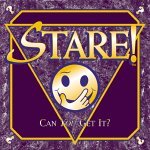
Stare! announces its idea with wide eyes on a purple box framed in gold. A player studies a picture, hands it over and answers questions about what was in it. A color, a position or a small background object can suddenly become the detail everyone wants to remember.Look, recall and look again
The original account describes individual or team play, with 20 seconds to study an image before the questions begin. It also offers shorter and longer viewing times: 10 seconds for a tighter challenge and 30 seconds for more time to look. Correct answers help players progress toward the end of the board.
Imagine looking at a busy scene and deciding where to begin: the central figure, the objects nearby or the edges of the picture. After the questions, returning to the image can be part of the enjoyment. A detail that felt obvious may have slipped away, while something tiny stayed clear. Teammates can compare what caught each person’s eye.
Try a postcard observatory
Make a picture especially for a partner in this original Toysit activity. Draw a small town square with five deliberate details: a striped awning, a fountain, a bicycle, a window box and a dog beside a bench, for example.
- The artist writes three questions whose answers are clearly visible in the drawing.
- The partner studies the postcard for an agreed time. Choose an untimed look if that feels more inviting.
- Turn the picture over and ask the three questions. They might concern a color, an object or where two things sit in relation to each other.
- Reveal the picture and find each answer together. Swap roles for a new postcard.
A second round can change just one feature of the same square. Let the returning visitor describe what they notice, then add both postcards to an imaginary travel album.
The historical record
Original Toysit coverage
The original product account and commentary are preserved below as historical coverage.
Stare! by Game Development Group, Inc.
Furrowed brows and hearty laughter are the most likely outcome of this fun but challenging new game from Game Development Group. The object is to be the first to reach the end of the game board. Been there, done that, you're thinking? Look again. In fact, stare hard--because that's the only way you'll get anywhere. Players (individually or in teams) must stare at an image on a card for 20 seconds. Actually, that's the challenging version. Depending on the relative level of masochism at the table, you can opt for the almost impossible version--stare for 10 seconds--or the general version, stare for 30 seconds (best if there are kids playing), and then answer questions about what you saw. It's not easy folks--just try to remember what color socks the man next to you on the bus was wearing this morning, or how many people were reading magazines.
The Stare Board Game is a captivating memory challenge that tests players' observational skills in a fun and interactive way. In this game, participants are given a set amount of time to stare at an image, trying to memorize as many details as possible. After time is up, they're quizzed on various aspects of the image, from minor details to major elements. The game not only fosters keen attention to detail but also helps improve memory and recall abilities. It's a hit across multiple age groups because it blends cognitive challenge with a social, competitive element. Whether you're trying to sharpen your memory skills or are simply looking for a fun game to play at gatherings, Stare offers an enjoyable experience that keeps players coming back for more.
Sources and editorial notes
The original Toysit account supports the 20-second viewing round and 10- and 30-second alternatives. GDG’s linked rules are marked Third Edition, 2019; its current product page describes a newer 2025 edition. These corroborate the basic observation pattern, not the exact contents, age label or detailed board rules of the older pictured box. Historical memory-improvement claims are preserved as earlier commentary, not established effects. The postcard activity is original, and no physical testing was performed.
- Original Toysit image — Existing same-site photograph reviewed and retained unchanged.
- Game Development Group: Stare! — Current manufacturer description; its 2025 edition is distinct from the older Toysit photograph.
- GDG Stare! Third Edition rules, 2019 — Publisher-linked PDF; both pages reviewed, including the reverse-side product illustrations.
- Original Toysit coverage — Complete original product account and historical commentary preserved.

Images and descriptions are retained as historical material. How Toysit covers toys.
Created for Toysit by Tabbloza — the artwork in our header.