
From the Toysit archive
Pottery Wheel Toy: design a little vessel with a purpose
Picture a tabletop pottery kit and plan a tiny decorative vessel for an imaginary owner, with a profile, pattern and purpose.
The play at a glance
A small studio for a three-dimensional idea
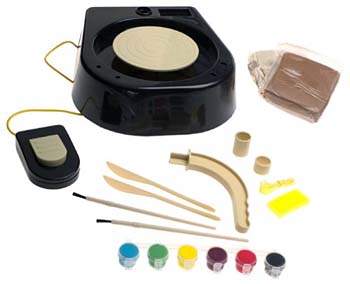
The photograph gathers a miniature pottery studio around a black tabletop wheel: a cream-colored circular top, a separate foot pedal, clay, shaping tools, brushes and little paint pots. It suggests a different kind of picture-making—giving an idea a rim, a side and a shape that can be seen from several directions.Imagine the vessel before shaping it
A vessel has several choices built into its silhouette. A wide opening can suggest a bowl, a tall side can suggest a jar, and a band of color can turn a plain form into something belonging to a particular character. The photographed kit places tools and paint beside the wheel, making shaping and decoration parts of the same small studio scene.
The historical account describes clay projects, a pedal and an illustrated booklet. For a set you own, let its identified instructions determine setup and suitable materials. The design game below begins with paper, where you can try several shapes and choose a favorite.
Try a miniature vessel commission
Pretend that a character has asked your studio for a special decorative piece. Perhaps a moon-base gardener wants a seed-jar model, or a castle messenger wants a miniature bowl with a zigzag border.
- Write the commission card. Name the owner, the imaginary purpose and one requested detail. “For Mira at the moon greenhouse: a small jar with three blue stars.”
- Draw two side profiles. Try one broad shape and one narrow shape. Circle the one that best fits the character’s story.
- Plan the pattern. Add a band, dots or a repeating symbol. Show where the pattern goes on the drawing.
- Present the finished idea. Give your drawing a studio label with the owner’s name and the piece’s title. If an identified, unaffected kit and its instructions permit a suitable project, an adult can help translate the plan into a small decorative model.
Keep the project decorative. A drawn vessel or a model for an imaginary owner supplies the whole story; it need not hold food, drink or water. Ask the “customer” to explain which detail makes the piece feel like theirs.
Identify an older kit before use
A specific January 26, 2004 CPSC recall covers Discovery Kids Imaginative Arts Pottery Wheel Kits sold during October 2003 with SKU 690974 on the white UPC price label at the box’s lower right back. The notice concerns excess bacteria in brown clay and directs owners to stop using affected kits. Check those identifiers before using an older set; this photograph alone cannot establish whether a kit is included. The recall page contains its original remedy information, whose present availability has not been confirmed.
Until the set is identified and its directions are available, enjoy the commission as a paper studio project. Save the drawings together as a catalog of imaginary customers and the pieces made for them.
The historical record
Original Toysit coverage
The original product account and commentary are preserved below as historical coverage.
Sculptors of all ages can create an endless array of clay masterpieces with this powerful tool
Finally, a pottery wheel that really works! Sculptors of all ages can create an endless array of clay masterpieces with this powerful tool. Includes 2 pounds of clay, tools, six paints, and a thorough instruction booklet with lots of projects. Teacher and parent tested and approved. AC adapter included. Pottery wheels have been used for thousands of years to create clay pots. Today's kids can enjoy making their own clay pots with the help of this well-designed kit. It includes a molded plastic pottery wheel with a foot pedal, an AC adapter, white and terra cotta clay, six tiny pots of paint, a sponge, two paintbrushes, two clay knives, and a clay-cutting cord. Additional common household items such as paper towels, newspaper, and a plate are also needed to complete the pots. A 12-page instruction booklet is included with safety tips, a brief history of pottery, and step-by-step, illustrated instructions for molding and painting pots. The pottery wheel can be operated with the AC adapter or with four D batteries (not included), and parental supervision is recommended. --Marcie Bovetz, mother and former children's librarian
Receiving a pottery wheel as a gift can be a transformative experience for someone who is artistically inclined. It opens up a whole new realm of creative possibilities, extending beyond two-dimensional mediums like painting or drawing. Pottery allows for tactile, hands-on creation that engages not just the mind but also the senses. The wheel itself becomes a tool for both art and meditation, as the spinning clay requires a focused, yet relaxed attention to shape and detail. Learning to manipulate clay on the wheel teaches patience, hand-eye coordination, and even a bit of physics and chemistry as one learns how the clay responds to various techniques and firings. Moreover, pottery offers practical rewards; you create functional art that can be used in daily life, from mugs to bowls to vases. This fusion of function and aesthetic adds another layer of satisfaction to the creative process. For someone already interested in art, a pottery wheel can broaden their artistic horizons, introduce a gratifying new skill set, and provide a therapeutic creative outlet.
Sources and editorial notes
The original photograph and complete Marcie Bovetz-attributed account are preserved. A matching manufacturer manual or package was not recovered; retailer identification as Curiosity Kits remains a lead, not a confirmed model match. CPSC recall 04-533 was reviewed for its precise Discovery Kids SKU and sales period, not applied to every pottery kit. Its page was readable through web retrieval while direct HTTP returned 403. The new activity is decorative design; historical testing, therapeutic, firing and functional-vessel claims are not new Toysit findings.
- Original Toysit image — Existing same-site photograph reviewed and retained unchanged.
- CPSC recall 04-533 — specific Discovery Kids kits — Read the exact SKU 690974 and October 2003 sales scope. It does not establish the identity or recall status of the Toysit photograph; historical contact and remedy details are not a current service promise.
- Original Toysit coverage — Complete original product account and historical commentary preserved.

Images and descriptions are retained as historical material. How Toysit covers toys.
Created for Toysit by Tabbloza — the artwork in our header.