
From the Toysit archive
Power Air Surfer
Power Air Surfer combines stacked wings and two propellers with a button controller, plus an original pilot’s-eye direction-card game.
The play at a glance
Two wings, bright patterns and a pilot’s-eye view
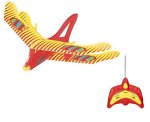
The Power Air Surfer’s yellow patterned wings sit one above the other around a red body and tail. Its matching controller repeats the same bright colors. The stacked outline makes the plane easy to picture as the star of a miniature flying display, with a broad curve across the field becoming the memorable part of its journey.
Watch how a turn changes the view
The guide shows two propellers mounted on struts between the wings. Its controller has separate left and right turn buttons and a propeller on/off button. The flight instructions emphasize brief turn inputs; they also explain that the observer’s view changes when the plane comes back toward them.
The matched guide marks the toy for ages eight and up and recommends adult supervision in a large, clear grassy area. Follow the complete instructions for assembly, wind conditions and operation. Keep people clear of the flight path and fingers clear of moving propellers.
Try pilot’s-eye direction cards
Draw a little Air Surfer on three cards: one facing away from you, one sideways and one coming toward you. Give each drawing a small cockpit dot so the imagined pilot’s viewpoint is easy to find.
Put a separate arrow card beside each plane to show a turn to the pilot’s left. Rotate a paper plane slowly on the table to check the choice. The arrow that points to your left in one view may point to your right when the aircraft faces you.
Now make a tiny route book. Choose two cards, join their imagined paths with a pencil line and invent a landmark between them. A partner can read the route from the pilot’s seat while you read it from the ground. Keep this card game at a separate table, away from powered aircraft.
A biplane in a toy-sized package
The manual’s parts drawing makes the stacked design especially clear: a top wing, a lower wing, a central body and the propeller struts that connect the scene. Those same shapes can guide a simple drawing even when the toy itself is packed away.
The historical record
Original Toysit coverage
The complete earlier product account and commentary are preserved below as historical coverage.
Radio Control Air Surfers Plane Red and Yellow.
Dynamic wing design. Maximum flight range: Up to 300 feet. Wing span: 30 inches. Dives. Barrel Rolls. Spins. Glides. Easy to use controller. Powerful strut mounted propellers. Battery requirements: Plane: 7.2V rechargeable battery (included); Radio Controller: 1 x 9V battery (not included); Field Charger: 8 x 1.5V C cell batteries (not included). Assembly required.
The history of radio-controlled (R/C) aircraft dates back to the early-to-mid 20th century, when hobbyists and engineers began to experiment with radio control systems for flying model airplanes. Initially, these early R/C models were cumbersome and difficult to operate, primarily due to the limitations of radio technology at the time. The 1950s and 1960s marked a significant turning point, with the introduction of transistors and miniaturized components that made R/C systems more reliable and easier to use. Advances in materials, such as lighter and more durable plastics and foams, also contributed to the rise in popularity of R/C aircraft. Over the years, the technology continued to evolve, incorporating sophisticated features like gyro stabilization, GPS navigation, and even first-person view (FPV) capabilities. Today, R/C aircraft range from simple gliders to complex scale models of real-world airplanes, as well as multirotor drones that have applications beyond just hobbyist use. The community around R/C flying has also grown substantially, with numerous clubs, competitions, and online forums dedicated to the craft.
Sources and editorial notes
All eight pages of Hasbro’s item 14022 instruction scan were read and visually inspected, including the aircraft, controller, assembly and flight diagrams. The wing arrangement and controller shape correspond to the original image. The scan includes ©2002 and codes DN14022us01a/b. The archive’s stunt list and performance figures remain historical claims rather than tested results. The direction-card game is an original Toysit activity; no physical testing was performed.
- Original Toysit image — Existing same-site image reviewed and retained unchanged.
- Hasbro Power Air Surfer item 14022 instructions (PDF) — Complete eight-page manufacturer scan, preserved by Transformer Toys; all pages and diagrams inspected.
- Original Toysit coverage — Complete historical account retained, including its original claims and wording.

Images and descriptions are retained as historical material. How Toysit covers toys.
Created for Toysit by Tabbloza — the artwork in our header.