
From the Toysit archive
Rokenbok Start Set
Follow a Rokenbok cargo route from loader to conveyor to chute, then plan a small layout and identify the parts that need to work together.
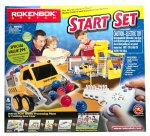
The play at a glance
Give the vehicle somewhere useful to go
The older Rokenbok Start Set combines a construction layout with a controlled loader, a motorized conveyor and a chute system. The vehicle has a task: collect cargo, deliver it and return for another load.
That makes the layout part of the play. A collection point can be easy to see but awkward to approach; an impressive structure can leave too little room for a vehicle to turn. Start by tracing the route.
Trace the material-handling loop
The original account describes a loader delivering cargo to a conveyor, with chutes and dumping bins continuing the route. Think of the system as a sequence of handoffs: each stage needs somewhere to receive material and somewhere to send it next.
- Collect
- The loader begins near a supply of the set’s intended cargo.
- Deliver
- A clear approach lets the vehicle reach the conveyor’s receiving area.
- Lift and route
- The conveyor and chute arrangement move material through the constructed site.
- Return
- A collection point and a vehicle route make another trip possible.
This is a description of the archived play idea. The controls, loading method and setup must come from instructions that match the actual equipment.
Plan the route on paper first
Draw four simple areas: cargo supply, conveyor approach, chute destination and return route. Use a small rectangle to represent the vehicle and trace its path with a finger. This editorial planning activity works without powering or assembling an uncertain set.
Look for conflicts. Does the return route cross the loading area? Is a support occupying the place where the vehicle would approach? Can the operator see the handoff, or does a wall hide it?
Try moving one destination on the sketch. A shorter route may be less convenient if it creates a tight corner; a slightly longer one may keep the loading area clear. The useful comparison is between two layouts for the same task.
Keep an observation separate from an explanation
If a complete, identified set has been properly assembled and is operating according to its own instructions, watch one short cargo trip before expanding the site. Record what happens at the handoff you wanted to study.
“The vehicle reached the receiving area but needed another approach” is an observation. “The route needs more turning room” is a possible explanation. Keeping those separate makes it easier to choose what to change.
Change one part of the layout at a time, following the set’s procedures for stopping and rearranging it. Do not reach into a running conveyor, substitute loose household objects for the intended cargo, or treat a stalled mechanism as a reason to force it. If the hardware is incomplete or its instructions cannot be matched, stay with the paper-layout activity.
Check the system, not just the vehicle
A loader alone does not establish that an older Rokenbok box is ready to operate. Identify the controller, any required base or receiver, conveyor, structural pieces, cargo and matching instructions as a system. A shared brand name does not prove that parts from different control generations work together.
Keep model markings with the corresponding equipment. This page does not prescribe a charger, power supply, radio channel or repair method. The retained box image is too small to settle those questions.
After a session, save the layout sketch and one useful observation. That gives the next builder a starting point even when the structure is taken apart for storage.
The historical record
Original Toysit coverage
Both original paragraphs remain below, including the earlier account of industrial conveyor belts. That general construction-industry discussion is not an operating manual or evidence of this toy’s performance.
Great way to start with Rokenbock.
Grab your hard-hat and go. There's a lot to be done in this action packed Radio Controlled Construction site. As the boss, it's your job to scoop and haul the precious Rokenbock start set cargo. With the help of your wireless Radio Controlled Loader vehicle, the towering Motorized Conveyor, and a wild chute system with dumping bin boxes, running a construction site has never been so easy (or so much fun!)
Conveyor belts play a crucial role in the construction industry, simplifying the transportation of bulk materials like gravel, soil, and other debris. They are especially useful in settings where labor would otherwise be intensive, and where using traditional vehicles might be inefficient due to space or environmental constraints. Conveyor belts come in various forms, including portable systems that can be mounted on trucks or trailers, and larger, more permanent systems used in quarries or waste management facilities. They are particularly valuable for tasks like moving material into hard-to-reach areas, such as the upper floors of buildings under construction or across challenging terrains. Conveyor belts can also be integrated into automated systems, allowing for more efficient material handling with less manual intervention. Overall, they are an indispensable tool in modern construction, contributing to both efficiency and safety.
Sources and editorial notes
Reviewed October 16, 2026 against the original Toysit text, box photograph and related older starter-set page. Both Toysit routes carry ASIN B0000658L8, but this renovation preserves them as separate records. A manufacturer-attributed ROK Works Start Set scan was found in search, but its host refused direct and browser access; the complete diagrams could not be reviewed. The exact controller generation, power requirements and compatibility remain unconfirmed. This guide therefore offers a conceptual route-planning activity, not assembly or radio-control instructions. No physical set was tested.
Images and descriptions are retained as historical material. How Toysit covers toys.
Created for Toysit by Tabbloza — the artwork in our header.