
From the Toysit archive
Silly 6 Pins
Understand Silly 6 Pins’ talking base, two-hit turns and Practice mode, then try a simple roll-and-observe family activity.
The play at a glance
Two hits, not simply two rolls
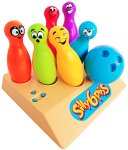
Silly 6 Pins puts six character pins on a talking base. The base responds to the pins being knocked down, turning a roll of the ball into a little conversation.
Its Game mode has a useful distinction: each turn allows two hits, with missed rolls repeated. That differs from the old Toysit description of a frame as simply two balls.
Set the pins for this base
For a matching 41367 unit, the manual directs players to stand the pins facing forward in their matching colored positions, starting with yellow Sophie at the front and working backward. Use its illustrated setup rather than arranging the characters as unrelated loose pins.
Select Practice or Game to start; the Off button does not turn the unit on. The manual specifies three AA batteries. An adult should check an older unit and follow its battery instructions before play.
Choose the kind of feedback
- Practice
- The pins react and joke without keeping a score. Reset after all have fallen.
- Game
- A turn permits two successful hits, repeating misses. Clearing all six on the first hit is a strike; clearing the remainder on the second is a spare.
- Reset
- Wait for the turn’s score before standing the pins again. Raising pins after the first hit restarts the turn.
After everyone has taken a turn, the highest score wins. The manual calls for another round to resolve a tied high score. This is the toy’s own short game, not a ten-frame bowling scorecard.
Watch what remains standing
For a relaxed activity, use Practice mode and agree on a comfortable rolling distance. Leave the lane clear for one person at a time. Before rolling, point out a pin or a gap and predict where the ball might go.
After the roll, count the pins still standing. Compare that observation with the ball’s route: did it reach the center, brush an outside pin, or pass the group? Let the player choose one change for the next attempt.
Try a slower roll before a longer distance. A ball that travels along the floor is easier to follow than a tossed ball that bounces through the lane. The next player can help describe what happened without coaching every movement.
Keep a simple family record
If the group wants a paper record in Game mode, write each player’s name and the result announced for the completed turn. Leave room for a short observation such as “aimed more toward the middle.” Do not count a miss as one of the two successful hits.
In Practice mode, skip the scores and record a favorite moment instead: an unexpected pin left standing, a roll that curved, or a character’s response. This keeps the purpose clear rather than mixing practice observations with an invented scoring system.
Rotate the roles of roller and observer, with everyone behind the rolling position while the ball travels. Retrieve the ball when the lane is clear. Stop if the base or a pin is damaged; the instructions do not call for taking the mechanism apart.
These activities invite attention to what the ball and pins actually do. They do not establish improvements in coordination or other developmental outcomes, and the game need not produce a high score to be worth a short shared session.
The historical record
Original Toysit coverage
The complete original account, character names, quotations and later benefit paragraph remain below. The manufacturer’s manual corrects the old color-position advice and two-ball shorthand. Developmental claims are preserved as historical prose, not measured results.
Silly 6 Pins Bowling Game
Sally, Stevie, Stanley, Sophie, Stewie, and Sid are six colorful, lightweight bowling pins--each with their own personality--that talk to kids while they bowl. Taunts such as C'mon! Roll the ball already! get kids started, and phrases such as Whew! That was close, keep them aiming for the pins. Bells, whistles, and cheers are heard if a spare or strike is bowled. The tan plastic base has six colored circles to hold the pins in place, but it is not required that colors match up for a game to begin. Silly 6 Pins only keeps score one frame (two balls) at a time, so keep a pad of paper nearby if you're playing as a family. Three AA batteries are required, but not included. These six pins will bowl you over with laughter! They all know when they're up - and when they're down! Did you get a strike, a spare? The pins announce your score for each frame through the talking base! Now you're rolling...with Silly 6 Pins!!!
A bowling game for children that features sound-making pins elevates the traditional bowling experience into a multi-sensory adventure. As kids roll the ball down the lane to knock over the pins, the resulting sounds—whether musical tones, funny noises, or even applause—provide instant feedback and gratification. This auditory element adds a layer of excitement and keeps children engaged for longer periods. The sounds also offer an educational aspect, helping kids understand cause and effect relationships as they associate the act of knocking down pins with specific sounds. Besides honing their hand-eye coordination and motor skills, the audio features could also inspire dancing, laughter, and added joy, making the game a lively, interactive experience for both the child and family members participating.
Sources and editorial notes
Reviewed October 16, 2026 using Hasbro’s model 41367 record and four-page 1999 manual. The six named characters, blue ball, talking base and control arrangement correspond to the archived photograph and description. Pages 2–3 specify color-matched setup, separate Practice and Game modes, two hits per turn, and resetting after the score. The original text is retained despite its conflicting setup and scoring shorthand. No physical game was tested.
- Hasbro: Silly 6 Pins, model 41367 — Manufacturer identification and linked instructions.
- Hasbro: Silly 6 Pins manual (PDF) — Original four-page instruction sheet; setup and play on pages 2–3.
Images and descriptions are retained as historical material. How Toysit covers toys.
Created for Toysit by Tabbloza — the artwork in our header.