
From the Toysit archive
Simon Stix
Simon Stix: light-to-movement sequences, the three games in Hasbro’s guide and the conflicting catalog and package descriptions.
The play at a glance
Remember the order, then translate it into movement
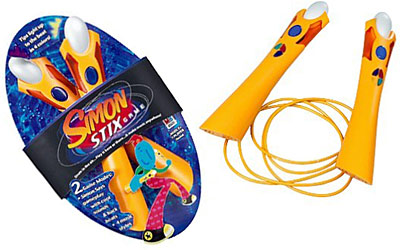
Simon Stix moves the Simon sequence idea into two handheld sticks. A light signal identifies a movement; a series of signals asks the player to keep both the order and the actions in mind.Read the lights as movement instructions
In the linked 41659 guide, red or green calls for a shake or tap of the corresponding stick. Yellow calls for both together. Blue calls for crossing the sticks at their blue oval areas. The connecting cord joins the pair; the guide warns that holding them too close can trigger a cross response.
That mapping adds a layer to the familiar memory game. A player may remember a color correctly yet choose the wrong movement. When explaining a mistake, separate “which signal came next?” from “what did that signal ask me to do?”
Why the game counts disagree
Hasbro’s catalog says two modes and four music styles; the original Toysit paragraph says three modes and seven styles. The pictured package says two modes. The linked guide nevertheless names Simon, which extends a sequence; Beat Simon, which presents sequences to repeat; and Freestyle, which responds to your own movements without scoring.
Use those three names as a description of the guide, not a promise about every boxed revision. Its cover specifies one player, ages 7+, and its battery instructions require three AAA cells per stick. Match the controls and supplied sheet on an older set before choosing rules.
Try a paper sequence without a timer
Make four cards labeled LEFT, RIGHT, BOTH and CROSS. Add distinct shapes so the activity does not depend on recognizing colors. This is a separate Toysit exercise, not an official Simon Stix mode.
- Lay out three cards, read them together, then turn them face down.
- Ask the other person to say the order. Revealing the cards is part of the activity, not a penalty.
- Repeat the same order while pointing to two drawn sticks, then let the other person compose a sequence.
Compare what made the sequence easier to describe: spoken names, shapes or a rhythm. Keep the length comfortable and skip timed play if it gets in the way of the conversation. This offers another way to explore the design without claiming that practice improves memory generally.
The historical record
Original Toysit coverage
The original Simon Sticks wording and party-game essay remain below. Its three-mode, seven-style and pass-it descriptions do not align consistently with the official catalog and linked manual. The edition differences are explained above rather than silently harmonized.
Sequence memory game with lights, sounds, automatic scoring, and seven styles of music
Remember and repeat the sequence of Simon lights to win. Two ways to play: play alone or pass it. Three game modes and seven music styles to choose from. Lights, sounds, music, and automatic scoring.
Electronic sequencing games like Simon have a knack for capturing the attention and enthusiasm of people at parties. These games are not only simple to understand but also inclusive, allowing players of all ages and skill levels to jump in and have a go. The escalating difficulty of remembering sequences becomes a social experience, inviting both camaraderie and friendly competition. As players take turns, bystanders often join in to help or challenge the player, creating a sense of collective excitement. Moreover, the musical tones and flashing lights add an extra layer of sensory engagement that fits well with the lively atmosphere of a party. The short rounds make it easy for players to rotate, ensuring that everyone gets a chance to participate. Thus, electronic sequencing games can become the centerpiece of engagement, laughter, and conversation, making them a fantastic addition to any social gathering.
Sources and editorial notes
The complete Hasbro 41659 play guide was visually reviewed. It describes three games and one player, while the official product page says two modes, four music styles and one or more players. The pictured box also advertises two modes. The photograph does not resolve every revision difference. No memory benefit or physical performance was tested.
- Hasbro: Simon Stix 41659 — Catalog description; counts differ from the linked guide.
- Hasbro: Simon Stix play guide (PDF) — Controls, signal diagrams, Simon, Beat Simon and Freestyle.
Images and descriptions are retained as historical material. How Toysit covers toys.
Created for Toysit by Tabbloza — the artwork in our header.