
From the Toysit archive
Survivor Board Game
The original Survivor board game brings an island tray, card challenges and voting to the table, alongside an original cooperative island story.
The play at a glance
An island contest arranged on a table
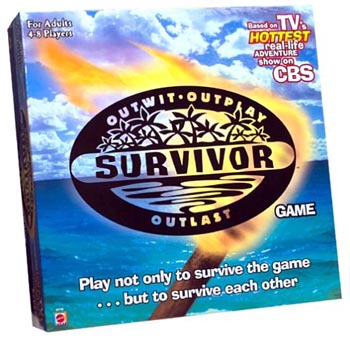
A yellow glow crosses the blue Survivor box behind its island logo. Inside the original game, a molded island tray holds cards and provides a raised place for Tribal Council. Team markers begin around the outer track, then individual markers enter the inner track. The package and rules describe a game for four to eight adults, with riddles, drawing, choices and votes shaping the contest.From teams to an individual contest
The two team markers travel around the outer circle while players collect Survival Item cards. The three card categories include riddles, hint-based guessing, matching answers and drawing. When the teams merge, each person takes an individual marker for the inner track.
Reaching Tribal Council gives that round’s chief immunity while the group votes someone out. With two players remaining, the eliminated players return to help choose the winner. The raised island, separate tracks and erasable voting cards give those changes a place on the table.
That structure provides the historical game’s contest. An invented island can also support a different sort of scene: a council where everyone combines ideas to prepare a welcome festival.
Hold a cooperative island supply council
Draw a harbor, camp and bridge on a large sheet. Give each place a cheerful, imaginary need. The harbor wants a welcome flag, the camp needs a sign for visiting penguins, and the bridge is waiting for a decoration to mark the festival route.
Draw three supply cards: colored cloth, a blank board and a basket of paper flowers. Each player proposes one delivery and explains how the object could help. A single object can inspire several ideas; cloth could become the flag or a ribbon for the bridge.
Choose a plan together and draw the deliveries on the map. If two places want the same supply, invent a way to share it or draw another useful object. Keep everyone in the story as a designer, messenger, mapmaker or welcoming host.
Welcome one unexpected visitor
Add a visitor with a new request: a penguin band needs a place to perform, or a cloud painter wants a view of the harbor. Look at the map and agree where the visitor could fit. Draw a sign or small stage to make the welcome visible.
Finish by telling the route from harbor to camp to bridge, naming what each player contributed. This paper council is a separate cooperative story; its imaginary supplies and problems are creative prompts.
The historical record
Original Toysit coverage
The complete earlier coverage follows. Its promotional language, broad learning claims and generic game commentary remain historical material; the researched qualifications appear in Sources.
Board Game from the Survivor Television Show.
Based on the wildly popular first season of the Survivor TV series, this multiplayer (four to eight adults) game adopts the basic premise of the show as players rely on quick wits, as well as pure luck and the collective vote of the Tribal Council, to become the game's sole survivor. With a plastic replica of the island of Pulau Tiga as its centerpiece and cardholder, the game is played on an illustrated game board and comes complete with 168 game cards in three different categories of questions and riddles, as well as some Pictionary-type cards. The game also includes a special die, 10 playing pieces and stands, nine erasable voting cards, an erasable pen, immunity idol, and an instruction sheet. This exciting new adult board game plays just like the TV show with both team and individual play - You can even vote members out of the game. The object of the game is to be the only remaining player to survive the game, and up to eight people can play at one time.
The Survivor TV series made its way into the board game world by capitalizing on the show's immense popularity and the desire of fans to experience the strategic challenges and social dynamics of the game in their own homes. The Survivor board game is typically designed to simulate the core elements of the TV show, such as forming alliances, competing in physical and mental challenges, and voting off fellow players.
The process of adapting Survivor into a board game involves licensing agreements between the TV show's creators and a board game manufacturer. Game designers work on translating the essence of Survivor into gameplay mechanics, which can be a complex task. They create rules, game components like cards, tokens, and a game board, and ensure that the game captures the essence of the TV show.
The Survivor board game allows fans to immerse themselves in the strategic gameplay and social interactions that make the TV series so compelling. It often includes elements like hidden immunity idols, tribal councils, and challenges that players must compete in. By bringing the Survivor experience to the tabletop, the board game provides fans with an opportunity to strategize, form alliances, and outwit their opponents, just like the contestants on the TV show. It's a way for fans to feel like they are part of the Survivor adventure from the comfort of their own living rooms.
Sources and editorial notes
All six pages of Mattel’s 42745 guide were reviewed. Its imprint carries a 2000 Survivor Productions copyright; the current Mattel service record lists a 2001 release. The copyright imprint and service release field record different kinds of dates. The guide lists eight voting cards, compared with nine in the original account. It documents a visible immunity idol and tabletop card challenges; the later historical essay’s hidden-idol and physical-challenge generalizations are not established features of this edition. The cooperative paper council is a separate original activity. The companion activity is original to Toysit. No physical game or electronic playback was tested.
- Mattel: Survivor 42745 rules — All six PDF pages reviewed for components, team/individual phases, challenge types, voting, ending and copyright imprint.
- Mattel: Survivor 42745 product record — Manufacturer product identity, adult audience and 2001 release field reviewed; distinguished from the rulebook copyright.
- Original Toysit coverage — Complete earlier text, original identifiers and retained product image inspected and preserved.
Images and descriptions are retained as historical material. How Toysit covers toys.
Created for Toysit by Tabbloza — the artwork in our header.