
From the Toysit archive
Tyco Vertigo
Explore the 2003 Tyco Vertigo’s hinged frame, separate folding from turning, and use a simple movement map to describe what changes.
The play at a glance
Watch the frame as well as the wheels
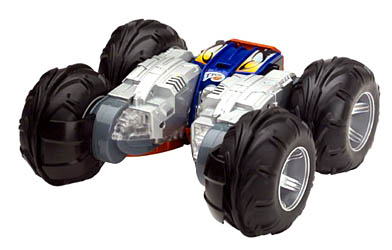
This Vertigo is the Tyco vehicle with a hinged, scissor-action frame. Mattel’s B6451 instructions show the body splitting into a different arrangement during reverse travel and distinguish flat spins from a vertical split spin with lights.
Its appeal lies in how the whole shape moves. Watching only the wheels misses part of the action; watching only the flashing lights misses the mechanism that carries them.
Three things to look for
- The frame
- Follow the body sections and the joint between them. Describe whether their relationship changes.
- The wheels
- Notice which wheels touch the surface. A change in contact can be more informative than a dramatic name for a stunt.
- The whole vehicle
- Describe where the toy travels and which way it faces. Moving across the floor, turning in place and folding are different observations.
These are reading prompts for the photograph and guide, not an invitation to touch a powered mechanism.
Keep the effects separate from the explanation
The manual associates changing lights with its vertical spinning action. A description can mention that visual effect while still explaining the frame and wheel movement in ordinary words.
Its named stunts are useful labels inside the guide, but a reader can learn more from an account of what moves relative to what. The activity below uses drawings and needs no flashing-light display.
Use the right boundaries for this version
The later archive paragraph sounds like an invitation to create rough terrain. The actual guide sets narrower conditions and explains that performance depends on the surface and battery charge. A surviving toy should be matched to the complete instructions and original power system before use.
The manual also identifies a flashing-light effect. That feature is part of the documented product, not a requirement for exploring shape and motion on paper.
Make a movement map
- Draw a simple vehicle outline on three small cards.
- On the first, use an arrow to show travel from one place to another.
- On the second, show the whole outline changing direction.
- On the third, show one body section changing position relative to another.
- Label the cards “travel,” “turn” and “fold,” then combine two to describe an imagined movement.
The drawings are conceptual, not construction plans or exact Vertigo positions. Their purpose is to make a description clearer without reproducing a stunt.
The historical record
Original Toysit coverage
The original Vertigo description and later paragraph about stunt-vehicle treads remain below. The later claims about sand and mud are not reliable operating guidance for this model. The manufacturer guide excludes sand, water and snow. This article concerns the scissor-frame family documented by B6451/B6452, not an earlier vehicle with the same Vertigo name.
Radio Controlled Vertigo
With hinged scissor-action frame, Vertigo is the ultimate stunt vehicle for incredible flips and rolls. Kids will want to master the Arm-Twister 360 stunt. The Vertigo vehicle also features cool flashing lights for even more action -- day and night. It's the ultimate spin machine. Requires one TMH FlexPak rechargeable battery pack, plus one 9V battery for the transmitter.
Stunt R/C vehicles equipped with extraordinary treads are an adrenaline-pumping experience for both kids and adults. These unique treads enable the vehicles to handle multiple terrains, be it rocky landscapes, sandy surfaces, or muddy paths. This adds a layer of excitement and unpredictability, as the toy can conquer obstacles that standard R/C vehicles can't. The advanced tread design often pairs with powerful motors and responsive controls, offering precision driving and high-speed action. Performing flips, spins, and jumps becomes not just possible, but also remarkably thrilling. Such R/C vehicles allow for creative play, encouraging users to construct challenging terrains and even compete in races or obstacle courses. Overall, they offer a perfect blend of engineering, technology, and entertainment.
Sources and editorial notes
Mattel’s B6451-0720 guide was downloaded and visually reviewed, including the frame, transmitter, movement diagrams and English restrictions. The B6452 record corroborates the scissor-frame description. The older 38191 Vertigo manual was not substituted. The documented stall-protection circuit is not evidence of learning or autonomous navigation. No vehicle, light effect or battery was tested. The movement map is an independent Toysit activity.
- Mattel Vertigo B6451 instructions — Scissor-frame family diagrams, motion descriptions and model-specific restrictions.
- Mattel Vertigo B6452 product record — Historical identification of the 2003 scissor-frame vehicle.
Images and descriptions are retained as historical material. How Toysit covers toys.
Created for Toysit by Tabbloza — the artwork in our header.