
From the Toysit archive
ViewMaster
Look for foreground, background and small details in a reel viewer, with context for Toysit’s preserved 2004 anniversary report.
The play at a glance
Two photographs, one impression of depth
A ViewMaster reel viewer presents a slightly different photograph to each eye. Viewed together, the pair can give a scene a sense of depth: a person or tree seems to stand in front of the distant background.
Choose one scene and stay with it. Looking closely, describing a detail and letting someone else find it makes a simple shared activity.
Look, describe, then trade places
With a suitable reel and a viewer set up according to its own instructions, choose a scene. Ask the viewer to name one thing that appears near, one thing farther away and one small detail. A scene need not contain dramatic depth to be worth exploring.
Pass the viewer to a partner without changing the scene. Give a clue such as “look beside the tallest tree” rather than immediately naming the object. Let the partner describe what they notice, then compare the two accounts.
Finish by advancing to another scene and looking for a difference: a new viewpoint, a different setting or a change in scale. Pause when someone wants longer. The lever is a way to choose a picture, not a reason to race through every picture.
What to look for in a stereo scene
- Foreground
- Find an object that seems closest. Describe its position without relying only on its size.
- Background
- Look beyond the main subject. Name a detail that helps establish the place.
- Overlap
- Notice where one object hides part of another. This is a depth clue in ordinary photographs too.
- A pair of viewpoints
- The two eyes receive different views of the same scene. Their difference contributes to the stereoscopic effect.
Depth perception varies between viewers. If someone does not experience a strong 3D effect, compare the visible colors, shapes and story instead. Stop if viewing is uncomfortable; the activity does not require straining to achieve a particular result.
Identify the viewer and its reels
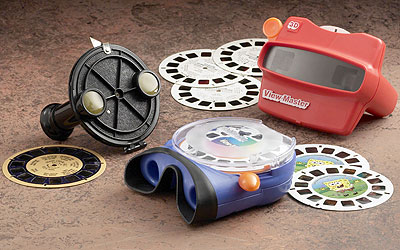
The original photograph shows several generations of viewers and loose reels. It does not establish that every pictured item belonged to the anniversary boxed set. Record the maker’s name and markings on the actual viewer, then read the subject and identifying text on each reel.
Check reels for bending, damaged film windows or loose parts, and check that the viewer operates without force. Follow the model’s loading and lighting instructions. Keep a traditional light-admitting viewer away from direct sunlight while looking through it. A smartphone-based View-Master product is a separate system and is outside this guide.
Place the anniversary report in context
Toysit’s dated report describes a specially decorated viewer and eight reels for the brand’s 65th anniversary. The National Stereoscopic Association’s convention account independently describes the set’s images spanning the 1930s through the 2000s.
Those documents establish the historical release, not the contents or condition of a box offered today. If identifying a surviving set, compare its packaging and reel labels with the documented edition. Preserve any original booklet with it; a familiar brand name alone cannot confirm that a collection is complete.
The historical record
Original Toysit coverage
The complete July 6, 2004 anniversary report, both attributed quotations, and the later overview sections are preserved below. Historical sales wording, corporate descriptions and chronology remain part of that record; they are not current product or collecting advice.
Stereoscopic photography limited edition boxed set includes a classic 3D viewer and eight reels to honor its decades of history
In 2004, Fisher-Price celebrated the 65th anniversary of the ViewMaster brand. With just a glimpse through a ViewMaster viewer, people have been able to see 3D images of some of the world's most popular people, places and events, both real and imaginary, past and present. Today, with more than one billion sold, ViewMaster can be found everywhere from music videos and television shows to commercials, restaurant menus and celebrity party invitations.
"ViewMaster has secured itself as a classic toy that continues to fuel the imaginations of children around the world," says Chuck Scothon, senior vice president of marketing, Fisher-Price. "It is truly a phenomenon that has transcended the toy box to achieve pop culture status."
"I've been an avid ViewMaster collector since the age of five," says Mary Ann Sell, president of the National Stereoscopic Association, a non-profit organization dedicated to stereoscopic photography, which is a method used to create 3D images. "Ever since I was a child, ViewMaster has provided a magical window in time, allowing me to explore past events and letting me travel the world. As an adult, I continue to be fascinated by all of the wonderful 3D images I see through my ViewMaster viewer and this milestone anniversary will be acknowledged at the annual National Stereoscopic Association Convention this month."
From Pope John Paul II to Popeye, celebrities real and fictional have been known to play with ViewMaster viewers. It has appeared in various music videos for artists including REM, the Black Crowes and Mary J. Blige, and hip-hop star Jay-Z even went as far as using it as a celebrity party invitation. ViewMaster has also starred on television including an appearance on "That '70s Show" and in General Motors' 2002 ad campaign.
It all began in 1938 when William Gruber, a piano tuner by trade and a stereo photographer by hobby, invented the ViewMaster. Soon after the idea took shape, Gruber created the first ViewMaster viewer and introduced it in Portland, Oregon in 1939. However, it wasn't until the following year at the 1940 New York World's Fair that many Americans had their first ViewMaster viewing experience. No one could have predicted the tremendous public response. Just one year following its debut, ViewMaster was being sold to more than one thousand stores across the country.
Throughout its history, ViewMaster viewers have played a variety of roles. From 1942 to 1945, during World War II, viewers were used in training for the U.S. military. After the war, public demand for ViewMaster viewers and reels skyrocketed. During the 1950s, the company mainly produced reels of various national parks and scenic attractions across the country, intended as souvenirs for adults. In 1951, due to the acquisition of its competitor, the Tru-Vue Company of Rock Island, Illinois, ViewMaster obtained the license to use Disney characters and quickly gained momentum in the children's market. Ever since, ViewMaster reels have featured some of the most popular cartoons, superheroes and fairytales that have become the mainstays of any ViewMaster reel collection.
The design and development of ViewMaster products was handled by several different corporations during the 1970s and 1980s. In April 1997, Tyco Toys, which had purchased ViewMaster brand in 1989, merged with Mattel. As a result of the merger, the ViewMaster line was assigned to Fisher-Price, where this American classic continues to thrive.
To celebrate ViewMaster's 65th anniversary in 2004, Fisher-Price is releasing a limited edition ViewMaster Boxed Set that includes a specially-decorated classic viewer and eight reels, one for each decade of the ViewMaster's existence, featuring scenes from the Apollo Moon Landing and the first American full-length animated movie, Snow White, to Indiana Jones and SpongeBob. Additionally, Fisher-Price will release the ViewMaster Time Capsule Assortment, which allows parents to take their kids back in time with nostalgic ViewMaster viewers and reels featuring favorite cartoon characters of the past.
Fisher-Price is a wholly-owned subsidiary of Mattel.
The National Stereoscopic Association promotes the study, collection, and use of stereographs, stereo cameras and related materials; provides a forum for collectors and students of stereoscopic history; promotes the practice of stereo photography; encouragees the use of stereoscopy in the fields of visual arts and technology; and fosters the appreciation of the stereograph as a visual historical record
ViewMaster Stereoscopic Viewing Toy
- Introduction in the 1930s: The ViewMaster was introduced in 1939, offering a new and exciting way to view 3D images through stereoscopic technology. It quickly became a favorite among children and adults alike.
- Travel and Education: In the early years, ViewMaster reels featured scenic landscapes, famous landmarks, and educational content, making it a popular tool for virtual travel and learning.
- Partnership with Disney: The collaboration with Disney in the 1950s brought beloved characters and stories to the ViewMaster, enhancing its appeal to children and expanding its market reach.
- Home Entertainment: The ViewMaster became a staple in home entertainment, providing families with a unique and engaging way to explore the world and enjoy storytelling in 3D.
- Integration with Popular Culture: Over the years, the ViewMaster has featured content from popular movies, TV shows, and cultural icons, keeping it relevant and appealing to successive generations.
- Technological Advancements: The ViewMaster has evolved with technology, incorporating new features and improving image quality, ensuring its continued success and adaptability.
- Collectible Value: Vintage ViewMaster reels and viewers have become sought-after collectibles, reflecting the toy's enduring charm and historical significance.
Stereoscopy: A Continued Popularity
- 3D Movies: Stereoscopy is a key technology in modern 3D cinema, providing immersive and realistic viewing experiences for audiences.
- Virtual Reality (VR): Stereoscopy plays a vital role in VR, creating depth and dimension in virtual environments, enhancing realism, and offering engaging experiences.
- Medical Imaging: In the medical field, stereoscopy is used for advanced imaging techniques, aiding in diagnostics and surgical planning.
- Scientific Research: Stereoscopy is employed in various scientific applications, from studying microscopic organisms to exploring celestial bodies.
- Photography and Art: Stereoscopic photography and art continue to be popular among artists and enthusiasts, offering creative and expressive possibilities.
- Video Games: Stereoscopy enhances video gaming experiences by adding depth and realism, contributing to the popularity of 3D gaming.
The ViewMaster's success and the continued popularity of stereoscopy demonstrate the timeless appeal of 3D viewing. From entertainment and education to science and art, stereoscopy continues to captivate and inspire, reflecting human curiosity and the desire to explore the world in new and exciting ways.
Sources and editorial notes
Reviewed October 16, 2026 using the original report and photograph, the National Stereoscopic Association’s Stereo World convention report (volume 30, number 4, printed pages 27 and 32), and The Strong’s museum history. The NSA report corroborates the eight-reel anniversary set. The Strong places the New York World’s Fair introduction in 1939; the archived report instead refers to a 1940 viewing experience. The archive’s “one billion sold” wording does not identify what was counted and is not used as a verified total here. No physical viewer or reel was tested.
- National Stereoscopic Association: Stereo World, volume 30, number 4 — Contemporaneous convention account and photograph of the 65th-anniversary set; printed pages 27 and 32 (PDF pages 29 and 34).
- The Strong National Museum of Play: View-Master — Museum context for the photographic viewer, scenic reels and later character subjects.
Images and descriptions are retained as historical material. How Toysit covers toys.
Created for Toysit by Tabbloza — the artwork in our header.