
From the Toysit archive
Tyco XFO
Understand Tyco XFO’s vertical flight controls, its separate field charger and the difference between a controlled descent and an emergency rotor stop.
The play at a glance
A flying toy controlled through rotor speed
XFO stands for Xtreme Flying Object. Mattel’s B6463 guide describes vertical takeoff and control of ascent and descent through rotor speed. It does not describe the left/right navigation of a steerable model helicopter.
One distinction is especially useful: easing off the control produces descent, while pushing beyond its normal position activates a separate stop feature. Stopping the rotor in the air is an emergency action, not the normal way to land.
Recognize the original equipment chain
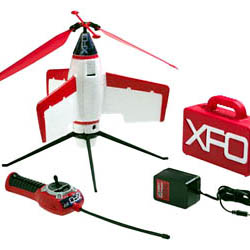
The original system includes a wall charger, a separate field charger and the aircraft. The field charger is more than a carrying case. Matching and inspecting that equipment matters before considering an old example.
Use only the model’s specified equipment and complete instructions. The diagram does not establish that any surviving battery or charger remains usable.
Know what the control does—and what it does not
Altitude control does not choose a horizontal destination. Wind and the surrounding space therefore matter to this toy’s use. A drawing of a route across a park would not become a route the XFO can automatically follow.
“Hover” in the old description should not be read as a promise of modern position-holding navigation. The article explains the documented controls, without adding capabilities based on the toy’s futuristic appearance.
Read the preflight conditions first
The guide requires outdoor use in calm, clear weather and launch from level ground. It calls for substantial open space, separation from people and animals, and avoidance of roads, water, trees and power lines. Read its full distances and restrictions before any operation; this summary is not a launch checklist.
For a historical example, equipment condition is a separate question from whether the location looks suitable. Damaged, leaking or corroded equipment should not be used or charged.
Sketch the questions before the flight
- Draw an imaginary outdoor space on paper.
- Mark people, trees, water, roads and other obstacles.
- Separate facts visible in the drawing from things it cannot show, such as wind and equipment condition.
- List which questions require the actual manual or a real inspection.
- Explain why an apparently empty patch in a drawing is not proof that a flight would be suitable.
This independent planning exercise requires no aircraft or powered rotor. It does not approve a site, replace the manufacturer’s checks or propose a height challenge.
The historical record
Original Toysit coverage
The original product paragraph and general helicopter explanation remain below. The 50-foot claim is preserved as period promotion, not a measured Toysit result or a challenge. The discussion of tail rotors and blade-pitch control is general helicopter background and does not describe the documented XFO control system.
Tyco RC X.F.O.
The XFO Extreme Flying Object from Tyco Radio Control is a whole new way to catch some air. With spinfins and a radical rotor, XFO is like nothing else on earth or beyond. Designed for fun and easy flying, it can soar over 50 feet into the air. How high can you go? Hover it in mid-air. Bring it in for a smooth landing. Includes a special rechargeable battery. Ages 10 and over.
Rotors are the backbone of helicopter flight, serving as the equivalent of wings in an airplane. A typical helicopter has two main sets of rotors: the main rotor on top for lift and thrust, and a smaller tail rotor to counteract the torque generated by the main rotor. The main rotor consists of two or more blades attached to a central mast, which is powered by the helicopter's engine. As the engine turns the rotor mast, the blades cut through the air, generating lift due to their aerodynamic shape and angle of attack. By adjusting the pitch angle of these blades, the pilot can control the amount of lift produced, allowing the helicopter to ascend, descend, or hover. The tail rotor works to counterbalance the spinning effect that the main rotor would otherwise impose on the helicopter's body, keeping it stable and allowing for controlled turns. Some modern helicopters use alternative systems like coaxial rotors or NOTAR (No Tail Rotor) to achieve the same effects.
Sources and editorial notes
All seven pages of Mattel’s B6463-0920 guide were rendered and reviewed, including assembly, charging equipment, flight-control positions, clearances and emergency stop. The original photograph matches this product family. No aircraft, rotor, battery, charger or flight was tested. The equipment diagram and site-sketch activity are independent explanatory aids, not assembly, charging or launch instructions.
- Mattel XFO B6463 instructions — Complete assembly, equipment, flight-control and preflight guidance.
- Mattel XFO B6463 product record — Historical product-family description.
Images and descriptions are retained as historical material. How Toysit covers toys.
Created for Toysit by Tabbloza — the artwork in our header.