
From the Toysit archive
Zome System Pioneer Kit
Connect shaped struts and nodes to explore flat figures and spatial models, with the historical 121-piece Pioneer kit placed in context.
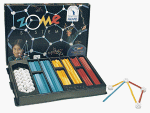
The play at a glance
Let the connection shapes guide the build
Zome uses small connector balls, often called nodes, and colored struts. The shape of a strut’s end determines which opening it fits, so choosing a connection is part of discovering the model’s geometry.
The earlier page identifies a Pioneer kit. Zometool’s period classroom document confirms a Pioneer, also called Zome 3, with 121 pieces and an instruction booklet in a sorting tray and cardboard box.
Shape matters as much as color
In Manual 2.3, blue struts use rectangular holes, yellow struts triangular holes and red struts pentagonal holes. The openings also point in different directions. Turning a node can therefore change where the next edge of the model will go.
Push each connection straight and seat it fully. The manual warns against forcing parts or twisting and pulling an entire model apart. Support one connection at a time when taking a build down.
Start with a square
Find four nodes and four blue struts of equal length. Use the manual’s square diagram to orient the connections and close the four sides. Count the corners and edges, then turn the model and see which features stay the same.
If you have eight nodes and twelve equal-length blue struts, a cube frame is a possible next step: two matching squares connected at their corresponding corners. Check your parts before starting; the kit’s total piece count does not tell you how many of each length remain.
Change one feature and compare
Make a second flat shape using a diagram from the manual, or compare a flat frame with a spatial one. Notice which struts, holes and directions differ. A sketch beside the models can record what changed.
These are activities for exploring shape, not a claim that completing a model proves a particular learning gain. More elaborate diagrams may require parts beyond the ones available in an incomplete old kit.
Keep the small kit useful
Sort struts by color and length and give the nodes their own compartment. Before dismantling a favorite model, count or photograph the pieces it uses so it is easier to revisit.
The period 121-piece specification helps identify the Pioneer offering. It is not a substitute for checking individual parts, and it should not be used as the inventory of a later Creator or other Zometool kit.
The historical record
Original Toysit coverage
The original kit description and educational discussion are retained below. The new guide distinguishes documented components and suggested activities from broad claims about children’s development.
Zome System Pioneer Kit
Introduce kids to the exciting possibilities of Zome System. Zome System is the construction toy for the 21st century used around the world by top scientists and designers, but easy for your child to learn. It's incredibly fun for kids. Zome System features shape and color coded parts which kids can use to build domes, bridges, crystals and fractals. Zome System includes 121 pieces in various colors.
Inspiring Creativity and Thought Processes with the Zome Construction System
- Shape Recognition: The shape-coded parts in the Zome Construction System help children recognize and understand different geometric shapes, enhancing their spatial awareness and geometric understanding.
- Color Coding: The color-coded components guide children in identifying and categorizing parts, fostering organizational skills and attention to detail.
- Structural Exploration: Building structures like domes and bridges encourages children to explore engineering principles, understand load distribution, and develop problem-solving skills.
- Mathematical Concepts: The system allows children to explore mathematical concepts such as symmetry, proportion, and scaling, providing a hands-on approach to learning mathematical principles.
- Scientific Exploration: Creating models of crystals and fractals introduces children to scientific concepts in a fun and engaging way, fostering curiosity about the natural world.
- Creative Expression: The flexibility of the Zome Construction System encourages creative expression, allowing children to design and build their unique creations, enhancing imagination and artistic skills.
- Collaborative Learning: Working together to build complex structures fosters teamwork, communication, and collaboration, essential skills for social development.
- Motor Skills Development: Assembling the parts requires fine motor skills and hand-eye coordination, promoting physical development and dexterity.
- Critical Thinking: Planning and executing complex structures require critical thinking and strategic planning, enhancing cognitive development and logical reasoning.
- Interdisciplinary Learning: The Zome Construction System integrates concepts from mathematics, science, art, and engineering, providing a comprehensive and interdisciplinary learning experience.
- Environmental Awareness: Building structures that mimic natural formations can foster an appreciation for nature and environmental awareness, encouraging responsible stewardship of the planet.
The Zome Construction System offers a multifaceted educational experience that nurtures creativity, critical thinking, and interdisciplinary learning. Its shape and color-coded parts provide an intuitive and engaging platform for children to explore various scientific, mathematical, and artistic concepts, fostering intellectual curiosity and personal growth.
Sources and editorial notes
Zometool’s period classroom document, whose kit-summary page is marked ©2002, and Manual 2.3 were inspected on October 15, 2026. The former confirms the Pioneer’s 121-piece specification; the latter explains the connection system. Exact completeness of an individual old kit and its packaging revision remain unverified. No models or learning outcomes were physically tested.
- Zometool: period classroom resource (PDF) — Printed page 220 identifies the 121-piece Pioneer kit; PDF page 201.
- Zometool Manual 2.3 (PDF) — Connection shapes, handling guidance and illustrated geometric models.
Images and descriptions are retained as historical material. How Toysit covers toys.
Created for Toysit by Tabbloza — the artwork in our header.