
From the Toysit archive
Little People Discovery City
Make a two-stop errand in Little People Discovery City: use the roadway, shops and telephone while supplying your own character conversations.
The play at a glance
A small town for a short journey
Discovery City brings familiar places together around a moving roadway. A character can visit a shop, meet a friend or head to the playground. The set provides recorded sounds and responses; the players give the journey its purpose.
Choose two places before adding a complicated story. A short trip with a clear return can be enough to make the city feel busy.
Separate a toy response from your conversation
The 77702 guide shows a roadway control, figure pads at the stage and telephone, a cash-register button and a turning pet-shop window. Opening the fire-station door releases the truck down its ramp.
The manual warns that its printed dialogue examples represent responses that may vary. Do not expect a particular sentence on every press. These are recorded interactions, not a conversation system that understands the child’s story.
Players can add their own dialogue before or after a sound. A character may be buying lunch, calling a friend or looking for a place to sit, even when the toy’s next phrase concerns something else.
Try a two-stop errand
Choose one figure and two places on the city. This original activity works as a small journey, with or without activating every feature.
- Name the first stop and a reason to go there: “We are visiting the shop.”
- Move the character there and describe one action.
- Choose the second stop, perhaps to meet a friend or spend time in the park.
- Return to the starting place and say what happened on the trip.
If the roadway is in use, keep the route clear and follow the matching instructions for its vehicles and gate. Stop the movement when you want time for a conversation. The journey does not have to fit within one circuit.
With another player, divide the roles: one chooses the destination, the other speaks for the visitor. Switch after the return so both help shape the town.
Let a place suggest a new story
Repeat the trip with only one change. The shop might be closed in the story, the friend might be at the park, or the visitor might decide to call instead. Those choices create a new sequence without requiring extra figures or accessories.
For a quieter round, leave the powered actions off and make the conversation yourselves. For a sound-focused round, choose one feature and listen before trying another. There is no need to activate the entire city at once.
Use the matching parts list
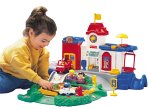
The 77702 manual lists four Little People figures and two cars, while Mattel’s product record says five figures. Use the label and instructions belonging to an actual package when checking completeness. The small original photograph is useful context, not a reliable inventory.
Inspect the roadway, ramps, gate, accessory attachments and secured battery cover. Follow the guide for assembly and care. It shows storage behind the playground ramp, which can make returning pieces part of the last trip. Keep the older award reference separate from identification: it does not establish the release date or contents of every edition.
The historical record
Original Toysit coverage
The original product description, award reference and Little People essay are preserved in full below. The 77702 instructions support the description of four figures, though Mattel’s product record lists five. The original 2000 award claim has not been independently established and is retained as historical reporting.
This playset is filled with animation, lights, speech and sound effects and all happens within familiar places for preschoolers to explore and discover.
Exciting new format that brings Little People characters to life. This playset is filled with animation, lights, speech and sound effects and all happens within familiar places for preschoolers to explore and discover. It features a roadway that comes to life with animation, a Town Square where Little People introduce themselves and sing songs and a Fire Station with lights and sounds. Fisher-Price Little People characters are a childhood favorite, and fans can hear them come alive in this action-filled city. Winner of the 2000 Family Fun Award, this city is perfect for imaginative play. The different parts of the town include a fire station and a quick-release garage door, driving ramps and a motorized roadway, Central Park, a grocery store, a pet shop, and a restaurant. When the four Little People characters are placed near the telephone or onstage in Central Park, they can talk and sing. Other features come to life all around the city, like the animals at the pet shop that make different sounds. Residents include a firefighter (with a fire truck), a police officer (with a police car), and two young civilians, and they all store underneath the slide when it's time to clean up.
Little People by Fisher-Price stand as a testament to the enduring appeal of toys that combine entertainment with education. These iconic figures and playsets are specially designed for toddlers and preschoolers, featuring durable construction and vibrant colors that captivate young imaginations. With playsets ranging from farmyards and airports to bustling towns and interactive vehicles, Little People offer endless opportunities for open-ended play and creativity. As children manipulate the chunky figures and explore the various elements of each set, they develop fine motor skills, hand-eye coordination, and problem-solving abilities. Furthermore, Little People toys encourage social interactions and language development as children engage in collaborative play and storytelling. Through these engaging play experiences, Little People foster a love of learning and exploration in early childhood.
Sources and editorial notes
Reviewed October 16, 2026 using Mattel’s 77702 record and all eight pages of its instructions. The manual’s parts list, roadway, figure-response, shop and storage drawings were visually reviewed. Differences between the record and manual prevent treating either figure count as universal across packages. The two-stop errand is an original suggestion. No physical set or recorded speech was tested.
- Mattel: 77702 Little People Discovery City — Historical product record; its figure count differs from the manual.
- Mattel: Discovery City instructions (PDF) — Four-figure parts list, roadway, activity pads, shops and storage.
Images and descriptions are retained as historical material. How Toysit covers toys.
Created for Toysit by Tabbloza — the artwork in our header.