
From the Toysit archive
Tyco Morph Machines
Revisit the 2004 Morph Machines announcement and explore how removable body parts change an RC vehicle’s appearance and the stories around it.
The play at a glance
Change the body, then change the story
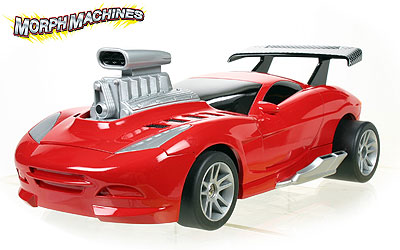
Toysit’s September 11, 2004 report introduced Morph Machines as a customizable RC vehicle developed through a task on The Apprentice. Its central idea was rebuilding the car’s appearance with different body parts, then driving it.
Mattel’s 2005 H6956 record describes removable parts attached with magnets. That supports a vehicle you customize by hand. It does not support the later archive paragraph’s claims that a button turns the car into a boat or a truck into an aircraft.
Separate rebuilding from remote control
Changing a hood or body panel changes what a vehicle looks like. Steering it changes where it goes. Those are two different kinds of participation, even when they belong to the same toy.
A helpful description names the action: attach a part by hand, choose a route, then drive. The word “morph” alone does not explain a mechanism, and a dramatic new silhouette does not establish new abilities.
Read the announcement in its own time
The original report looks ahead to a toy release. The later manufacturer record describes the production line. Keeping both sources visible lets readers distinguish an announced concept from documented product details.
The old text also uses broad language about what boys enjoy and how well the idea tested. Those statements remain part of the report; this renovation makes no universal claim about children’s preferences or measured learning benefits.
Give each design a purpose
A different body can suggest a different story: a delivery trip, a repair visit or a parade. Ask what the driver is trying to accomplish and which visual change helps tell that story.
For an actual surviving set, identify the correct original components and instructions before changing parts. The drawing exercise below calls for no replacement magnets, altered attachments or modifications to a powered toy.
One chassis, three imagined jobs
- Draw the same simple wheeled base three times.
- Give each version a different body outline.
- Name a job or destination for each design.
- Circle the changes that affect appearance and label any invented abilities as fiction.
- Explain which part you would change first if you wanted to tell a different story.
This independent design activity explores the relationship between appearance and purpose. It does not represent three approved Morph Machines builds or suggest that a new body changes the motor or driving system.
The historical record
Original Toysit coverage
The complete September 11, 2004 announcement and later descriptive paragraph remain below. The announcement describes snap-on changes and anticipated early-2005 availability; Mattel’s production record describes magnetic attachments. The later claims of button-operated boat and flying transformations are unsupported for this documented product and should not be read as features or operating advice. The original price and testing language belong to the historical report, not a current offer or Toysit test.
Toy from the Apprentice that can be transformed and customized will be manufactured by Mattel for Tyco RC line
The winning toy from The Apprentice task has everything boys love. It lets kids transform and customize their radio control vehicle by simply snapping on a different hood with a big blown engine, or attaching a pickup truck bed on the back. Kids control the vehicle, drive it, race it, crash it, then they simply put it back together again.
The toy tested so well that Mattel will manufacture it for one of its marquee brands, Tyco R/C, the leading name in radio control, under the name Morph Machines. The Morph Machines will be on toy store shelves in early 2005 for an approximate retail price of 30 dollars.
Morph Machines by Tyco R/C were a line of radio-controlled vehicles known for their ability to transform or "morph" from one type of vehicle into another with the press of a button, offering double the play value. For instance, a car could change into a boat, or a truck could transform into a flying machine, providing dynamic and versatile play experiences for children. This innovative design was an engaging twist on traditional remote-controlled toys, capturing imaginations and allowing for a wider range of imaginative scenarios. Morph Machines were also equipped with robust controls and sturdy construction, making them ideal for both indoor and outdoor play. The morphing mechanism added a layer of complexity and intrigue, giving kids the opportunity to explore different terrains and challenges with a single toy. As a result, Tyco R/C's Morph Machines became a hit, combining the thrill of speed, the excitement of transformation, and the fun of mastering remote controls into one captivating package.
Sources and editorial notes
Mattel H6956 and H6955 records were checked against the dated announcement and original image. They establish the 2005 product family and removable magnetic body parts; a matching assembly/operating manual was not located. The announcement image does not establish every production component or attachment detail. No vehicle, magnet or component was tested. The body-design exercise is an independent paper activity.
- Mattel Morph Machines H6956 product record — Production description of removable body parts and magnetic attachments.
- Mattel Morph Machines H6955 assortment record — Historical 2005 assortment context.
Images and descriptions are retained as historical material. How Toysit covers toys.
Created for Toysit by Tabbloza — the artwork in our header.