
From the Toysit archive
PowerTouch Learning System
PowerTouch pairs printed books with a touch-sensitive base, inviting word-and-picture exploration and an original picture-page sound walk.
The play at a glance
Open the cover and give a picture a voice
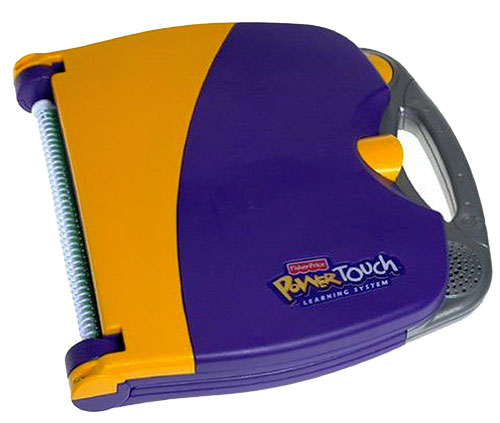
The purple and yellow PowerTouch folds around a printed book, with a gray handle along one side. Opened out, the system gives a player a page to look at and words or pictures to touch with a finger. Its documented modes offer different ways to explore the same scene. A homemade picture can suggest another kind of adventure, with a storyteller providing the sounds at every stop.
Explore the same page in different ways
The parent guide describes seating the book’s binding in the open base and touching words or pictures with one finger. Story mode reads the story aloud; other modes identify words, sound them out or spell them. Separate activities include finding, counting and music.
The base also presents an alphabet when the book is removed. For the guide’s starter set, the two included books use the system’s stored content. Additional titles use a corresponding cartridge; matching the book and cartridge matters.
The guide asks for a flat surface, a securely seated book and hands clear of the touch-sensitive page except for the selecting finger. These small details help explain the intended play arrangement. The linked manuals supply the full owner instructions for a matching unit.
Draw a picture-page sound walk
On one large sheet, draw a door, a tree and a pond, with a path joining them. Add a traveler: perhaps a mouse carrying an empty basket. This drawing stays outside the electronic reader; it is a separate storytelling page.
One player points to a picture and another supplies a sound or a sentence. At the door, a soft “knock, knock” might bring a friendly greeting. The tree could rustle and offer a fallen leaf. At the pond, a frog might ask why the basket is empty.
Let the traveler answer. Perhaps the basket is collecting invitations for a party. Draw a little envelope beside each place that has joined the story, or simply name the invitations aloud.
Take another route through the picture
Begin at the pond this time and visit the tree before the door. Ask what changes when the frog speaks first. It might send the traveler to find a shady meeting place, giving the tree a different part in the adventure.
Add one new detail to the page, such as a bridge or a window. Give it a sound and a reason for being there. A player may point while someone else narrates, and the storyteller role can pass around the group.
At the end, retell the journey in your chosen order. The same three pictures can hold several stories because the players supply their connections.
The historical record
Original Toysit coverage
The complete earlier coverage follows. Its launch-era availability, promotional claims, opinions and broader commentary remain part of the historical record; researched details and qualifications appear in Sources.
Reading and learning activities for children as young as three
In 2003, Fisher-Price energized the learning toy aisle with innovation as retailers reported accelerating sales of the revolutionary new Power Touch Learning System.
In the first month that product was on shelf, Power Touch was already performing very well against competitive product in the highly successful learning category. Many retailers are reporting weekly sales volumes that are double that of last year's #1 new Preschool Learning toy, Kasey the Kinderbot.
"Our mission has been to bring a new level of innovation to the learning category," says Neil Friedman, President of Fisher-Price. "Clearly, we've been able to answer a need among parents and children for the kind of learning products that are most intuitive to the way children really learn."
"The new platforms are proving their appeal with consumers, showing very good velocity right out of the gate. We are excited that Fisher-Price is adding real value to the learning category with both innovative products and strong marketing initiatives," said Wayne Yodzio, Vice President, Divisional Merchandising Manager, Toys 'R Us.
These products represent the next generation of educational toys with the application of electronics to enhance learning in a way that's fun and engaging, according to Jim Silver, publisher of The Toy Book. "The introduction of Power Touch has taken learning toys to a new platform with its hands-on approach and unique auto page detection capabilities, and Learn Through Music breaks new ground all together, with its emphasis on rhythm, repetition and rhyme to help toddlers develop language acquisition," he says.
The Power Touch Learning System uses breakthrough technology to provide the most natural way for children, as young as three years of age, to tap into reading and learning activities. Many teachers encourage early readers to follow along with their finger as they read or hear a story, a method called "finger-point reading." The Power Touch System uses this same approach, using easy finger touch activation to let children learn reading skills by simply touching words and pictures with their fingers. This advanced technology eliminates the need for any tool or stylus to activate the electronics, allowing for an intuitive and seamless interface between the child and the book. The system features more than 60 learning activities in reading, phonics, spelling, music, math and more. Additionally, an interactive alphabet board built into the base of the system further enhances the development of early literacy skills for preschoolers.
The Power Touch Learning System brings additional innovation to this type of book-based learning system with its "auto page detection" feature. An optical reader built into the base automatically recognizes which page the child has turned to, without requiring the child to remember to press a secondary button. This ensures that the child will always receive the appropriate response to the corresponding page they are exploring.
Sources and editorial notes
The complete 2003 parent guide 77989pr-0920 and four-page getting-started guide 77989pr-0921 were visually reviewed. The pictured system belongs to this design; the exact 77989/C2228 retail edition is unresolved. Service records share the guide but differ in their battery fields, so no battery specification is generalized here. The parent guide distinguishes two cartridge-free starter books from additional books with matching cartridges. The preserved September 23, 2003 launch report’s sales, learning benefits and optical-mechanism/perfect-response assertions remain attributed period claims; no new engineering or outcome claim is made. The companion activity is original to Toysit. No physical toy, audio, software or disc playback was tested.
- Fisher-Price: PowerTouch parent’s guide — All eight PDF pages reviewed, including book seating, modes, starter-book distinction, care and troubleshooting.
- Fisher-Price: PowerTouch getting-started guide — All four pages reviewed for additional-book cartridge use and touch-page guidance.
- Fisher-Price: 77989 service record — Identifies the 2003 system and its documentation.
- Fisher-Price: C2228 service record — Comparison record; its differing battery field is not substituted for the matched guide.
- Original Toysit coverage — Complete earlier text, original SSI values and historical image inspected and preserved.
Images and descriptions are retained as historical material. How Toysit covers toys.
Created for Toysit by Tabbloza — the artwork in our header.